

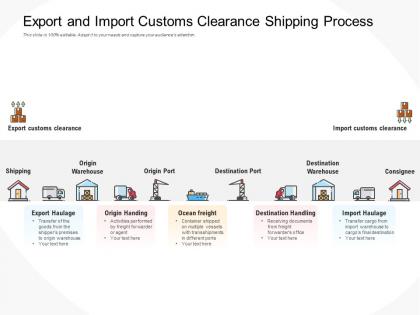
Export and import customs clearance shipping process




Try Before you Buy Download Free Sample Product
 Impress Your
 Audience
 100%
100% Editable
 Save Hours
 of Time


Our Export And Import Customs Clearance Shipping Process enable you to be clear and concise. You will give a crisp account.
People who downloaded this PowerPoint presentation also viewed the following :
Export and import customs clearance shipping process with all 2 slides:
Capture the house with our Export And Import Customs Clearance Shipping Process. Everyone attending will be fully engrossed.
FAQs for Export and import customs
You'll want the commercial invoice, packing list, and bill of lading for sure. The invoice shows what everything's worth and what you're shipping. Packing lists are honestly underrated - I've watched so many shipments get stuck because people skipped them. They show exactly what's in each box. Bill of lading is your proof of shipment. Depending on what you're bringing in, might need certificates of origin or import licenses too. Some products are weird about permits. Oh and definitely check with a customs broker first - every product category has its own random requirements that'll bite you if you don't know about them.
So basically, tariffs are just taxes governments slap on stuff crossing borders. They'll jack up your import costs, which means either your profit margins get squeezed or you pass those costs to customers (fun times). Higher tariffs might make you switch suppliers too - suddenly that vendor in Country X looks way better than the one hit with a 25% tariff. Honestly, the smart move is building these costs into your pricing from day one. Otherwise you're gonna get hit with a customs bill that makes you want to cry. It's one of those things that can totally reshape your whole supply chain strategy.
Honestly, paperwork is everything - get your commercial invoices and packing lists perfect before you ship anything. One tiny mistake cost me days on a shipment once, super frustrating. HS codes matter too, so classify your stuff right. If you're doing this regularly, AEO status is worth looking into. But real talk? Find a solid customs broker. Yeah it costs money, but they know all the random rules and exceptions that'll trip you up. I tried doing it myself at first - big mistake. The good brokers basically pay for themselves by avoiding delays and fees.
So basically these electronic systems handle all the boring paperwork automatically instead of you doing it by hand. You just upload everything digitally and can track your stuff in real-time. Pretty cool honestly - it catches regulation issues before they become actual problems. No more paper forms or waiting forever for some guy to review your documents. Most problems you can fix from your computer instead of driving to the customs office and sitting there all day (been there, not fun). The whole thing just moves way faster since computers don't take coffee breaks.
Honestly, paperwork screwups cause most delays - missing invoices, wrong commodity codes, you know the drill. Customs randomly picks shipments for physical inspections too, which is annoying but whatever. Classification disputes are the worst though - when they argue about how you've categorized stuff. Payment issues with duties and taxes also slow things down, especially if your broker doesn't have pre-clearance. My take? Check your docs twice before shipping and just expect some delays for inspections. Better to plan for it than get caught off guard.
Honestly, just get all your paperwork sorted before anything else - invoices, packing lists, certificates of origin, the whole deal. Inspectors will ask the weirdest questions about your shipments, so keep crazy detailed records. Make sure everything's labeled right with proper tariff codes too. Find yourself a solid customs broker who actually knows what they're doing. Seriously, a good one will save your ass when customs decides to be difficult. Oh, and don't wait until your shipment gets flagged to figure this stuff out - that's when you're already screwed. Being ahead of the game makes everything way smoother.
So a customs broker is basically someone who deals with all the government paperwork when you're shipping stuff internationally. They're like your middleman with customs - super helpful honestly because those regulations are confusing as hell. Your broker will handle import/export forms, figure out what taxes you owe, and make sure you don't accidentally break any trade rules. The tariff codes alone would probably take you weeks to understand. If you're shipping regularly, definitely worth building a relationship with a good one. Saves time and keeps you from screwing up expensive mistakes.
So free trade agreements are actually pretty great for cutting through customs BS. Tariffs get reduced or wiped out completely between member countries, plus the paperwork is way less of a nightmare. You'll see faster processing and lower duty costs when shipping to FTA partners. Just gotta make sure your goods actually qualify for the preferential treatment - the certificates of origin thing can be annoying but it's worth it. Oh, and double-check which FTAs cover your routes first. I learned that the hard way once. Rules of origin requirements matter too, so don't skip that step.
Dude, customs violations will absolutely wreck your business. Fines are brutal, they'll seize your stuff, and angry customers hate delays. Government audits are the worst - trust me on that one. Lose your import privileges in bad cases. Your reputation takes a hit too when people find out. Honestly? Get your team proper training and find a customs broker who isn't completely useless. Way cheaper to do it right the first time than deal with the mess later.
Get your basic docs sorted first - commercial invoices, packing lists, certificates of origin. The paperwork's honestly pretty brutal at first but you'll get the hang of it. I'd definitely use a customs broker for your initial shipments since they actually know what they're doing with tariff codes and all that duty stuff. Also worth checking if you qualify for any trade agreements to cut down costs. Oh, and be crazy accurate with product descriptions and values because customs will call you out on any BS. Maybe start with just a couple test runs? That way you can figure things out before going big.
So HS codes are basically how every country categorizes products for trade - same 6-digit system worldwide, though some places tack on extra digits. They determine your duty rates and taxes, plus whether customs will actually let your stuff through. Get it wrong and you're screwed - delays, penalties, shipments sitting in customs forever. The annoying thing is similar products can have totally different codes depending on what they're made of or how they'll be used. I learned this the hard way once. Always verify with your freight forwarder or customs broker first. Trust me, it's worth the extra step.
Honestly, it's all over the place depending where you're shipping. The US and EU have pretty decent online systems that actually work. But some developing countries? Good luck - you'll be running around to different offices with stacks of paperwork. Processing times are totally random too. Some places are super picky about every little detail on your forms, others don't really care as much. Oh and duty calculations - that's a whole other mess that varies everywhere. I'd definitely hit up the country's customs website first, or maybe find a local broker if it's anything expensive or weird.
Dude, be super specific with your labels - actual product descriptions, where it's from, real values. Customs officers get pissed at vague crap like "parts" or "samples." I've literally watched shipments sit for weeks because someone half-assed the paperwork. Pack stuff secure but remember they might tear it open to look inside. Waterproof labels are clutch, and put your commercial invoices both inside AND outside the box. Oh, and double-check those HS codes - they're pickier about that stuff now. Random tip that saved me once: photograph everything before you seal it up.
Sign up for email alerts from your customs authority's website - they send updates when regulations change. Industry associations are super helpful too since they break down all the complex government stuff into summaries that actually make sense. I follow a bunch of customs brokers on LinkedIn (sounds boring but they're honestly great at explaining what new rules mean in real life). If you're already working with a broker, they should be telling you about changes anyway. Maybe set up quarterly check-ins to go over anything that affects your products specifically.
Dude, don't mess around with customs forms - I learned this the hard way. Wrong info can get you slapped with fines that'll make your head spin. Your packages get stuck in limbo, and customs starts treating all your future shipments like they're smuggling operations or something. Worst case? They just keep your stuff entirely. Legal trouble's possible too if they think you're lying on purpose. Honestly, spending an extra 20 minutes double-checking product codes and values beats dealing with that nightmare. Trust me on this one.
No Reviews