


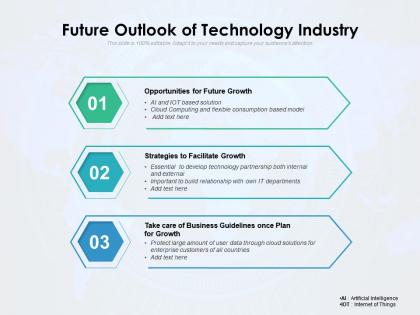
Future outlook of technology industry





Try Before you Buy Download Free Sample Product
 Impress Your
 Audience
 100%
100% Editable
 Save Hours
 of Time


Our Future Outlook Of Technology Industry are topically designed to provide an attractive backdrop to any subject. Use them to look like a presentation pro.
People who downloaded this PowerPoint presentation also viewed the following :
Future outlook of technology industry with all 2 slides:
Use our Future Outlook Of Technology Industry to effectively help you save your valuable time. They are readymade to fit into any presentation structure.
FAQs for Future outlook
Emerging technologies expected to reshape industries include artificial intelligence and machine learning, quantum computing, 5G and edge computing, biotechnology and gene editing, and autonomous systems. These innovations streamline operations by automating complex processes, enhancing data analysis capabilities, and enabling real-time decision-making, with many organizations finding that strategic adoption delivers significant competitive advantages and operational efficiency.
AI and machine learning will reshape the workforce by automating routine tasks, creating new technology-focused roles, and requiring workers to develop advanced digital skills. While some traditional positions may be displaced, these technologies ultimately enable human workers to focus on creative, strategic, and interpersonal responsibilities, with many organizations finding that upskilling programs help employees transition successfully.
Sustainable technology will revolutionize business practices through renewable energy integration, circular economy models, carbon footprint optimization, and resource-efficient operations. These innovations enable organizations to reduce operational costs, enhance brand reputation, and meet regulatory requirements, with manufacturing, retail, and logistics sectors finding that sustainability delivers competitive advantages while attracting environmentally conscious consumers and investors.
Quantum computing will revolutionize complex problem-solving by processing vast datasets simultaneously, optimizing logistics networks, accelerating drug discovery, and enhancing financial modeling through unprecedented computational power. Industries like pharmaceuticals, aerospace, and financial services are increasingly investing in quantum applications, with many organizations finding that quantum algorithms can solve optimization challenges in minutes rather than years, ultimately delivering significant competitive advantages.
Biotechnology advancements are revolutionizing healthcare through personalized medicine, gene therapies, regenerative treatments, and precision diagnostics. These innovations enable targeted cancer treatments, organ regeneration, and predictive health monitoring, with hospitals and pharmaceutical companies increasingly delivering faster diagnoses, reduced treatment costs, and dramatically improved patient outcomes across diverse medical conditions.
5G technology enables smart cities through ultra-low latency, massive device connectivity, enhanced data processing speeds, and real-time analytics capabilities. These advancements streamline traffic management systems, automated emergency responses, and energy grid optimization, while supporting millions of IoT sensors simultaneously, ultimately delivering improved urban efficiency and citizen experiences across transportation, healthcare, and municipal services.
Blockchain technology will redefine transactional security through decentralized verification, immutable ledgers, cryptographic protection, and real-time transparency that eliminates intermediaries. Financial institutions, supply chain companies, and healthcare organizations are leveraging these capabilities to reduce fraud, streamline operations, and enhance customer trust, ultimately delivering faster settlements and competitive advantages in increasingly digital markets.
Virtual and augmented reality in education and training will revolutionize learning through immersive simulations, hands-on practice environments, and personalized instruction delivery systems. These technologies enable medical students to perform virtual surgeries, engineers to explore complex machinery, and corporate teams to practice scenarios safely, ultimately delivering enhanced retention rates, reduced training costs, and accelerated skill development across industries.
Autonomous vehicles will revolutionize urban planning by reducing parking requirements, enabling narrower roads, and supporting mixed-use developments with optimized traffic flow. Cities can repurpose parking structures for housing or commercial spaces, redesign intersections for efficiency, and create pedestrian-friendly zones, with many urban planners finding that smart infrastructure integration ultimately delivers more sustainable, livable communities.
Emerging renewable energy trends include advanced solar panels with perovskite cells, floating offshore wind farms, green hydrogen production, enhanced battery storage systems, and AI-optimized energy grids. These technologies streamline energy transition by reducing costs, increasing efficiency, and enabling seamless integration, with many utilities finding that strategic combinations ultimately deliver competitive advantage in an increasingly sustainability-focused market.
Cybersecurity advancements will revolutionize data protection strategies through AI-powered threat detection, zero-trust architecture implementation, and automated response systems. These technologies enhance organizational security by identifying vulnerabilities faster, streamlining compliance processes, and enabling real-time threat mitigation, with financial institutions and healthcare organizations finding significantly improved data integrity and regulatory adherence.
Expected developments in space technology include reusable rockets, lunar mining operations, Mars colonization missions, satellite internet constellations, and commercial space stations. These advancements streamline costs, enhance global connectivity, and create new revenue streams, with aerospace companies, telecommunications providers, and research institutions finding that space commercialization delivers unprecedented opportunities for innovation and competitive advantage.
Edge computing will revolutionize data processing by enabling real-time analytics closer to data sources, reducing latency, minimizing bandwidth costs, and enhancing security through localized processing. Organizations across manufacturing, healthcare, and retail are leveraging edge analytics for instant decision-making, predictive maintenance, and personalized customer experiences, ultimately delivering faster insights and competitive advantages.
Advanced automation raises ethical considerations including job displacement and workforce transitions, algorithmic bias and fairness, privacy protection in data processing, accountability for automated decisions, and equitable access to technological benefits. While these challenges require careful navigation, organizations increasingly find that proactive ethical frameworks, transparent decision-making processes, and inclusive implementation strategies ultimately deliver sustainable competitive advantage and stakeholder trust.
Technology enables personalized retail experiences through AI-powered recommendation engines, predictive analytics, dynamic pricing algorithms, omnichannel integration platforms, and real-time customer data processing. These solutions streamline shopping journeys by analyzing purchase history, behavioral patterns, and preferences, with many retailers finding that personalized approaches significantly increase conversion rates, customer loyalty, and average order values.
No Reviews