


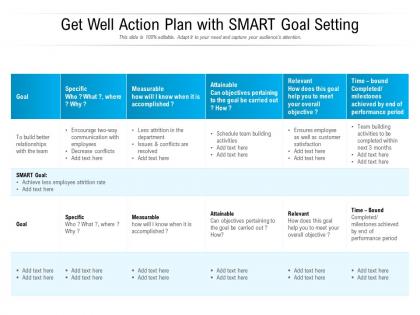
Get well action plan with smart goal setting




Try Before you Buy Download Free Sample Product
 Impress Your
 Audience
 100%
100% Editable
 Save Hours
 of Time


Our Get Well Action Plan With SMART Goal Setting are explicit and effective. They combine clarity and concise expression.
People who downloaded this PowerPoint presentation also viewed the following :
Get well action plan with smart goal setting with all 2 slides:
Give your audience a fulfilling experience. They will find our Get Well Action Plan With SMART Goal Setting elevating.
FAQs for Get well action plan with
SMART goals are basically: Specific, Measurable, Achievable, Relevant, and Time-bound. Like instead of "I wanna get better at presenting," you'd say "I'll do three client presentations without saying 'um' every five seconds by March 15th." You need to know exactly what you're doing (specific), track it somehow (measurable), and not set yourself up to fail - nobody becomes TED Talk material overnight, you know? Plus it should actually matter for your bigger picture. Deadlines create that good pressure too. Honestly, just try rewriting one goal you have right now using this format. Makes everything way clearer.
Honestly, just schedule regular check-ins with yourself - I do mine weekly but monthly works too depending on what you're tracking. Put it in your calendar or you'll definitely forget (learned that the hard way lol). Since SMART goals are supposed to be measurable anyway, you should have actual numbers or milestones to look at. I just use a basic spreadsheet to log stuff consistently. Here's the thing though - if you're behind, tweak your approach instead of giving up completely. Making progress visible is huge because then you can actually celebrate the small wins and fix things before they get worse.
Honestly, just chunk your big goal into weekly bits so you can catch yourself falling behind early. When I set deadlines last year I was way too optimistic - learned that lesson the hard way! You've got to be real about your schedule and what you can actually handle. Always add buffer time because life happens. Something always comes up, trust me. Check in with yourself weekly and don't feel bad about pushing deadlines back if you need to. Each milestone should feel tough but not impossible given whatever chaos you've got going on.
Here's my take: SMART goals actually work because your team stops wandering around confused about priorities. Instead of "let's boost sales" (ugh, hate those vague goals), everyone knows the exact target and deadline. You can track real progress instead of just crossing your fingers and hoping. The realistic part is huge too - prevents people from burning out on impossible stuff. I've seen teams waste so much time second-guessing what they should focus on. Try it on your next project though, seriously. You'll be surprised how quickly everyone gets on the same page about what comes next.
Figure out what your company actually cares about right now - like are they obsessing over customer retention or hitting revenue targets? Once you know that, make your goals tie directly into those priorities. So if retention is the big thing, maybe aim to boost client satisfaction scores by 15% through monthly check-ins or whatever makes sense for your role. Honestly, most people skip this step and wonder why their goals feel pointless. Be super specific about how your work impacts the bigger picture. Oh and definitely run it by your manager first - they love when you think beyond just your immediate tasks.
Ugh, the worst thing you can do is be super vague about what you want. Like don't just say "get better at presentations" - be specific! "I'll do 3 client presentations and get good feedback by Q2." Way better. Also, resist the urge to set like 10 goals at once because you'll just stress yourself out. Pick 2-3 solid ones. Oh and actually check in on your progress monthly or whatever works - otherwise you'll forget about them completely (been there). Trust me, specific goals with regular check-ins actually work.
Dude, specificity is like having GPS instead of just wandering around hoping you'll find the right place. Your brain loves knowing exactly what success looks like - no guesswork or overwhelm. "Increase sales by 15% in Q2" hits different than just "improve sales," right? Way less decision fatigue about what to tackle next. I swear, vague goals are motivation killers. When you're super specific, breaking it into actual steps becomes so much easier. Write your next goal so clearly that some random person could read it and know exactly what you're going for.
Okay so here's what I mean by SMART goals - they need actual numbers and deadlines, not just vague hopes. Sales example: "Increase quarterly revenue by 15% ($50K to $57.5K) by December 31st through 20 additional client calls weekly." For marketing: "Boost email open rates from 22% to 28% within 6 months by A/B testing subject lines and segmenting our subscriber list." HR could do: "Reduce employee turnover by 10% this fiscal year by implementing monthly one-on-ones and exit interview feedback loops." See the difference? Each one's got specific numbers, clear timelines, and concrete actions. That's what separates real goals from just wishful thinking - honestly, most people skip this part and wonder why nothing changes. Pick whatever area you want to work on and try writing one yourself.
Dude, apps like Todoist or Notion are game-changers for tracking SMART goals. Break everything into smaller milestones with actual deadlines. Progress bars are weirdly addictive - I get way too excited watching them fill up lol. Calendar syncing helps with the time stuff, and habit trackers keep you honest about daily actions. Don't overthink the system though. Pick something simple that fits how you already work, not some fancy setup you'll abandon in two weeks. Even a basic spreadsheet works if that's your thing. Start with whatever you're already using.
Honestly, feedback is what makes SMART goals actually work. You can't just set a goal and hope for the best - that's like driving with your eyes closed. I learned this the hard way with my fitness goals last year. Regular check-ins help you see if you're hitting your targets or need to switch things up. The whole "measurable" thing is pointless without feedback data to review. Set up weekly or monthly reviews to see how you're tracking. Sometimes you'll need to adjust your approach, and that's totally normal. Without feedback, you're basically guessing your way to success.
Honestly, just make your creative goals way more flexible than the typical SMART framework. Time ranges work better - like "finish 5-8 portfolio pieces sometime in Q1" instead of some random hard deadline. Focus on stuff you actually control when measuring progress. Hours spent practicing, number of sketches, clients you reached out to. Not vague things like "improve my style" (even though that's obviously what we're all trying to do). Be specific about process: "create 3 logo concepts using new typography methods" is so much better than "get better at design." Weekly mini-sprints help too. The whole point is using structure without killing your creativity.
Honestly, I do monthly check-ins with myself to see if my goals still make sense. Life changes fast, you know? Sometimes what seemed important in January feels totally irrelevant by March. I ask myself stuff like: do these timelines actually work with my current situation? Am I tracking the right metrics, or just the ones I thought I "should" care about? Don't feel bad about scrapping goals that aren't serving you anymore - I've ditched plenty that just weren't realistic. The whole point is figuring out what's actually helping you move forward versus what sounds good on paper.
Yeah so this is actually super tricky stuff. Americans tend to make goals all about crushing personal targets, but in like Japan or Korea? It's way more about what helps the whole team win. Time gets weird too - some cultures treat deadlines as more of a "suggestion" which obviously screws with that whole time-bound thing. Plus in really hierarchical places, people won't just spell out specific goals without their boss weighing in first. Honestly, I'd just build in some wiggle room with timelines and frame goals around what actually matters to each culture instead of forcing everyone into the same box. Way less headache that way.
Honestly, accountability is a game-changer for actually hitting your goals instead of just writing them down and forgetting about them. Nobody wants to tell their buddy they've been binge-watching Netflix instead of working out, right? Your accountability partner keeps those goals stuck in your head because you know they're gonna ask about your progress. Short bursts of external pressure really do work when your own motivation isn't cutting it. Plus they'll totally call BS when you start making weird excuses - which we all do sometimes. Find someone who won't just nod along when you're clearly slacking.
Honestly, just pick one part of your SMART goals and bump it up like 10-20% while leaving everything else the same. Maybe tighter deadlines or higher targets - whatever feels doable but still pushes you. The confidence you get from hitting a few of these is huge, trust me. Keep notes on what actually worked so you're not just winging it next time. I used to go way too hard and just burned myself out. Now I check in every few months to see how I'm doing, then adjust from there. Way better than those crazy dramatic goal changes that never stick anyway.
No Reviews