

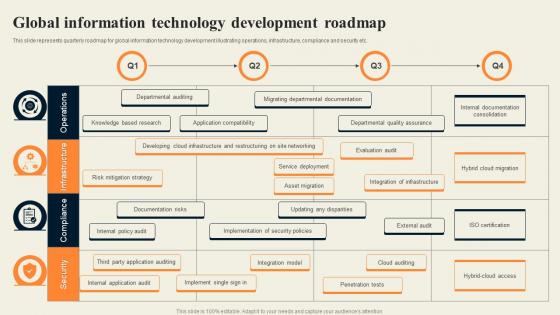
Global Information Technology Development Roadmap




Try Before you Buy Download Free Sample Product
 Impress Your
 Audience
 100%
100% Editable
 Save Hours
 of Time


This slide represents quarterly roadmap for global information technology development illustrating operations, infrastructure, compliance and security etc.
People who downloaded this PowerPoint presentation also viewed the following :
Global Information Technology Development Roadmap with all 6 slides:
Use our Global Information Technology Development Roadmap to effectively help you save your valuable time. They are readymade to fit into any presentation structure.





FAQs for Global Information
Honestly, AI/ML is getting baked into everything now - you can't escape it. Edge computing's also huge since people want stuff processed closer to them instead of some distant server farm. Cloud-native development? That's basically the standard at this point. Quantum computing actually has some real momentum behind it (finally!). Oh, and everyone's obsessing over cybersecurity mesh architectures. Low-code platforms are letting non-developers build actual apps, which is pretty wild. Remote teams aren't going anywhere, so better collaboration tools are a must. Start messing around with AI tools now if you haven't already.
Honestly, cloud computing is perfect for this. You can literally click a button and have servers running in different countries - no huge upfront costs or waiting around. Traffic spikes? It handles them automatically. Your users get faster load times since you're serving them from nearby regions. The pricing model is pretty sweet too - just pay for what you actually use. Works whether you're a tiny startup or some massive company. I'd say start with AWS or Google Cloud and mess around with their auto-scaling stuff first. You'll be surprised how much of a difference it makes.
Dude, AI is seriously changing how dev teams work right now. GitHub Copilot and similar tools are handling all the boring coding stuff automatically. Testing, deployment, debugging - it's all getting way faster. Teams everywhere from Silicon Valley to Bangalore are seeing huge productivity boosts. The language barrier thing is pretty cool too - real-time translation means your remote devs can actually communicate properly now. Honestly wasn't expecting this to happen so quickly, but here we are. You should definitely start playing around with these AI dev tools soon. Trust me on this one.
Oh man, data privacy laws are all over the place depending on where you're launching. GDPR in Europe is super strict about consent stuff. The US is weird - it's mostly state-by-state, like California's CCPA. China's data localization rules are honestly a nightmare and they keep changing them. Brazil, India, Canada all have their own thing going on too. Here's what I'd do: bake privacy protections into your system from the start (way easier than retrofitting later) and definitely get local lawyers involved early. Trust me on that last part - learned it the hard way.
Honestly, remote work changed everything for IT teams. You can hire devs from anywhere now - no more being stuck with whoever's in your city. Time zones actually work in your favor too since someone's always coding while others sleep. The tools finally don't suck anymore. Git, Slack, decent video calls - it all just works now. Yeah, you'll miss those random brainstorming sessions by the coffee machine, but getting access to way better talent makes up for it. Just nail down your communication stuff upfront and figure out when everyone can actually be online together. Game changer.
Yeah totally! IT can be huge for emerging markets. You'll want to pump money into digital infrastructure first - gotta have the foundation, right? Then focus on education to actually train people in tech skills. Policy stuff matters too - make it easy for startups and foreign companies to set up shop. India's crazy successful at this, went from nothing to tech giant in maybe 20 years. Oh and don't forget traditional industries. Agriculture, manufacturing, finance - they all need digital upgrades. Honestly I'd just pick whatever sector looks most ready for change and start there.
Honestly, it comes down to nailing communication and being culturally aware. Document everything clearly so stuff doesn't get lost between time zones. Learn your teammates' holidays - trust me, scheduling meetings during Ramadan or Chinese New Year makes you look clueless. Async tools are your lifesaver when real-time chats aren't possible. The psychological safety thing is huge too. People need to feel okay asking "wait, what?" without judgment. Oh, and start projects with a team charter covering everyone's communication styles and cultural stuff. Flexible scheduling is non-negotiable unless you enjoy 3am calls forever.
Honestly, tech is perfect for tackling the UN's 17 sustainability goals. Pick one that clicks with you first - maybe education apps or water monitoring systems with IoT sensors. Healthcare AI is huge right now too. The amazing thing about code? It scales like crazy. Build something once, help millions of people. I've seen fintech apps lift people out of poverty and smart energy systems actually fighting climate change. Don't overthink it though - just start small with a prototype. Your coding skills can literally become a multiplier for fixing real problems. Pretty wild when you think about it.
Oh man, compatibility issues will drive you crazy. Legacy systems love their ancient protocols that hate talking to modern APIs. Plus there's always some mission-critical thing from like 2003 that everyone's scared to mess with - you know the type. Security gaps pop up everywhere between old and new tech. Performance gets wonky too. Training people across different time zones on these mixed workflows? Good luck with that. Documentation's usually garbage, obviously. Map out your integrations early and pad your timeline big time. These things never finish when you think they will.
Localization is a total game-changer for user experience. People just feel way more comfortable when they can use software in their own language - dates, currencies, all that stuff formatted how they expect. It's like the difference between stumbling around somewhere foreign vs being in your hometown, you know? Beyond just translating text though, you really want to think about how people in that culture actually behave online. I've seen apps get way better engagement and fewer confused users reaching out to support once they nail this. Short sentences work. But honestly, the retention boost alone makes it worth the effort.
Honestly, it's mostly about digital transformation stuff - everyone's scrambling to modernize after COVID hit. Cloud services, AI automation, that whole thing. Remote work basically broke how companies used to operate, so now there's tons of gaps for startups to jump into way faster than the big players can. Money was super cheap for a while too (less so now but whatever). Thing is, investors aren't throwing cash at every shiny demo anymore. They actually want to see revenue numbers and how you'll make real money. Can't just pitch the cool factor and expect checks to roll in like 2021.
Honestly, mobile-first is everything here - people's phones are basically their only way online. Work with local community groups though, they'll tell you what actually matters vs what you think matters. Build stuff that works on crappy internet connections too. Oh and translate everything into local languages, not just Google Translate garbage but real localization. Pick one problem to solve first instead of trying to fix everything. The cost barrier is usually way bigger than the tech barrier, so partner with orgs who get that reality.
Dude, multinational corps get hit with insane cybersecurity headaches. Different countries have totally different data laws - GDPR in Europe vs whatever Asia's doing. Compliance becomes this massive mess. Your teams are spread everywhere, which just gives hackers more ways in. Coordinating security across time zones? Already brutal without the constant threat of breaches. Local vendors might not even meet your home country's standards, so maintaining consistency gets weird. Oh, and distributed teams create way more attack surfaces than you'd think. Build a unified security framework from day one and actually train your local teams properly - don't just send them a PDF and call it good.
Honestly, open-source is a game changer for working with international teams. No expensive licenses to worry about. Developers in SF can collaborate with people in Mumbai and Berlin on the same codebase without all the usual corporate BS getting in the way. GitHub made this so much smoother - though I still can't believe how well async work across time zones actually functions now. The standardized tools and transparent processes mean you can tap into talent everywhere. If you're doing anything international dev-wise, I'd start with open-source frameworks. Way less headache.
Honestly, start with mapping out dependencies and compliance stuff first - data privacy laws are completely different everywhere and will screw you over. Get local IT partners who actually know the regulatory mess in each country. Don't try launching everywhere at once though, that's asking for trouble. Phase it out so you can fix problems as they pop up. Buffer time is crucial too because these things always drag on longer than you think. Oh and test everything twice before you flip the switch - learned that one the hard way.
-
My search for complete decks ended with SlideTeam. Such a surplus collection of HD PowerPoints. Moreover, their standard and widescreen formats have helped me in delivering bullseye presentations.
-
Informative and engaging! I really like the design and quality of the slides.