

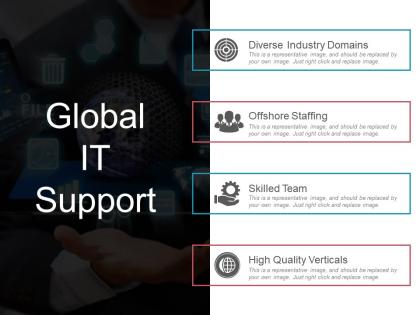
Global it support ppt examples




Try Before you Buy Download Free Sample Product
 Impress Your
 Audience
 100%
100% Editable
 Save Hours
 of Time


In the era of technology, every business or industry relies on IT services partially or even completely. The global business service PowerPoint template is suitable for thousands of organizations worldwide that facilitating other organizations through their IT solutions. A user can explain how it enables other organizations to use IT infrastructure in business change, transformation as well as growth of strategic assets by using the global business service solutions presentation slide. A presenter can use the global business service solutions PPT template to demonstrate capabilities, processes, technologies that play a vital role in achieving an organization’s objectives. Likewise, the global IT support slide for PowerPoint is perfect to facilitate businesses by delivering value IT support. The IT service management template is useful to describe the technology process management framework which efficiently focuses yet an effective improvement and upgrades. The information technology infrastructure PowerPoint slide is an impressive presentation tool for all large as well as small size global organizations. It helps them to present value of business improvement through IT capabilities. Display fairness for all with our Global It Support Ppt Examples. Don't allow any differentiation to emerge.
People who downloaded this PowerPoint presentation also viewed the following :
Global it support ppt examples with all 5 slides:
Equip them to act freely with our Global It Support Ppt Examples. Guide folks on how to exercise discretion.



FAQs for Global it
Honestly, time zones are gonna be your worst enemy. Language barriers make everything take twice as long, and don't get me started on how spotty internet can be in some regions. Different cultures report problems totally differently too - some people are super blunt, others beat around the bush forever. Plus you've got all these data privacy laws to juggle. Oh, and tech standards? Complete mess depending where you are. I'd probably start with just a couple regions first, get that running smooth, then add more. Going global right away sounds like a recipe for burning out your whole team.
Honestly, start with overlapping shifts - you want like 2-3 hours where your teams can actually talk to each other. Map out where you're dropping the ball coverage-wise first, then work backwards. Documentation is huge (way bigger than most people realize) and you'll need solid handoff processes so tickets don't just disappear into the void. Real-time dashboards help too since everyone needs to see what's happening regardless of timezone. Oh, and set up clear escalation paths - nothing worse than urgent stuff sitting around because nobody knows who to wake up at 3am. The handoff protocols are really what make or break this whole thing.
Dude, automation is what keeps global IT teams sane. Your chatbots handle password resets and basic stuff while people tackle real problems. Set up ticket routing that works across time zones - honestly, users in Japan shouldn't wait for someone in New York to wake up. Self-service portals are clutch too. Real-time monitoring catches issues before angry emails start flooding in (trust me on this one). Start simple with ticket sorting, then build up to fancier workflows. Without it you'll be buried in repetitive requests that could've been solved automatically. It's night and day difference for consistency.
Oh man, cultural stuff can really mess with IT support calls. Some cultures are crazy direct, others beat around the bush forever - makes it hard to figure out if something's actually urgent. Time zones are weird too since what feels like an emergency to you might not hit the same way elsewhere. Language barriers are obvious, but honestly? The whole hierarchy thing trips people up more than you'd think. Like some places are super formal with their tech support. My advice - just ask a bunch of clarifying questions right away and match their communication vibe based on where they're from.
Honestly, start with First-Call Resolution Rate - aim for 70% or higher. Mean Time to Resolution is huge too, especially when you're dealing with different time zones. Customer satisfaction scores by region will tell you a lot, and don't sleep on SLA compliance rates. Ticket volume spikes are actually pretty revealing - they usually mean there's a training gap somewhere or you missed a system issue. The annoying thing about global support is making sure you can actually compare data across regions since cultures handle feedback so differently. Track escalation rates too, and see which issues keep getting passed around between teams. Pick like 2-3 metrics first though - don't overwhelm yourself trying to measure everything at once.
So you'll want consistent security policies everywhere but adapt them for local stuff like GDPR. Build a central framework first, then let regional teams tweak it for their laws. Zero-trust is your friend here - encrypt literally everything and get identity management that spans time zones. Audits are annoying but they catch problems before they explode. Also set up incident response that handles different countries' legal requirements. Oh and honestly? The whole "standardize core practices but stay flexible" thing sounds boring but it actually works really well in practice.
Honestly, start with TeamViewer or LogMeIn for remote access - that's your bread and butter right there. Get a cloud ticketing system running too since you'll be juggling different time zones constantly. Slack or Teams will save your sanity when you're trying to figure out weird issues with coworkers in other countries. VPN setup is pretty much mandatory for security stuff. Mobile device management tools are clutch now that everyone's working from random coffee shops. Monitoring software catches problems before users start complaining, which is nice. Focus on remote access and ticketing first though - seriously, those two cover most of what you'll deal with daily.
Keep the really important stuff and anything security-related in-house. But honestly, global teams are perfect for help desk work, monitoring, and those routine tasks that don't need your A-team. Your internal people should focus on strategy and vendor relationships - the big picture stuff. Time zones actually work in your favor here since someone's always online when everything crashes at 2am (and it will). I'd start small though. Figure out what absolutely has to stay internal, then test the waters with low-risk operations first. Don't go all-in right away.
Communication skills are absolutely critical - you've gotta explain tech stuff to people across different cultures and time zones. Patience is probably even more important though, especially when you're troubleshooting at 3am with someone who speaks broken English. Learn the cultural differences because what makes sense here might be totally wrong elsewhere. Your technical skills need to be rock solid, obviously. Get really good with remote tools since you can't always chat in real-time. Oh, and definitely make friends with local IT people in each region - seriously, they'll be lifesavers when things go sideways.
Set up feedback loops that actually lead to changes, not just data collecting. Regular post-ticket surveys work, plus quarterly check-ins with key people across regions. Here's the thing though - don't just listen to whoever complains loudest. Sometimes your quietest users spot the biggest problems. Use what you learn to tweak escalation rules and training focus. Maybe adjust staffing for time zones too. Oh, and this part's huge - always circle back to tell people what you fixed based on their input. People stop giving feedback when they think it disappears into a void.
Start by figuring out what training gaps you actually have right now - that'll save you time later. Three big things to focus on: get everyone using the same technical processes (super important for troubleshooting), cultural awareness training, and language support for technical terms. The cultural stuff is honestly where most companies mess up - people communicate so differently across regions. Oh, and set up regular sessions where your different teams can chat about what's working and what isn't. Language barriers with technical jargon will kill productivity if you're not careful about it.
Honestly, start with something simple like password resets or basic software problems - you'll be shocked how much time it saves. Chatbots can handle the easy stuff while ML does the smart routing so tickets actually go to people who know what they're doing. The predictive analytics thing is wild too, catches problems before everything goes sideways. I'd probably avoid trying to boil the ocean though. Pick one workflow, see how it goes, then add more. Oh and the pattern recognition across different time zones? Super helpful for figuring out when you actually need people working.
Dude, globalization is making IT support way more uniform everywhere. Companies can't have Tokyo running totally different help desk software than London anymore - I've watched that trainwreck happen. More ITIL frameworks and standardized ticketing systems are popping up globally now. Cross-border teamwork gets easier, and users get consistent experiences regardless of location. Honestly, the SLA standardization alone saves so much headache. Short sentences here. Document your current processes ASAP though - this standardization wave hits everyone eventually.
Honestly, it's a game changer for response times. Your people can get help right away instead of waiting for the local IT guy to show up Monday morning. 24/7 coverage across time zones makes a huge difference - no more "sorry, try again tomorrow" nonsense. You'll also get way more consistent service since everyone follows the same processes and shares knowledge. No more of that "oh great, the one person who knows our system is out sick" drama. Just make sure they actually get your business, not just the basic tech stuff. Train them on how you actually work, what matters to your team. Otherwise you're just outsourcing headaches.
So first thing - map out where you are and what time zones you're dealing with to spot the gaps. Most companies way overthink the centralized vs regional thing, but just pick what makes sense for your team size. Get everyone on the same tools and processes or you'll hate your life later. Language support is huge if you're going international, plus you've got to deal with local compliance stuff (ugh). Set up clear escalation paths between regions so people know who to bug when things go sideways. Honestly though? Start with just one or two regions first. Going full global right away is a recipe for chaos.
-
Great product with highly impressive and engaging designs.
-
Best way of representation of the topic.