


Google Company Profile Organisation Chart CP SS




Try Before you Buy Download Free Sample Product
 Impress Your
 Audience
 100%
100% Editable
 Save Hours
 of Time


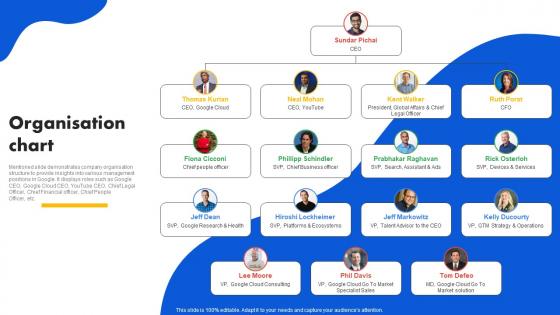
Mentioned slide demonstrates company organisation structure to provide insights into various management positions in Google. It displays roles such as Google CEO, Google Cloud CEO, YouTube CEO, Chief Legal Officer, Chief Financial officer, Chief People Officer, etc.
People who downloaded this PowerPoint presentation also viewed the following :
Google Company Profile Organisation Chart CP SS with all 9 slides:
Use our Google Company Profile Organisation Chart CP SS to effectively help you save your valuable time. They are readymade to fit into any presentation structure.








FAQs for Google Company Profile Organisation
Okay so first nail down the basics - business name, category, address, phone, website, hours. That stuff's non-negotiable. Good photos are honestly game-changers, way more than people think. Then add your description and try to get some reviews rolling. Oh, and if you qualify for those attribute tags like "women-owned" definitely use them. The messaging thing is super handy for direct contact. Posts and Q&As help too but don't stress about those right away. Get the foundation solid first, then you can mess around with the other features.
So basically Google's whole "organize the world's information" thing isn't just corporate fluff - it actually explains everything they do. Search, Maps, YouTube, Android... they're all just different ways to collect and serve up info to billions of people. The clever part? They give it away "free" but make bank on ads. Think about it - every Google product you use is fundamentally about getting you information faster. It's honestly pretty smart how they've become the middleman for basically all human knowledge. Creates this massive data advantage too.
You know how Google stays so innovative? Their flat structure is huge for that. Ideas don't get buried under like 5 layers of managers - people can just collaborate across teams without waiting for approval after approval. That whole "20% time" thing only works because of this setup, honestly. Plus product teams talk directly to leadership, so when something isn't working they can change direction fast. If you're looking at your own company, just count how many people an idea has to go through before anything happens. That bottleneck kills most good ideas before they even get started.
Yeah Google's culture is actually pretty brilliant for retention. Sure, everyone talks about the free food and 20% project time - and honestly, those perks don't hurt. But the real magic is how they've built psychological safety into everything. People can take risks without getting thrown under the bus. They're obsessed with data-driven decisions too, which I guess makes sense for a tech company. The autonomy thing is huge though - employees get to actually innovate instead of just following orders. Their retention rates blow most tech companies out of the water. My advice? Don't just copy their ping pong tables. Focus on trust and giving people work that actually matters.
So Google makes most of their cash from ads - we're talking like 80% of everything. You know those sponsored links when you search? Plus all the YouTube ads that annoy us? That's their goldmine. Cloud services are growing super fast too, which makes sense since everyone's going digital. Then there's this "Other Bets" thing with self-driving cars and random experimental stuff. Honestly, that division bleeds money right now but could pay off big eventually. Bottom line - ads still run the show there, so that's what they really care about.
Google's been carbon neutral since 2007, which is wild when you think about it. They're shooting for 100% renewable energy 24/7 by 2030 - honestly pretty crazy ambitious. Their data centers are getting more efficient, and they're pouring money into renewable projects. Even Google Maps shows eco-friendly routes now, which I actually use sometimes. They've got tools on Google Cloud that help other companies track emissions too. You should check out their annual sustainability reports if you're curious - they're weirdly honest about what's working and what isn't.
Dude, Google's dealing with some serious stuff right now. The DOJ is all over them for antitrust violations, and Europe won't stop hitting them with fines. Competition's brutal too - TikTok's stealing YouTube's thunder, and ChatGPT has everyone wondering if we'll even need Google search anymore. Don't get me started on Apple making their ads less effective with all those privacy updates. Tech moves so fast it's honestly insane. They really need to figure out revenue streams beyond search ads or they're gonna be in trouble.
Google's basically buying their future, honestly. YouTube, Android, self-driving cars - each acquisition completely flipped how we see them beyond just search. They're scary good at spotting trends before anyone else catches on. These deals totally reshape where they put their money and focus internally. Pro tip: track their buying patterns if you want to predict their next moves. They're usually 2-3 years ahead of pivoting strategies. Don't just watch the billion-dollar headlines either - sometimes the smaller acquisitions tell you more about where they're headed.
So Google tracks pretty much everything - your searches, where you go, what you click on. They use all that to personalize your stuff. Like your search results get tailored to you, and the ads actually become relevant instead of random garbage. Gmail gets better at catching spam, Maps knows which routes you drive. YouTube figures out what videos you'll binge. It's kinda creepy when you think about it, but honestly makes everything work smoother. You can turn off most of the tracking in privacy settings though if it bugs you.
Honestly, Google's privacy stuff is pretty sketchy when you think about it. They collect insane amounts of data, and most people don't really get what they're signing up for. The consent forms are basically novels nobody reads. Then there's all the ad targeting - they know way too much about us. Government access is another can of worms entirely. Sure, they've added better privacy controls lately, but it feels like damage control more than anything. The power imbalance is wild too. Go check your Google account settings sometime - you'll probably be shocked at what they've got on you. I was when I first looked.
Honestly, Google nailed it by keeping things stupid simple - just look at their homepage compared to everyone else's cluttered mess. While Microsoft and Apple try to look all sleek and corporate, Google's like that friend who just gets stuff done without making a big deal about it. The primary colors, clean design, basic language - it all screams "we're here to help, not sell you crap." They basically turned themselves into a utility instead of feeling like a tech giant. Pretty genius actually. If you're building something digital, copy that approach. Let the product speak for itself instead of drowning users in flashy nonsense.
So Google does a bunch of stuff to adapt globally. Search results change by region, YouTube Go exists for slower internet areas (which honestly makes total sense). Maps features aren't the same everywhere either. Google Pay works differently depending on your country too. They partner with local governments to deal with regulations and whatnot. The cool part is they don't just translate things - they actually redesign based on how people use tech in different places. You should probably look into what specific adaptations they've made in whatever markets you're targeting.
Dude, Google literally runs the show in tech. Their search decides what info billions of people see daily. Most phones run Android, which is theirs. AWS vs Google Cloud is this huge enterprise battle right now. Their AI stuff (remember AlphaGo?) usually predicts where everyone else heads next. It's honestly crazy - their open-source projects, who they acquire, even who they hire creates these massive ripple effects. Startups copy their moves constantly. If you're working in tech, you gotta watch what they're doing. Whatever Google ships today will probably hit your industry in like a year or so.
Google's got the usual stuff - employee resource groups, bias training, hiring initiatives for underrepresented folks. Their annual diversity reports show the numbers, but tbh they're still pretty behind like most tech companies. They do inclusive leadership training and have whole teams working on fair recruiting and promotions. Plus they partner with HBCUs and coding bootcamps, which is cool. The pay equity stuff too. If you want specifics, their careers site has the latest report - though I'm blanking on what year they're up to now. Worth checking out if you're curious about the actual demographics.
Google's betting big on AI and machine learning - it's everywhere in their products now. Healthcare tech and self-driving cars are huge focuses too. Quantum computing's another area they're throwing money at. Their moonshot stuff seems all over the place sometimes, but I guess that's how you stumble onto the next big thing. Regulation could really mess with their business model though - privacy laws and antitrust stuff. Oh, and they're going hard on carbon neutrality which is totally reshaping their data centers. Check their earnings calls if you want to see where the real money's flowing.
-
It's always a delight to see new templates from you! I am extremely pleased with the fact that they are easy to modify and fit any presentation layout in seconds!
-
My presentations were a bit amateur before I found SlideTeam’s designs. I’ve been able to find slides for nearly every topic I’ve had to present. Thanks, Slideteam!