


Organizational Structure Goldman Sach Company Profile CP SS




Try Before you Buy Download Free Sample Product
 Impress Your
 Audience
 100%
100% Editable
 Save Hours
 of Time


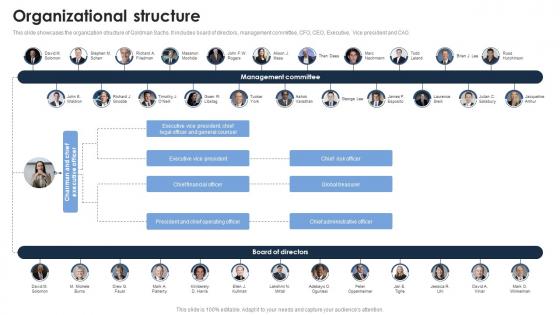
This slide showcases the organization structure of Goldman Sachs. It includes board of directors, management committee, CFO, CEO, Executive, Vice president and CAO.
People who downloaded this PowerPoint presentation also viewed the following :
Organizational Structure Goldman Sach Company Profile CP SS with all 9 slides:
Use our Organizational Structure Goldman Sach Company Profile CP SS to effectively help you save your valuable time. They are readymade to fit into any presentation structure.








FAQs for Organizational Structure Goldman Sach Company
Look, flat structures basically cut out the middle management bloat. Fewer layers means your manager might oversee way more people, but decisions happen faster since there's less bureaucratic BS to navigate. Communication flows more directly too - you're not playing telephone through five different levels. Downside? Career advancement gets trickier when there aren't as many rungs on the ladder. Plus your boss is probably juggling like 15 direct reports instead of 5. It really comes down to what you value more - being able to move fast and have actual input on decisions, or having a clearer path upward. Most people I know prefer the autonomy honestly.
Look, your org chart isn't just some HR exercise - it literally controls whether people show up motivated or just counting down to 5pm. Clear reporting lines? People actually know what they're doing and who to ask when stuff goes sideways. But if you've got like eight layers of management and nobody knows who calls the shots, forget it. Communication turns into a nightmare game of telephone, and your best people will bail for companies that have their act together. I've seen it happen so many times. You need enough structure so people aren't confused, but not so much red tape that getting anything approved takes three weeks. Seriously, look at your current setup - does it actually help or just create more meetings?
So tech is totally flattening out those old-school hierarchies we're used to. Remote teams can work together pretty smoothly now across different time zones, which honestly cuts down on needing so many middle managers. When everyone's got instant access to the same info and can chat in real-time, why do you need all those extra layers? AI's taking over the boring stuff too, so companies can focus their people on the creative and strategic work instead. The trick is - and this is where a lot of places mess up - your structure has to actually work WITH how the technology flows, not against it.
Honestly, map out what you're doing now first - the bottlenecks will shock you. Break down those silos by putting different departments on the same teams, but give them actual power to make decisions (not just meetings where nothing happens). Switch from yearly planning to quarterly sprints. Your managers are gonna struggle with this the most since they'll need to stop micromanaging and actually coach people instead. Get some decent collaboration tools so teams can work together without email chains from hell. Oh, and definitely pilot this with one or two teams before you mess with the whole company.
So with matrix structures, you're basically stuck reporting to two people - a functional manager AND a project manager. Pretty messy if you ask me. The upside? You get way more flexibility, better resource sharing between projects, and honestly great exposure to different parts of the company for your career growth. Downside is it's often a total headache. Your two bosses will want completely different things from you, creating this weird accountability mess where nobody's really sure who's in charge. If they're thinking about doing this at your place, they better nail down the role definitions first and have solid communication figured out.
Your org structure totally controls how info flows around the office. Traditional hierarchies? Everything goes up and down through management layers - super slow but keeps things controlled. Flat structures are way better for speed since you can just message people directly instead of playing telephone through managers. Matrix setups get messy though - multiple bosses means mixed signals sometimes. My old job had this issue where nobody knew who to actually listen to. Check your org chart for bottlenecks and create some informal communication shortcuts where you can.
So basically, flat orgs make decisions way faster since there aren't a million approval layers. But sometimes nobody knows who's actually supposed to decide stuff, which is awkward. Hierarchical setups give you clear bosses - everyone knows the chain of command - though decisions can take forever bouncing up and down levels. Matrix structures are honestly kind of a nightmare to navigate, but they're solid when you need input from different departments. I've seen companies fight their own structure instead of working with it, which never ends well. Match your decision process to whatever setup you've got.
Honestly, staying flexible is huge for startups. Market stuff changes constantly, so you'll want to move people around without waiting for approvals from like five different managers. Your team gets to try different things too, which keeps everyone from getting bored (way better than doing the same task forever). Quick scaling matters most though - sometimes you need to shrink fast, other times you're hiring like crazy based on funding rounds. Oh and don't stress about perfect org charts from day one. Start with clear roles but expect to shuffle things every few months as you figure out what actually works.
Honestly, start with who reports to whom - that's where remote teams usually crash and burn. Your hierarchy needs to be flatter since people can't just bump into each other by the coffee machine anymore. Be super explicit about everyone's role because you can't walk over and ask "wait, whose job is this again?" I'd map out how decisions currently get made and spot where remote work makes things messy. Build in more check-ins too - one-on-ones, team stuff, the whole deal. Sounds like a lot but trust me, it's way better than everyone constantly going "um, who handles this?"
Dude, you can't just slap the same org structure everywhere - cultural stuff matters way more than people think. Asian countries with high power distance? They want clear hierarchies and chains of command. But egalitarian places hate that - they're all about flat organizations. Direct communicators can handle decentralized decisions no problem. Indirect cultures need more centralized coordination or things get messy fast. Oh, and relationship-heavy cultures absolutely need structures that let people actually connect face-to-face. Honestly, just do your homework on the culture before you design anything. Trust me on this one.
Honestly, I'd start with a team survey about role clarity and bottlenecks - that's your goldmine right there. Track three things: how fast decisions actually move through your org chart, whether people feel good about their roles, and if you're hitting business goals. The span of control thing is huge too (totally overlooked by most companies). Are your managers drowning or can they actually help their teams? Quick decisions, clear communication, happy employees - those should all connect to better performance. If your structure makes work harder instead of easier, you've got your answer. Short sentences mixed with longer ones help you see patterns when you compare the survey stuff to your metrics.
Honestly, you've gotta flatten out all those approval layers - they're just killing good ideas before they even get started. Mix up your teams so different departments work together, and let people actually try stuff without asking permission for every little thing. Give them dedicated time to mess around with new concepts (Google does that 20% thing for a reason). Make sure your team feels safe throwing out crazy ideas without getting shot down immediately. Oh, and definitely put people with different skills together - they'll push each other in ways you wouldn't expect. Start small though - just pick one approval step that's slowing everything down and axe it this week.
Honestly, your org structure can make or break your strategic plans. I've seen companies try to be super agile while having like 15 approval layers - total nightmare. You need the structure to actually match what you're going for. Flat setups are amazing for moving fast and innovating. Hierarchical ones? Better when you need tight control and consistency. Here's what I always tell people during planning: take a hard look at whether your current setup will help you hit those goals or just create a bunch of headaches. Most of the time, that mismatch is where things fall apart.
Tech companies go super flat because they need to move fast and innovate. Manufacturing? Total opposite - they stick with traditional top-down stuff for safety reasons. Healthcare's weird though, they mix both approaches with medical hierarchies but also team-based care. Here's what's interesting - everyone's stealing from each other now. Tech bros are suddenly obsessed with manufacturing processes, while old-school industries are flattening out to compete. My advice? Figure out why your industry works the way it does, then cherry-pick what actually makes sense from other sectors. Don't just copy everything blindly.
Honestly, your leadership style and org structure have to work together or everything gets messy fast. Like, if you're naturally more collaborative but trying to run a strict hierarchy, people get confused about who's making decisions. I learned this the hard way at my last job - total disaster. Flat structures work great with democratic leaders who actually listen to their teams. But if you're more of a "here's what we're doing" type, you need clear reporting lines or nobody knows what's happening. Just figure out how you naturally lead first, then see if your current setup actually makes sense for that.
-
I discovered this website through a google search, the services matched my needs perfectly and the pricing was very reasonable. I was thrilled with the product and the customer service. I will definitely use their slides again for my presentations and recommend them to other colleagues.
-
One word for SlideTeam–Versatile!