


Organizational Structure ABB Company Profile CP SS




Try Before you Buy Download Free Sample Product
 Impress Your
 Audience
 100%
100% Editable
 Save Hours
 of Time


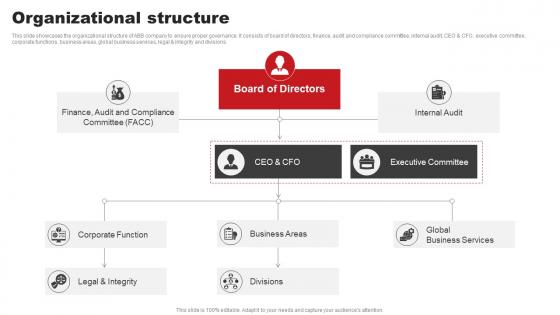
This slide showcases the organizational structure of ABB company to ensure proper governance. It consists of board of directors, finance, audit and compliance committee, internal audit, CEO and CFO, executive committee, corporate functions, business areas, global business services, legal and integrity and divisions.
People who downloaded this PowerPoint presentation also viewed the following :
Organizational Structure ABB Company Profile CP SS with all 9 slides:
Use our Organizational Structure ABB Company Profile CP SS to effectively help you save your valuable time. They are readymade to fit into any presentation structure.








FAQs for Organizational Structure ABB Company
You need clear hierarchy and defined roles first - that's non-negotiable. Make sure spans of control actually make sense too. I've watched companies crash because managers had like 15 direct reports (chaos) or the flip side where everyone's breathing down someone's neck. Crystal clear reporting lines are huge. People should know exactly who they answer to. Build both formal and informal ways for info to flow between departments. Oh, and start by mapping what you have now - you'll probably find weird gaps where nobody knows who makes certain decisions.
So company size totally changes how you need to set things up. When you're small, everyone can just do whatever needs doing - flat structure works great. Once you hit maybe 50-100 people though? That's when things get messy and you need actual departments and managers. Bigger companies end up with all these layers and formal processes because honestly, there's no other way to manage hundreds of people. The trick is adding just enough structure so stuff actually gets done, but not so much that people spend half their day filling out forms. It's a balancing act for sure.
Honestly, communication is like your company's bloodstream. Bad communication between departments? You'll end up with rigid hierarchies just to push info around. But open channels mean flatter structures work because people don't need to constantly go up the ladder and back down. I've watched this happen at three places now - it's wild how predictable it is. Here's the thing though: set up your communication systems FIRST, then reorganize. Don't do it backwards or you're basically just moving furniture around while the house is on fire.
Honestly, your org structure makes a huge difference in how motivated people feel. Flat structures work great - people get more autonomy and decisions happen faster. But if you've got too many layers? Everything slows down and your team feels cut off from leadership. I mean, I've watched this tank morale so many times it's not even funny. You need clear reporting lines, sure. Just don't go overboard with hierarchy or you'll create bottlenecks everywhere. If motivation's tanking, check whether your structure actually empowers people or just gets in their way.
Look, flat structures are amazing for speed - no endless approval chains slowing everything down. Communication flows way better too. Your people get real ownership, which honestly makes everyone happier at work. But here's the thing: it gets messy fast. When something breaks, good luck figuring out who's supposed to fix it. I've seen teams just... paralyzed because nobody knew whose call it was. Growing becomes this coordination headache without clear chains of command. Oh, and career paths? Pretty much nonexistent since there's nowhere to climb. If you're thinking about it, definitely test it out small first. Just make sure your communication game is rock solid before diving in.
Dude, culture totally shapes how you should structure your company overseas. Asian markets? You'll probably need more layers and clear boss-employee chains since they expect that hierarchy. Scandinavia's the opposite - try being all rigid there and people will hate it. Flatter works way better. Oh, and communication styles are key too. Some cultures are all about relationships first, so your structure needs to reflect that. Others just want clear processes. My advice? Do your homework on each market's norms before you draw up any org charts, or you'll be fixing headaches for months.
Dude, remote work is basically flipping everything upside down. Companies are ditching those old pyramid structures for these flat, cross-functional teams. Middle management? Getting axed left and right thanks to AI doing their jobs better. It's honestly pretty brutal to watch unfold. Workers have way more autonomy now, and decisions happen lightning fast instead of going through five approval layers. My take? Figure out who in your company actually creates value vs who just shuffles emails around. Those email shufflers are gonna be the first ones out the door when budget cuts hit.
Honestly? Look at how fast decisions get made - if everything's stuck waiting for approvals, that's your first red flag. Check if teams actually know who handles what, because confusion there kills productivity fast. I always tell people to just ask employees directly where they feel blocked. Those conversations reveal way more than any formal assessment (and they're free). Track your usual business stuff too - customer satisfaction, how quickly you ship things. Oh, and do this check maybe every few months? Problems compound quickly when structure's broken. If people seem frustrated or innovation's stalling, structure issues are usually lurking underneath.
So here's what I've learned the hard way - your company structure has to actually match what you're trying to achieve. Want to innovate fast? Flatten those hierarchies and get people from different departments working together. Expanding globally? Give your regional teams real power to make decisions locally. Most companies do this completely backwards though. They stick with whatever org chart they've always had and wonder why nothing works. Bad move. The way you set up reporting lines and teams will either turbo-charge your goals or kill them entirely. Honestly, just map out what you have now versus where you want to go. The gaps will be pretty obvious.
Dude, having clear org structure is a game changer for decision speed. No more of those painful email threads where everyone's like "wait, who actually decides this?" When people know their lanes, they stop second-guessing everything. Your team moves faster because they're not constantly waiting around for someone to tell them what they can or can't do. Honestly, the accountability piece is huge too - when stuff goes wrong (and it will), you know exactly who owns what. I'd start simple, maybe just map out who calls the shots on different types of decisions in your area. Even a basic chart works.
So remote work totally changes how companies are structured. Middle management starts disappearing because people can just talk directly to each other. Teams have to become way more independent - I mean, you literally can't hover over someone's desk when they're in another state, right? Instead of caring about who's in the office longest, managers actually focus on whether stuff gets done. The org chart might look the same, but people end up working across departments more. Companies that figure this out early start organizing around projects instead of traditional hierarchies.
Honestly, hierarchical is way better for day-to-day stuff - clear bosses, faster decisions. But when things change? Total nightmare. Matrix is the opposite though. Super flexible since teams can work across departments, but oh my god the meetings. Everyone reports to like three different people so nothing gets done quickly. Really depends what you need more - speed or being able to adapt fast. Stable company? Go hierarchical. Always doing new projects and pivoting? Matrix might be worth the headache, even though you'll spend half your life in conference rooms.
Think of yourself as the person designing how everything connects - who reports to who, how decisions get made, all that stuff. You'll start by mapping out roles and communication lines, then actually tell people what the plan is. Here's the thing though: creating it is honestly the easy part. What gets tricky is keeping it working when shit inevitably changes. You've got to watch for bottlenecks and tweak things when they're not serving your goals anymore. Don't just let it happen randomly - be deliberate about it. Otherwise you'll end up with a mess nobody understands.
Honestly, org changes are such a mixed bag for morale. Flattening hierarchies? Your people will probably love the extra autonomy and feel way more engaged. But big restructures - especially when they come out of nowhere - tend to freak everyone out and send them job hunting. The whole thing really comes down to execution though. Be upfront about why you're doing it and actually involve your team in planning. Oh, and don't rush it - people need time to wrap their heads around new roles. I've seen companies botch this so badly by keeping everyone in the dark until the last minute.
Don't just reorganize for the sake of it - figure out what's actually broken first. Map out your workflows and spot the real bottlenecks. Too many companies I've seen just move people around without fixing the underlying mess, which is honestly pointless. Get your team involved since they know where things suck better than anyone. Group related stuff together and cut out unnecessary layers between the people making decisions and doing the work. Try it with a small pilot team first. You'll save yourself from rolling out something that doesn't work across the whole company.
-
I am not the best at presentations but using SlideTeam’s PPT template made it easier for me. Thank you SlideTeam!
-
“There is so much choice. At first, it seems like there isn't but you have to just keep looking, there are endless amounts to explore.”