

Organizational Structure Intel Company Profile Ppt Demonstration CP SS




Try Before you Buy Download Free Sample Product
 Impress Your
 Audience
 100%
100% Editable
 Save Hours
 of Time


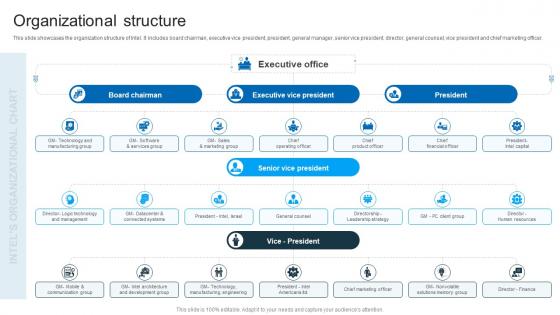
This slide showcases the organization structure of Intel. It includes board chairman, executive vice president, president, general manager, senior vice president, director, general counsel, vice president and chief marketing officer.
People who downloaded this PowerPoint presentation also viewed the following :
Organizational Structure Intel Company Profile Ppt Demonstration CP SS with all 9 slides:
Use our Organizational Structure Intel Company Profile Ppt Demonstration CP SS to effectively help you save your valuable time. They are readymade to fit into any presentation structure.








FAQs for Organizational Structure Intel Company Profile Ppt
So there are basically four main types you'll see. Functional is when departments are split by specialty - HR, marketing, all that. Then divisional organizes by product lines or regions. Matrix is this dual reporting thing that honestly gets pretty messy but somehow works for complex projects. Flat structures have minimal hierarchy. Each has trade-offs though. Functional gives you specialized expertise but creates silos. Divisional offers flexibility per business unit. Matrix lets teams share resources across projects, but coordinating can be a total nightmare. Flat structures speed up decisions and help collaboration flow better. Really depends on your company size and how much coordination you need between teams.
Honestly, good org structure is a game-changer for getting stuff done faster. When everyone knows who reports to who, decisions happen way quicker. No more of that awkward "wait, who's actually in charge here?" situation. Clear roles mean people aren't stepping on each other's toes or duplicating work (ugh, the worst). Your team can actually focus on their jobs instead of hunting down approvals from random people. Just make sure whatever structure you pick actually fits how your business works - I've seen too many companies force some fancy setup that looks pretty but totally doesn't match reality.
Honestly, communication is what makes your org chart actually matter instead of just being wall decoration. Info needs to flow everywhere - up, down, sideways between departments. Otherwise people work in bubbles and waste time redoing each other's work. I've literally watched entire teams ignore their "official" structure just to get things moving faster, which... fair enough honestly. The trick is matching your communication flow to how work really happens, not just your leadership pyramid. Check where information gets stuck in your current setup - that's usually where the problems are hiding.
Honestly, you gotta flatten that whole corporate hierarchy thing when people go remote. Traditional top-down management is basically useless when your team's spread across time zones. Give people real decision-making power instead of making them wait for manager approval on everything. Focus on what actually gets done, not whether someone's online for 8 hours straight. Communication gets tricky though - you need solid processes for async updates. Regular check-ins help too. Trust your people to own their stuff, but don't just leave them hanging. Build in those key touchpoints so everyone stays on the same page with priorities.
So flat structures are pretty great for quick decisions - no endless approval chains, you know? Communication flows way better too. Your team gets actual autonomy and can talk directly to leadership, which honestly feels amazing. But there's definitely downsides. Role confusion is real since nobody knows exactly what they're supposed to do. Career growth gets weird without clear promotion ladders. Oh, and managers? They're drowning trying to handle like 15 direct reports. If you go this route, nail down who does what from day one. Also figure out how people can actually advance their careers - maybe through skill development or project leadership stuff.
Think of culture as your company's personality - it totally dictates how you set things up. Collaborative cultures work best with flat structures and mixed teams. More traditional places? They usually stick with clear hierarchies and separate departments. It's honestly like how some people need everything organized while others thrive in chaos. The trick is matching your structure to what your culture actually values. Otherwise you get this weird disconnect where people don't know what behaviors actually matter, and that's just messy for everyone involved.
Your org structure basically controls whether people feel stuck or empowered at work. Too many layers? People can't make decisions. Unclear reporting lines mean nobody knows who to ask for help - honestly such a pain. When structures are clear and give people real autonomy, engagement shoots up because they feel trusted. Rigid hierarchies though? Total creativity killers. I've seen it happen so many times. Look at your setup and ask: does this help people do amazing work, or just create roadblocks? Sometimes the "boring" stuff like this matters way more than we think.
Start with small cross-functional teams and don't flatten everything at once. Find quick wins where these teams can own whole features, not just their slice of it. Training matters - people need to actually get agile, not just throw around the jargon. I've watched companies rush this and honestly, it's a mess. Psychological safety is key so folks will speak up during retrospectives. Get leadership on board because middle managers hate giving up their gatekeeping role (can't blame them really). Try pilot programs in safer areas first, then expand what actually works.
When market pressure hits, companies usually flatten their hierarchies or go full agile mode. Breaking down silos becomes priority
-
What a stunning collection of customizable templates! Really a time-saver..
-
Love how there are no boring templates here! The design is fresh and creative, just the way I like it. Can't wait to edit and use them for my extended projects!