


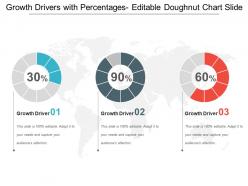
Growth drivers with percentages editable doughnut chart slide





Try Before you Buy Download Free Sample Product
 Impress Your
Audience
 100%
Editable
 Save Hours
of Time


Gain profitable results in your business with our business growth drivers PPT diagram. Recognize your potential market growth drivers for advancement and development of your business. With this Doughnut Chart PowerPoint diagram, it’s easy to communicate your well researched information. Doughnut charts express a part-to-whole relationship, where all pieces together represent 100%. You can use this doughnut graph PPT slide to manipulate the data accordingly and make it visually interactive. Doughnut charts support multiple statistics at once and makes it readable at a glance. Focus on presenting the data in the best possible way. Make the complex algorithms or data become easy to interpret in the form of visuals than its numerical counterparts using our doughnut statistics. Represent various growth drivers that influence and lead your business towards growth. You can compare and analyse the data easily using our Doughnut PPT chart. Hassle-free PowerPoint presentation is just a click away. Download this growth opportunity examples PPT template to enhance your PowerPoint presentation. Seed minds with our Growth Drivers With Percentages Editable Doughnut Chart Slide. your thoughts will produce a bumper crop.
People who downloaded this PowerPoint presentation also viewed the following :
Growth drivers with percentages editable doughnut chart slide with all 5 slides:
Discover the appropriate course with our Growth Drivers With Percentages Editable Doughnut Chart Slide. They help consider conflicting ideas.


FAQs for Growth drivers with percentages editable
Honestly, it's all about tech adoption and how crazy customer expectations have gotten. Everyone wants everything instantly now - no patience for clunky websites or slow service. Regulatory stuff is shifting fast too, plus supply chains are still a mess from 2020 (though some companies figured that out better than others). The sustainability push is real and hitting every industry. Economic conditions matter but... I'd say the winners are just adapting quicker to all these behavioral changes. My take? Find the one trend that's actually affecting your space and get ahead of it instead of scrambling to catch up later.
So here's the thing - innovation basically creates new ways to make money while helping you stand out from everyone else. You're either serving your current customers way better or reaching people you couldn't before. Netflix is perfect example, right? They ditched DVDs for streaming and boom, whole new world opened up. Works in pretty much any industry too. You can develop better products, make your processes smoother, whatever. Just don't innovate for the hell of it - has to actually solve problems people care about or you're wasting time.
Honestly, customer feedback is like having a crystal ball for your business. It shows you what's actually broken before you lose people. I'd start by tracking your biggest 3 pain points - then just build your next quarter around fixing those. Set up some basic feedback loops through surveys and user interviews. Support tickets are gold mines too. The teams that skip this step? They're the ones building features nobody gives a shit about. Been there, seen that disaster happen way too many times. Just make sure you actually do something with what customers tell you.
Dude, technology can totally transform how your small business runs. Automating boring stuff frees up so much mental energy - you can actually think about growing instead of drowning in admin work. CRM systems and cloud tools let you punch above your weight against bigger competitors too. My advice? Don't go crazy trying to digitize everything at once (learned that the hard way). Pick maybe two tools that'll solve your worst headaches first. Digital marketing platforms are usually a safe bet. Once you see what works, then you can add more. The setup phase sucks but it's worth pushing through.
Look, strategic partnerships are honestly a game-changer because you can borrow what you don't have instead of building it yourself. Think customer bases, distribution networks, tech, whatever. Takes forever to crack new markets solo (and costs a ton). When you partner with established companies, boom - instant credibility boost. They get value from you too, obviously. I've seen startups save like 2-3 years this way. Just make sure it's actually mutual benefit and not you trying to mooch off their success - that never works out well.
Track the stuff that actually matters - CAC, conversion rates, where your traffic's coming from for acquisition. Then look at engagement metrics like daily active users and churn to see if people are actually sticking around (not just signing up and bouncing). Revenue-wise, focus on LTV and expansion revenue. Honestly though, don't go crazy tracking everything - I made that mistake early on. Pick like 3-5 metrics that tie directly to your business model. The ones that'll help you make real decisions, not just look pretty on a dashboard. Way too easy to get lost in vanity metrics that don't mean anything.
Think of market segmentation as your secret weapon for finding real growth opportunities. You'll spot what actually drives demand in each customer group instead of just staring at boring overall numbers. Break things down by age, behavior, whatever makes sense - and boom, different patterns pop up everywhere. Millennials might be all about mobile features while your enterprise folks obsess over integrations (honestly, they always do). Each group has totally different triggers and problems they're dealing with. So rather than throwing money at random growth tactics, you can zero in on what your best customers actually care about.
Honestly, going solo in emerging markets is usually a disaster - you really need local partners who get the culture and regulations. Find markets where there's a growing middle class that actually matches what you're selling. Then hunt down distributors or partners who can help you tweak your products for local tastes (this part's huge). Oh and definitely test small first - I've seen companies blow their entire budget on a full launch that totally flopped. Building distribution networks takes forever but it's worth it. The partnership route might feel slower at first, but it's way less risky.
Look, engaged employees are basically productivity machines - they're more innovative, stick around longer, and actually give a damn about customer experience. Strong culture pulls in top talent too because honestly, who wants to deal with a toxic workplace? The numbers are pretty wild: highly engaged teams show 23% better profitability and 18% higher productivity. I mean, that's huge. Start tracking engagement scores and actually do something with the feedback instead of just collecting it. Short sentences hit different sometimes. Your culture is either helping you grow or quietly killing your momentum.
Look, sustainable development is honestly like insurance for your business growth. You're setting yourself up to thrive when resources get tight and new regulations hit. While competitors scramble later, you'll already be ahead of the curve. Customers are genuinely choosing sustainable brands more often now - and that translates to real revenue. I get that it sounds buzzwordy sometimes, but the numbers don't lie. My advice? Build sustainability metrics into your growth strategy from day one instead of slapping them on later. Trust me, you'll thank yourself when environmental costs start hitting everyone else's profits. Way easier than playing catch-up.
Regulatory changes can completely flip your growth strategy overnight - it's brutal. Look at GDPR killing data monetization models, or how banking regs actually created space for fintech companies. Most businesses just scramble to catch up, which honestly puts you at a disadvantage. You'll want to track regulatory trends early and build some flexibility into your plans. I learned this the hard way with a previous project. Don't just react when new rules drop. Instead, treat regulations like market intel - they show you exactly where industries are headed next.
Oh man, digital marketing is such a game-changer for getting new customers. Way cheaper than traditional ads and you can actually see what's working instead of just guessing. The targeting is crazy good - you can zero in on exactly who you want to reach. Plus you get real data so you're not just burning cash hoping something sticks. Honestly, the ability to test different messages and pivot fast is huge. My advice? Pick one or two platforms where your people actually hang out first, then double down on whatever works. Don't spread yourself too thin right away.
Honestly, tracking consumer behavior is like getting a sneak peek at what's coming next. You'll spot shifts in how people shop way before your competitors do. Once you see those patterns - what they're prioritizing, how preferences change - you can adjust your whole approach. Maybe tweak your messaging or jump into new markets. The tricky part is actually doing something with those insights instead of just collecting data (guilty as charged sometimes). Set up regular check-ins with your customers and build a system to act fast on what you learn. It's not magic, but pretty close.
Honestly? Cash flow will bite you first - growth eats money faster than you think. Then you'll struggle finding decent people quickly enough, plus your systems will probably crash when demand spikes. I made the mistake of keeping every decision flowing through me way too long. Don't do that. Build processes early, even when they feel overkill. Set aside cash cushions because you'll need them. Document the boring repetitive stuff now before it becomes chaos later. Training programs are worth it - good people need development. Most crucial thing though? Learn to let go. Your business shouldn't collapse if you take a vacation.
Honestly, the trick is finding spots where doing good actually makes you money too. Map out your main business goals first, then see where they overlap with social stuff that matters. Sustainable products are huge right now - people actually want that. Community programs can build crazy loyalty if done right. But here's the thing - it can't just be some side project when budgets get tight (which they always do). Pick maybe 1 or 2 areas where you can genuinely win on both sides. The whole "let's just slap CSR on everything" approach is dead.
-
Illustrative design with editable content. Exceptional value for money. Highly pleased with the product.
-
Awesome use of colors and designs in product templates.