

Hierarchal Growth Chart Of Employee Roles And Responsibilities




Try Before you Buy Download Free Sample Product
 Impress Your
 Audience
 100%
100% Editable
 Save Hours
 of Time


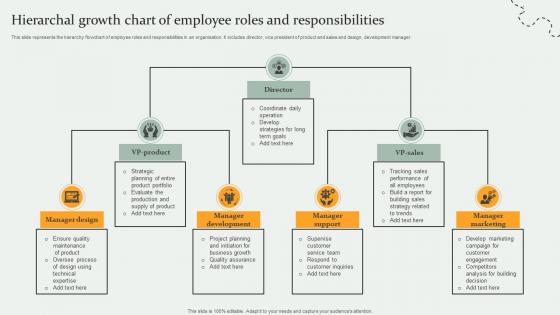
This slide represents the hierarchy flowchart of employee roles and responsibilities in an organisation. It includes director, vice president of product and sales and design, development manager.
People who downloaded this PowerPoint presentation also viewed the following :
Hierarchal Growth Chart Of Employee Roles And Responsibilities with all 6 slides:
Use our Hierarchal Growth Chart Of Employee Roles And Responsibilities to effectively help you save your valuable time. They are readymade to fit into any presentation structure.





FAQs for Hierarchal Growth Chart Of Employee
Honestly, the biggest win is just having clear accountability - like, everyone actually knows who reports to who instead of guessing. Decision-making gets way faster too since there's an obvious chain of command. Your team will thank you for the clearer career paths, and communication becomes so much smoother (no more awkward "wait, who handles this?" moments). Resource allocation becomes less of a headache, and when stuff inevitably goes wrong, at least someone's clearly responsible. Oh, and here's the thing - you probably already have an informal hierarchy happening. I'd start by just writing down what already exists naturally.
Okay so basically flat structures cut out all the middle management BS - you can actually talk to the people making decisions instead of going through five different bosses. Decisions happen way faster too. But honestly? Sometimes nobody knows who's supposed to handle what when stuff breaks. Traditional hierarchies are the opposite - super clear who does what and you know exactly how to climb the ladder, but getting anything approved takes forever. I'd probably go flat if your team values moving fast over having everything mapped out perfectly. Really depends what drives you crazy more - chaos or red tape.
So your company's hierarchy is basically how info gets passed around. Traditional places make you go through all the layers - you tell your boss, they tell theirs, whatever. Takes forever and honestly feels like that telephone game we played as kids. Flatter structures let people talk more directly across levels, which is way faster for decisions. But then nobody really knows who's calling the shots sometimes. I'd say just figure out how your specific company works - like when you actually need to follow the chain versus when you can just message someone directly.
Org charts are definitely your best bet here. PowerPoint has templates that do the heavy lifting with all the boxes and lines. The basic tree layout might seem kinda boring, but honestly it just works. You can make it more interesting with photos or color-coding different departments. Oh, and don't try to squeeze everyone onto one slide - total nightmare to read. If your company's big, I'd split it up by department and then have one overview slide that shows the big picture. Makes way more sense that way.
Honestly, the worst part is dealing with people who just hate any kind of change - especially when their status gets messed with. Managers will fight tooth and nail to keep their teams. Communication gets absolutely chaotic because nobody knows who they're supposed to report to anymore. Oh, and there's always that one person who keeps bugging their old boss instead of adapting (drives me crazy but happens every single time). My advice? Over-communicate everything and nail down your timelines first. Map out who needs what info and when before you tell anyone anything. Trust me on this one.
So basically, the whole hierarchy thing totally controls how fast stuff gets approved and who can actually make calls. Flat companies? Way faster - your ideas zip right up without getting stuck in approval hell. Traditional places though... ugh, everything crawls through like five different managers. Super annoying when you need something done yesterday. Your level in the pecking order also determines what you can decide on your own. Honestly, just figure out who approves what early on so you're not wasting time hitting up the wrong people. Makes navigating the whole system way less painful.
Your company's hierarchy totally shapes the vibe. Steep chains of command = more formal communication and slower decisions since everything needs approval from above. Flatter structures? Way more collaboration and faster innovation, though sometimes nobody knows who's actually in charge lol. People feel way more autonomous in flat orgs and actually speak up with ideas. Here's the thing though - just look at how info moves around your company. That'll tell you everything about whether your structure's working or killing your culture goals.
Start with clear job titles and who reports to whom - seriously, the "who's my actual boss?" confusion is such a productivity killer. Document decision-making authority so people stop escalating everything they could handle themselves. When hierarchy changes happen, tell everyone immediately. Your team shouldn't hear about reporting changes through office gossip (awkward much?). Keep the org chart where everyone can see it. Review it quarterly to catch outdated stuff or gaps. Also, make sure people know who reports TO them, not just who they report to - that part gets forgotten sometimes but it's just as important.
Yeah so you'll want different approaches for each level. New managers need the basics - communication, delegation stuff - and they actually love those interactive workshops where they can bounce ideas off each other. Mid-level people? That's where conflict resolution and strategic thinking come in, maybe some cross-department projects. Senior folks are trickier though - they need executive coaching and way more one-on-one mentoring since their problems are so specific to their role. Oh, and executives hate workshops but love case studies for some reason. Definitely survey each group first about what's actually bugging them before you design anything.
Hey! So for org charts, Lucidchart and Visio are solid choices - they've got templates made for this exact thing. PowerPoint works too if you don't want anything fancy. I've actually seen people pull off decent ones in Google Drawings, though it's kinda clunky to work with. Canva's another option that's pretty user-friendly. If you're at a bigger company, your HR software (like BambooHR or Workday) might already have this built in and pulls from your employee data automatically. Honestly though? I'd just start with whatever your team's already using. Why learn new software if you don't have to, right?
Honestly, most micromanaging happens because nobody knows who can decide what. You've got to draw some lines - let your team handle their daily stuff and smaller calls, but keep the big strategic moves, budget stuff, and anything that affects other teams in your court. I mean, people work better when they actually own their work, right? The trick is being super clear about what you expect, then literally backing off. Maybe pick one thing this week where you can give them more control and test it out. Once those boundaries are set, you'll probably find yourself relaxing more too.
Honestly, people think hierarchy just means micromanaging everything, but that's not it at all. Good hierarchy is really about who gets to make the final call when things get messy. Flat structures sound nice in theory, but I've seen teams get totally stuck because nobody knew whose decision it actually was. The rigid chain of command thing is pretty outdated too - most places are way more flexible now. It's more like having a framework so people can actually collaborate better, not some power trip situation. Focus on understanding why your company is set up the way it is instead of just memorizing the org chart.
Don't let this fester - hierarchy drama spreads fast. Listen to everyone first, not just the manager. Sometimes power trips happen, honestly. Get clear on who does what so there's no confusion about roles. Call out disrespectful behavior directly, doesn't matter what their title is. Set up ways people can report problems without going through the messy chain. Document everything though - you'll need it later. HR should probably know sooner than later if this keeps happening. Nobody gets to be a jerk just because they're higher up.
First thing - check your current workloads and see where the skill gaps are. Communication breakdowns usually show you exactly what's broken. Nobody should be managing 15 people (learned that the hard way), so look at span of control too. Are there actual growth paths for employees? Budget obviously matters, but honestly the collaboration piece between departments is huge. Oh, and definitely ask your people what's driving them crazy - they're living it every day. Map out the problem spots before you start fixing anything or you'll just create new headaches.
Look, feedback from your team will show you exactly where your company structure is broken. You'll catch things like communication getting stuck somewhere in the middle, or managers who are drowning but won't admit it. Honestly, most companies are terrible at spotting this stuff on their own. The real trick? Actually doing something with what people tell you. Maybe that means shuffling who reports to whom, getting your managers some training they desperately need, or just creating better ways for people to talk to each other. Your org chart should work for your people - not against them.
-
Extensive range of templates! Highly impressed with the quality of the designs.
-
It’s really cool, and you can find pretty much everything you could need for your work or school.