


How To Achieve Iso 27001 Certification Powerpoint Presentation Slides





Try Before you Buy Download Free Sample Product
 Impress Your
 Audience
 100%
100% Editable
 Save Hours
 of Time


Keeping confidential information of the organization, customers, and the personal data of valuable employees is not an easy task. To achieve the purpose mentioned above, organizations rely on the information security management system. Here is a professionally designed How to Achieve ISO 27001 Certification template that will be helpful to the organization that wants to introduce and manage the information security management system. The organization can illustrate its future goals through the our objectives and goals to grow business section. Organization can display their journey to achieve the certification with the help of the what will be our certification journey section. Introducing ISMS within the organization and managing it to get the certification section will help the organization to show the incorporation of the ISMS framework within its corporate control. Clause 6 planning can be met by the organization through the applicability statement. Internal ISMS audit program and activities and performance indicators, and evaluation dashboard sections may help the organization fulfill clause 9 Performance evaluation. Finally, the mitigation plan to resolve encountered risk events section will help the organization comply with clause 10 improvement. Customize this 100 percent editable template now.
People who downloaded this PowerPoint presentation also viewed the following :
Content of this Powerpoint Presentation
Slide 1: This slide introduces How to Achieve ISO 27001 Certification. State Your Company Name and begin.
Slide 2: This is an Agenda slide. State your agendas here.
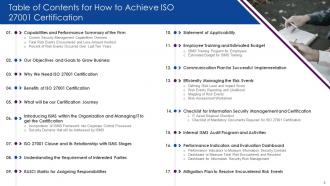
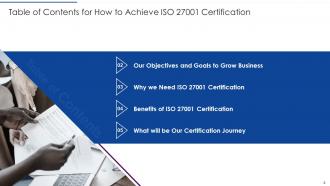
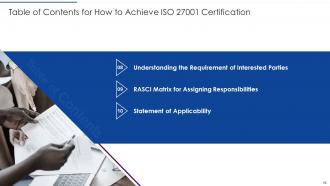
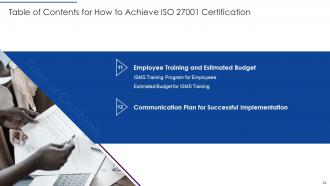
Slide 3: This slide presents Table of Content for the presentation.
Slide 4: This slide shows title for topics that are to be covered next in the template.
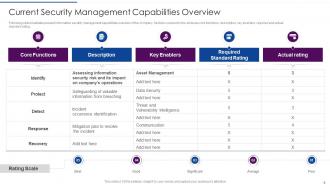
Slide 5: This slide presents Current Security Management Capabilities Overview.
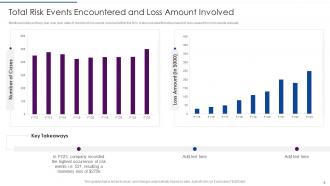
Slide 6: This slide displays Total Risk Events Encountered and Loss Amount Involved.
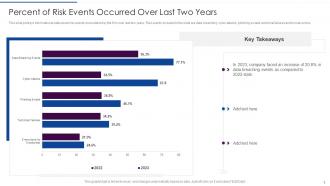
Slide 7: This slide represents Percent of Risk Events Occurred Over Last Two Years.
Slide 8: This slide shows title for topics that are to be covered next in the template.
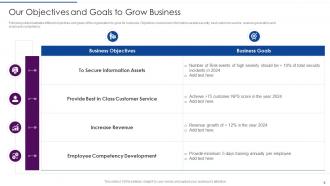
Slide 9: This slide showcases Our Objectives and Goals to Grow Business.
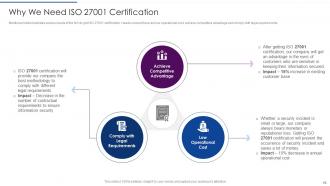
Slide 10: This slide presents various needs of the firm to get ISO 27001 certification.
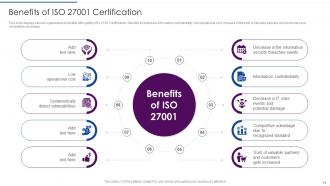
Slide 11: This slide displays various organizational benefits after getting ISO 27001 certification.
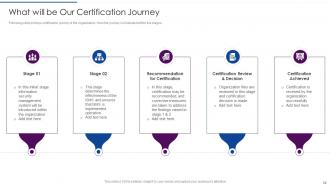
Slide 12: This slide represents certification journey of the organization.
Slide 13: This slide shows title for topics that are to be covered next in the template.
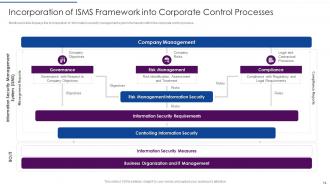
Slide 14: This slide presents Incorporation of ISMS Framework into Corporate Control Processes.
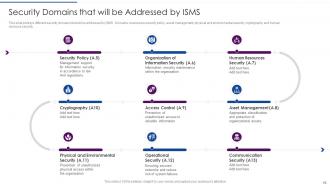
Slide 15: This slide portrays different security domains that will be addressed by ISMS.
Slide 16: This slide shows title for topics that are to be covered next in the template.
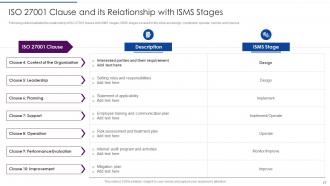
Slide 17: Following slide illustrates the relationship of ISO 27001 clause with ISMS stages.
Slide 18: This slide shows title for topics that are to be covered next in the template.
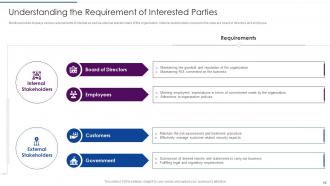
Slide 19: This slide presents Understanding the Requirement of Interested Parties.
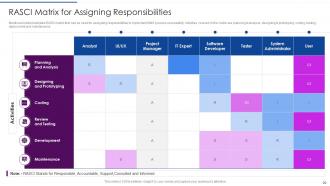
Slide 20: This slide displays RASCI matrix that can be used for assigning responsibilities to implement ISMS process successfully.
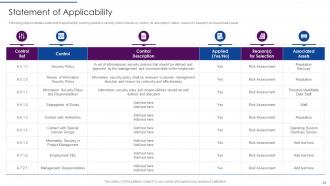
Slide 21: This slide represents statement of applicability covering sections namely control reference, control, its description, etc.
Slide 22: This slide shows title for topics that are to be covered next in the template.
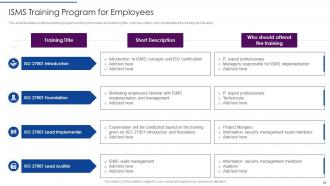
Slide 23: This slide illustrates employee training program covering information about training title, short description, etc.
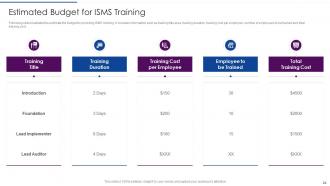
Slide 24: This slide presents estimate the budget for providing ISMS training.
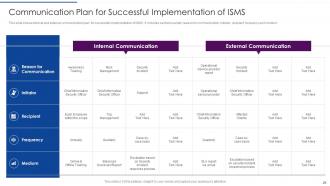
Slide 25: This slide shows internal and external communication plan for successful implementation of ISMS.
Slide 26: This slide shows title for topics that are to be covered next in the template.
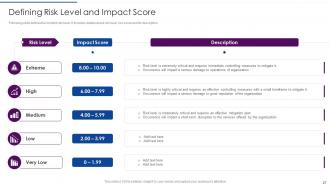
Slide 27: Following slide defines the incident risk level. It includes details about risk level, risk score and its description.
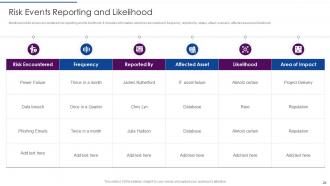
Slide 28: This slide represents encountered risk reporting and its likelihood.
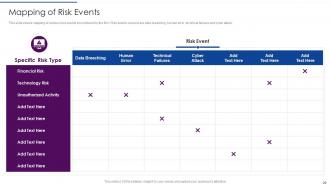
Slide 29: This slide shows mapping of various risks events encountered by the firm.
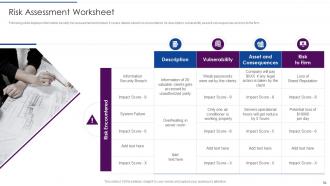
Slide 30: Following slide displays information security risk assessment worksheet.
Slide 31: This slide shows title for topics that are to be covered next in the template.
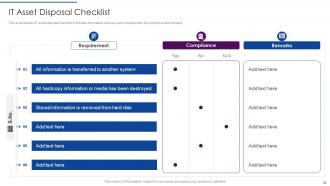
Slide 32: This slide displays IT asset disposal checklist including information such as system requirement, its compliance and remarks.
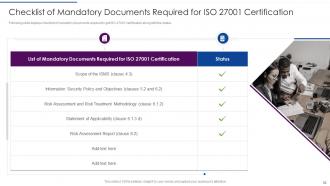
Slide 33: This slide showcases Checklist of Mandatory Documents Required for ISO 27001 Certification.
Slide 34: This slide shows title for topics that are to be covered next in the template.
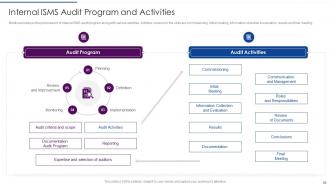
Slide 35: Mentioned slide portrays framework of internal ISMS audit program along with various activities.
Slide 36: This slide shows title for topics that are to be covered next in the template.
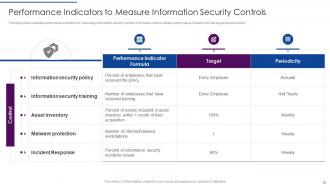
Slide 37: This slide displays Performance Indicators to Measure Information Security Controls.
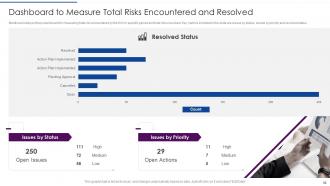
Slide 38: This slide represents Dashboard to Measure Total Risks Encountered and Resolved.
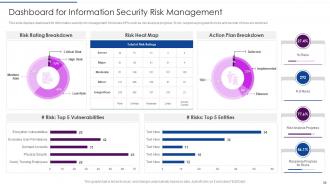
Slide 39: This slide showcases Dashboard for Information Security Risk Management.
Slide 40: This slide shows title for topics that are to be covered next in the template.
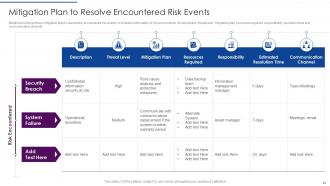
Slide 41: This slide displays Mitigation Plan to Resolve Encountered Risk Events.
Slide 42: This slide displays Icons for How to Achieve ISO 27001 Certification.
Slide 43: This slide is titled as Additional Slides for moving forward.
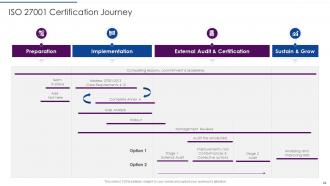
Slide 44: This slide shows ISO 27001 Certification Journey.
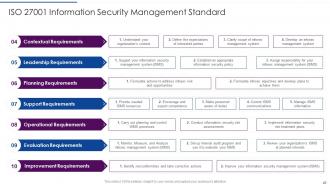
Slide 45: This slide presents ISO 27001 Information Security Management Standard.
Slide 46: This is About Us slide to show company specifications etc.
Slide 47: This is Our Mission slide with related imagery and text.
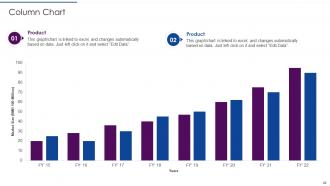
Slide 48: This slide displays Column chart with two products comparison.
Slide 49: This slide provides 30 60 90 Days Plan with text boxes.
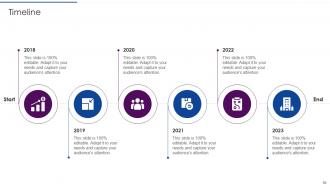
Slide 50: This is a Timeline slide. Show data related to time intervals here.
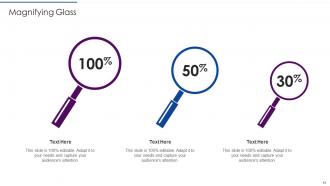
Slide 51: This slide showcases Magnifying Glass to highlight information, specifications, etc.
Slide 52: This slide shows Post It Notes. Post your important notes here.
Slide 53: This slide contains Puzzle with related icons and text.
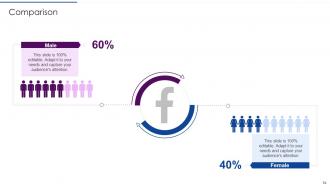
Slide 54: This is a Comparison slide to state comparison between commodities, entities etc.
Slide 55: This is a Thank You slide with address, contact numbers and email address.
How To Achieve Iso 27001 Certification Powerpoint Presentation Slides with all 60 slides:
Use our How To Achieve Iso 27001 Certification Powerpoint Presentation Slides to effectively help you save your valuable time. They are readymade to fit into any presentation structure.







FAQs for How To Achieve Iso 27001 Certification
Honestly, ISO 27001 is pretty worth it. Your data protection gets way better, and clients actually trust you more - especially in finance and healthcare where they basically require it now. The whole process forces you to find security gaps you didn't even know about, which is kinda scary but super helpful. Plus it gives you a real edge when you're competing for contracts. Your incident response improves too, and everything becomes more organized across the board. I'd probably start with a gap analysis first though - helps you figure out realistic timelines and what you're actually getting into budget-wise.
Honestly, ISO 27001 is worth it if you're handling any sensitive data. Clients see it and immediately know you're not messing around with security. A lot of companies won't even work with vendors who don't have it anymore - I've seen RFPs where it's basically mandatory. The whole thing shows you've got proper security controls in place and you're getting audited regularly to keep them up. Your stakeholders feel way more confident their data's protected. Can definitely help you win new business too. Takes some work to get certified but the trust factor alone makes it worthwhile.
So basically you need to set up your ISMS first, then do a risk assessment to figure out what actually needs protection. Document everything (ugh, I know, so much paperwork but it's unavoidable). Implement your security controls based on what you found. The certification audit happens in two stages - they check your docs first, then see if you're actually doing what you say you're doing. Pass that and you're certified for three years with yearly check-ins. Honestly though, start by just mapping out what info you have - makes the whole thing way less overwhelming later.
First, grab the actual ISO 27001 standard and map what you're already doing against those 93 controls in Annex A. Go department by department - they know their stuff better than anyone. Document everything you find, even the messy bits. Here's the thing though: be honest about what actually happens vs. what's supposed to happen on paper. I've seen too many companies fool themselves here. Once you've got your gaps identified, rank them by risk and how hard they'll be to fix. Don't try to tackle everything at once. Build a roadmap that won't kill your team.
Okay so risk assessment is literally the foundation of ISO 27001 - no way around it. You've gotta map out all your info assets first, then figure out what threats they face and how bad it'd be if things went sideways. Honestly, once you dive in it's not as scary as it sounds. Document everything (I know, boring but necessary), implement controls to bring risks down to acceptable levels, and review regularly. Oh and pro tip - start with your most critical data first. That's where you'll see the biggest impact when you're planning treatments. The whole process just becomes second nature after a while.
Look, the standard just says "planned intervals" but most places I've seen do it way more than once a year. Quarterly reviews work well for the big stuff. Monthly check-ins for critical components aren't overkill either. Your cert body's gonna audit you annually anyway, plus that big recertification every three years - so yeah, stay on top of it. Major business changes or new threats? Review immediately. Honestly though, whatever schedule your team can actually stick to is better than some perfect plan you'll abandon. Oh, and those surveillance audits always seem to come faster than expected.
Look, the money thing's gonna be your biggest headache - leadership sees it as expensive paperwork and nothing more. People hate new processes at first too, which is normal but still annoying. Gap analysis will probably surprise you since most companies think they're closer to ISO standards than they actually are. Oh, and the documentation part? It's absolutely brutal. Takes forever. Here's what actually works: get an executive champion early and put someone dedicated on project management. Otherwise you'll have this half-dead project limping along for years. Trust me on that one.
So here's the thing - ISO 27001 and GDPR work together surprisingly well. Your ISO controls already handle most of what GDPR wants anyway (access management, incident response, all that stuff). NIST is more like a toolkit you can use to actually implement ISO rather than something separate. Honestly, I'd start with ISO 27001 first since it gives you solid groundwork. Once that's in place, you'll find GDPR compliance comes way easier, and mapping everything to NIST guidelines is pretty straightforward. It's way less overwhelming than trying to tackle all three from scratch.
So you're gonna need a bunch of different docs for ISO 27001. Start with your ISMS stuff - security policy, risk assessment procedures, statement of applicability. That's your foundation right there. Then grab all your evidence docs like risk registers, incident logs, audit records. Oh, and don't skip the procedural stuff for access control, business continuity, supplier management. The paperwork's honestly pretty intense at first - I won't lie about that. But here's the thing: you're basically just proving you actually do what you claim. Map out what you've already documented first. You might be way closer than you realize.
Dude, your ISMS isn't some static document you file away and forget about. Do quarterly health checks - way better than scrambling before recertification hits. Internal audits will save your butt by catching issues early. Annual management reviews are non-negotiable for updating risk assessments when your business shifts. Honestly, most companies totally blow it on staff training, which is wild because it's so critical. Track your security incidents and near-misses, then actually use those insights to tweak your policies. Oh, and make improvement part of your normal routine instead of this big stressful event.
Your management team has to be all-in on ISO 27001, seriously. They can't just approve the budget and vanish - auditors will call that out instantly. The standard actually demands proof of their involvement: policy sign-offs, resource decisions, ongoing reviews. I've seen companies tank their certification because leadership treated it like a checkbox exercise. Short sentences work here. Your executives need to get their hands dirty and stay engaged throughout the process, or you're basically throwing money away on a failed audit.
Look, internal audits are your safety net for ISO 27001 compliance. They catch problems before the real auditors show up and make your life miserable. You'll need to do them at least once a year to check if your security management system actually works. It's like doing practice rounds before the big game, honestly. Document everything you find - gaps, control failures, whatever comes up. Then actually fix the stuff you discover (this part's crucial). My advice? Get a solid audit schedule going now instead of panicking when recertification rolls around. Trust me on this one.
Honestly, there's a bunch of stuff out there to help with ISO 27001. Gap analysis tools are clutch for figuring out what you're missing right now. Free templates exist - I'd grab one of those first and see where you stack up against the 114 controls. Risk assessment software makes documenting everything way easier, though some of the consulting firm toolkits can get expensive fast. ISO publishes their own guidance docs too. Project management platforms work great for tracking your progress through all the controls. Oh, and there are implementation frameworks floating around online that'll save you time. Start with mapping your current setup - it's eye-opening how much you might already have covered.
Training your people is huge for ISO 27001 compliance - it's literally required. Your team needs to know the security policies inside and out, spot phishing emails, handle data correctly, all that stuff. I've seen companies with amazing tech setups get wrecked because employees clicked the wrong link. Start with training that's specific to what each department actually does, then hit them with refreshers every few months. Security awareness sessions really do help make it part of how people think at work. Without proper training, even your best controls won't save you.
Honestly? Budget around $15k-$50k for getting certified initially - that's your gap analysis, docs, maybe a consultant, plus the actual audit. Annual check-ins are cheaper, like $5k-$15k. Then every three years you're back to that big number for full recertification. The real pain though is internal time. We're talking months of your team's life here. I'd honestly call around to different certification bodies first since their prices are all over the place. And yeah, figure out early if you'll need outside help or can handle it internally.
-
Top Quality presentations that are easily editable.
-
The ease of modifying templates is just superb! Also, the vast collection offers plenty of options to choose from.