


Information Security And ISO 27001 Powerpoint Presentation Slides




Try Before you Buy Download Free Sample Product
 Impress Your
 Audience
 100%
100% Editable
 Save Hours
 of Time


Keeping confidential information of the organization, customers, and the personal data of valuable employees is not an easy task. To achieve the purpose mentioned above, organizations rely on the information security management system. Grab our competently designed Information Security and ISO 27001 template that will be helpful to the organization that wants to introduce and manage the information security management system. The organization can illustrate its future goals through the our objectives and goals to grow business section. Organization can display their journey to achieve the certification with the help of the what will be our certification journey section. Introducing ISMS within the organization and managing it to get the certification section will help the organization to show the incorporation of the ISMS framework within its corporate control. Clause 6 planning can be met by the organization through the applicability statement. Internal ISMS audit program and activities and performance indicators and evaluation dashboard sections may help the organization fulfill clause 9 Performance evaluation. Finally, the mitigation plan to resolve encountered risk events section will help the organization comply with clause 10 improvement. Get access now.
People who downloaded this PowerPoint presentation also viewed the following :
Content of this Powerpoint Presentation
Slide 1: This slide introduces Information Security & ISO 27001. State Your Company Name and begin.
Slide 2: This slide states Agenda of the presentation.
Slide 3: This slide presents Table of Content for the presentation.
Slide 4: This is another slide continuing Table of Content for the presentation.
Slide 5: This slide shows title for topics that are to be covered next in the template.
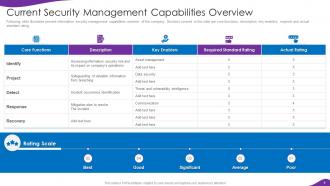
Slide 6: This slide presents Current Security Management Capabilities Overview.
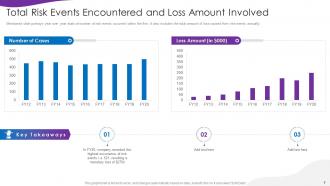
Slide 7: This slide displays Total Risk Events Encountered and Loss Amount Involved.
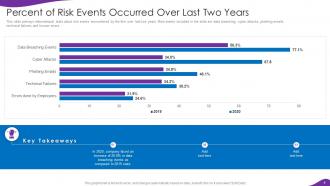
Slide 8: This slide represents Percent of Risk Events Occurred Over Last Two Years.
Slide 9: This slide shows title for topics that are to be covered next in the template.
Slide 10: This slide showcases Our Objectives and Goals to Grow Business.
Slide 11: This slide presents various needs of the firm to get ISO 27001 certification.
Slide 12: This slide displays various organizational benefits after getting ISO 27001 certification.
Slide 13: This slide represents certification journey of the organization.
Slide 14: This slide shows title for topics that are to be covered next in the template.
Slide 15: This slide presents Incorporation of ISMS Framework into Corporate Control Processes.
Slide 16: This slide portrays different security domains that will be addressed by ISMS.
Slide 17: This slide shows title for topics that are to be covered next in the template.
Slide 18: Following slide illustrates the relationship of ISO 27001 clause with ISMS stages.
Slide 19: This slide shows title for topics that are to be covered next in the template.
Slide 20: This slide presents Understanding the Requirement of Interested Parties.
Slide 21: This slide displays RASCI matrix that can be used for assigning responsibilities to implement ISMS process successfully.
Slide 22: This slide represents statement of applicability covering sections namely control reference, control, its description, etc.
Slide 23: This slide shows title for topics that are to be covered next in the template.
Slide 24: This slide illustrates employee training program covering information about training title, short description, etc.
Slide 25: This slide presents estimate the budget for providing ISMS training.
Slide 26: This slide shows internal and external communication plan for successful implementation of ISMS.
Slide 27: This slide shows title for topics that are to be covered next in the template.
Slide 28: Following slide defines the incident risk level. It includes details about risk level, risk score and its description.
Slide 29: This slide represents encountered risk reporting and its likelihood.
Slide 30: This slide shows mapping of various risks events encountered by the firm.
Slide 31: Following slide displays information security risk assessment worksheet.
Slide 32: This slide shows title for topics that are to be covered next in the template.
Slide 33: This slide displays IT asset disposal checklist including information such as system requirement, its compliance and remarks.
Slide 34: This slide showcases Checklist of Mandatory Documents Required for ISO 27001 Certification.
Slide 35: This slide shows title for topics that are to be covered next in the template.
Slide 36: Mentioned slide portrays framework of internal ISMS audit program along with various activities.
Slide 37: This slide shows title for topics that are to be covered next in the template.
Slide 38: This slide displays Performance Indicators to Measure Information Security Controls.
Slide 39: This slide represents Dashboard to Measure Total Risks Encountered and Resolved.
Slide 40: This slide showcases Dashboard for Information Security Risk Management.
Slide 41: This slide shows title for topics that are to be covered next in the template.
Slide 42: This slide displays Mitigation Plan to Resolve Encountered Risk Events.
Slide 43: This slide showcases Icons for Information Security & ISO 27001.
Slide 44: This slide is titled as Additional Slides for moving forward.
Slide 45: This slide shows ISO 27001 Certification Journey.
Slide 46: This slide presents ISO 27001 Information Security Management Standard.
Slide 47: This is Our Mission slide with related imagery and text.
Slide 48: This is Our Team slide with names and designation.
Slide 49: This is About Us slide to show company specifications etc.
Slide 50: This slide represents Stacked Bar chart with two products comparison.
Slide 51: This slide shows Post It Notes. Post your important notes here.
Slide 52: This is an Idea Generation slide to state a new idea or highlight information, specifications etc.
Slide 53: This is a Thank You slide with address, contact numbers and email address.
Information Security And ISO 27001 Powerpoint Presentation Slides with all 58 slides:
Use our Information Security And ISO 27001 Powerpoint Presentation Slides to effectively help you save your valuable time. They are readymade to fit into any presentation structure.
-

Information Security ISO 27001
-
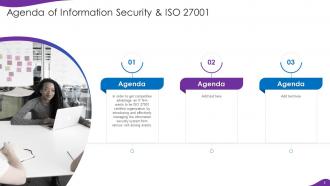
Agenda of Information Security ISO 27001
-
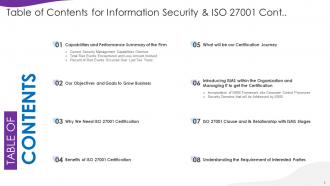
Table of Contents for Information Security ISO 27001 Cont
-
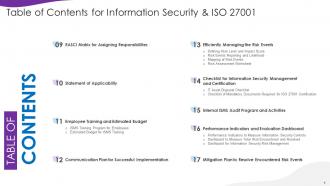
Table of Contents for Information Security ISO 27001
-
Table of Contents
-
Current Security Management Capabilities Overview
-
Total Risk Events Encountered and Loss Amount Involved
-
Percent of Risk Events Occurred Over Last Two Years
-
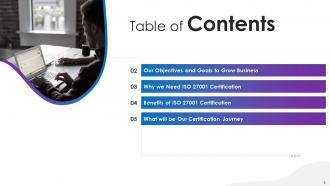
Table of Contents
-
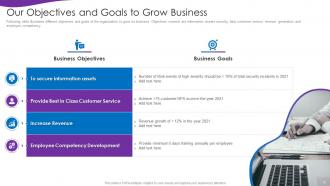
Our Objectives and Goals to Grow Business
-
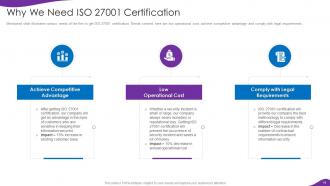
Why We Need ISO 27001 Certification
-
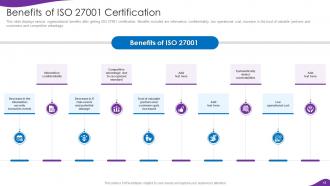
Benefits of ISO 27001 Certification
-
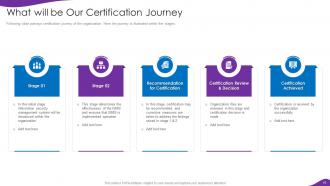
What will be Our Certification Journey
-
Table of Contents
-
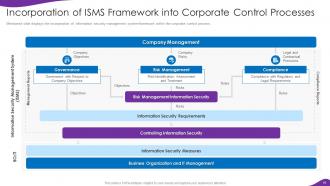
Incorporation of ISMS Framework into Corporate Control Processes
-
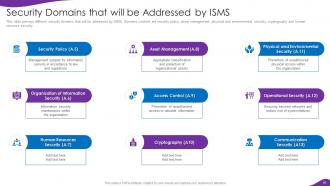
Security Domains that will be Addressed by ISMS
-
Table of Contents
-
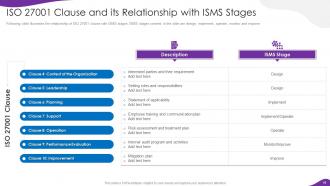
ISO 27001 Clause and its Relationship with ISMS Stages
-
Table of Contents
-
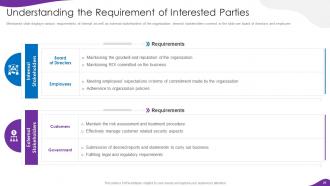
Understanding the Requirement of Interested Parties
-
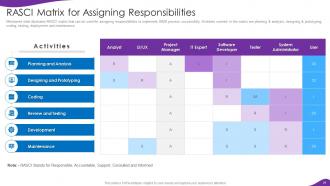
RASCI Matrix for Assigning Responsibilities
-
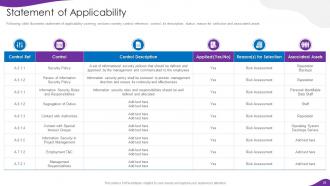
Statement of Applicability
-
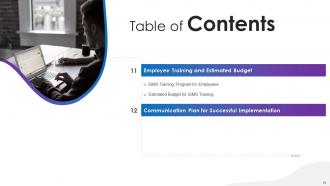
Table of Contents
-
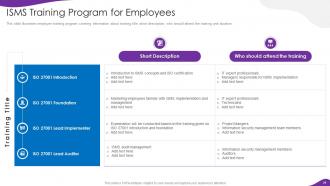
ISMS Training Program for Employees
-
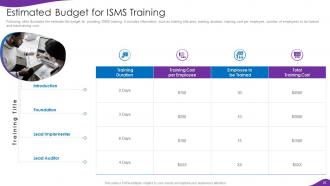
Estimated Budget for ISMS Training
-
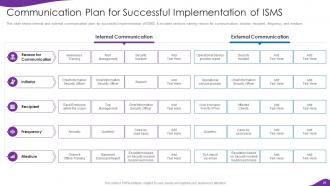
Communication Plan for Successful Implementation of ISMS
-
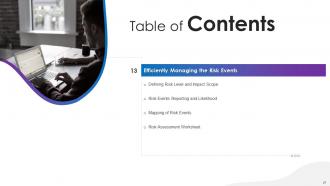
Table of Contents
-
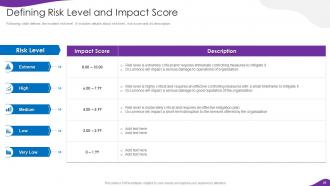
Defining Risk Level and Impact Score
-
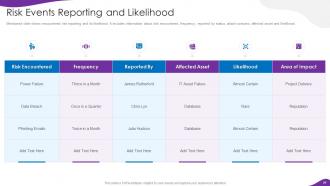
Risk Events Reporting and Likelihood
-
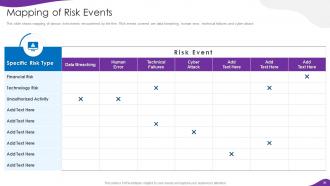
Mapping of Risk Events
-
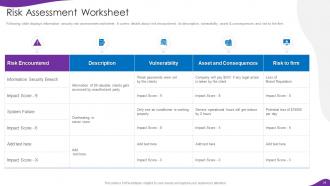
Risk Assessment Worksheet
-
Table of Contents
-
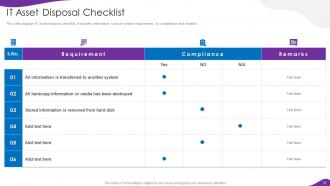
IT Asset Disposal Checklist
-
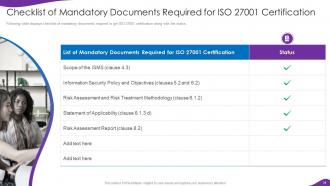
Checklist of Mandatory Documents Required for ISO 27001 Certification
-
Table of Contents
-
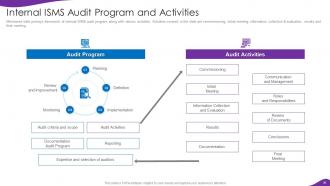
Internal ISMS Audit Program and Activities
-
Table of Contents
-
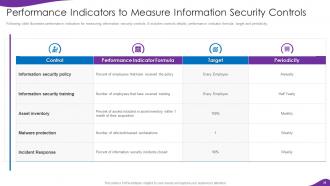
Performance Indicators to Measure Information Security Controls
-
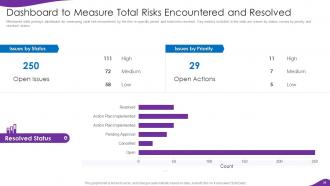
Dashboard to Measure Total Risks Encountered and Resolved
-
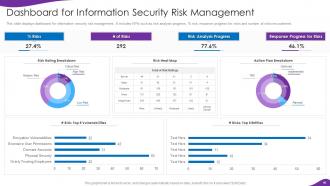
Dashboard for Information Security Risk Management
-
Table of Contents
-
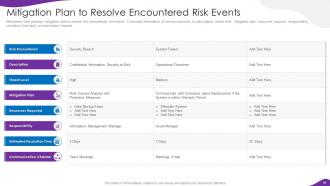
Mitigation Plan to Resolve Encountered Risk Events
-
Icons Slide Information Security ISO 27001
-
Additional Slides
-
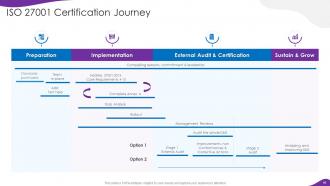
ISO 27001 Certification Journey
-
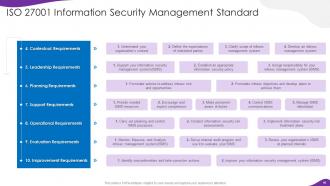
ISO 27001 Information Security Management Standard
-
Our Mission
-
Our Team
-
About Us
-
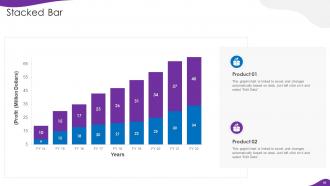
Stacked Bar
-
Post it Notes
-
Idea Generation
-
Thank You
-

-

-

-

-

FAQs for Information Security And ISO 27001
So the big three are confidentiality, integrity, and availability - keeping data private, accurate, and accessible. Then you've got authentication (proving who people are), authorization (controlling access), and non-repudiation (can't deny actions later). Honestly, these sound way more intimidating than they actually are. Most frameworks just build off these basics anyway. Oh, and definitely audit where you're at with each one first - I learned that the hard way when we skipped that step at my last job. Once you nail the fundamentals, everything else clicks into place way easier.
So first thing - run a vulnerability scan on your networks and apps. Nessus or OpenVAS work well, but they're kinda dumb without context, so don't stop there. Get some pen testers to actually try breaking in (way more fun than it sounds). Then do a proper risk assessment - figure out which vulnerabilities would actually hurt your business vs. the random stuff that doesn't matter. Oh, and write everything down because you'll forget half of it otherwise. The biggest mistake people make? Treating this like a one-and-done thing instead of something you do regularly.
Dude, train your people - seriously, it's your best bet against getting hacked. All the expensive security tech won't save you if someone clicks a sketchy email link or uses "password123." Training teaches them to spot phishing attempts and understand why hackers try certain tricks. The key is making it ongoing, not just some boring one-time thing everyone forgets. When people actually get *why* they're doing these security steps instead of just following rules, they'll actually stick with it. Oh, and make sure the examples relate to your actual business - generic training is pretty useless.
So encryption is basically like scrambling your data into complete nonsense that only people with the right key can read. Picture throwing your stuff in a locked safe - hackers might grab it, but they're just staring at gibberish without that key. The math behind it is actually pretty fascinating if you're into that stuff. What really matters though is it protects your information whether it's sitting on some server or flying around the internet. You'll want to check that whoever's handling your sensitive data uses something solid like AES-256. Don't be shy about asking vendors what encryption they're actually using.
Honestly, phishing emails are still the biggest pain - your employees click sketchy links or download bad attachments without thinking. Ransomware's gotten scary good too, basically locks up all your files until you pay up. Then there's social engineering where scammers just straight-up manipulate people into handing over passwords. Oh, and credential stuffing attacks use passwords from other data breaches to break into your stuff. Super annoying. Start with email training for your team - teach them to spot the obvious red flags. Multi-factor authentication everywhere you can set it up. That'll block most of these jerks.
Honestly, start with figuring out what personal data you're actually collecting and where it goes - like, map the whole journey. Then lock down who can access what and decide how long you'll keep stuff. Train your people because seriously, half of data breaches happen when someone clicks a sketchy link or ignores basic security. Have a plan ready for when things go sideways (they will). Document everything you do - regulators eat that stuff up, shows you're not just making it up as you go. Pick one regulation to focus on first. You can always expand later once you've got the basics down.
Okay so first things first - get a proper incident response plan down that hits detection, containment, investigation, and recovery. Practice runs are honestly a game changer because when everything goes sideways, you don't want your team fumbling around trying to remember who does what. Assign clear roles ahead of time: who's making decisions, handling forensics, talking to customers and stakeholders. Keep legal on speed dial and know your notification requirements cold. Oh, and document absolutely everything while it's happening. Trust me, you'll need that trail later for compliance stuff and figuring out what went wrong.
Honestly, AI's kinda wild for cybersecurity right now. The good news? You get these insane detection tools that can catch weird patterns way faster than any human. Short bursts, long analysis - whatever works. But attackers aren't sitting around either - they're cranking out AI-powered phishing emails that are genuinely terrifying how real they look. Deepfakes for social engineering too. I'd say start playing with AI security tools ASAP while teaching your people to spot the AI-generated nasty stuff. It's turning into this crazy back-and-forth where both sides keep one-upping each other.
Dude, you really need MFA - it's like having multiple locks on your door. Even if hackers get your password (which happens all the time now), they'd still need your phone or fingerprint too. Way harder to pull off. I always tell people passwords by themselves are basically useless these days with how many breaches there are. Start with your email and bank accounts first, then add it to everything else. Takes like 5 minutes to set up but saves you from so much potential headache later.
Honestly, layered security is the way to go, but don't make users jump through hoops for everything. Risk-based auth is clutch - only throw up extra barriers when something seems off or they're touching sensitive stuff. SSO is a lifesaver since people get convenience and you still have control. MFA used to suck but now with push notifications and Face ID, it's not terrible. The trick is being strategic about timing. Oh, and definitely test with actual humans first - they'll roast your security flow if it's annoying. Sometimes their feedback stings but it's usually spot-on.
Okay so first thing - get WPA3 on your home network and change that default router password (seriously, why does no one do this?). Always use a VPN when you're hitting company stuff. Keep your devices updated with security patches - I know it's annoying but just do it. Public WiFi is basically asking for trouble, so avoid coffee shop work sessions if possible. Set up multi-factor auth on everything work-related. Store files in whatever cloud storage your company approves, not random USB sticks lying around. Start by checking what you've got now and fix the worst stuff first.
Honestly, security audits are like getting your car inspected - annoying but necessary. They'll catch stuff you totally missed and prove your security controls actually do something. Plus you get real data to wave at your boss when asking for budget (which is half the battle, let's be real). Quarterly audits work best if you can swing it. The biggest thing though? Don't just stick the report in a drawer somewhere. Actually fix what they find - I've seen too many companies waste money on audits they ignore. Oh, and they're great for compliance stuff too.
Ugh, vendor security is such a headache but super important. These third parties get access to your stuff but you can't babysit their security like your own team. I always make them fill out those annoying security questionnaires upfront - yeah, they hate it but whatever. Put security requirements right in the contracts too. You'll want to audit them regularly because honestly, I've seen so many companies get screwed when some random vendor with too much access gets hacked. Oh, and limit what they can actually touch in your systems. Treat it like part of your main security strategy, not something you deal with later.
So AI threat detection is getting crazy good - it'll spot attacks before they even happen. Zero-trust is becoming the norm too, where nothing gets trusted automatically, not even stuff inside your network. Quantum-resistant encryption is vital since quantum computers might break our current security (honestly terrifying). Better automated responses are coming, plus security tools that finally work together instead of being completely useless silos. Oh and quantum stuff is still years away but worth watching. Start digging into this now before your team's totally behind.
Start by figuring out what personal data you actually have - might shock you how much random stuff is sitting around. Only collect what you really need, then encrypt it all. Most breaches happen because too many people had access when they didn't need it. Set up clear rules about who can see what data. Follow GDPR or CCPA rules depending where you are. Don't keep data forever either - have policies for deleting old stuff. Treat it like it's dangerous because honestly, it kind of is these days.
-
Requested a complete pitch deck. Delivered immediately and with high quality well researched content.
-
Informative and engaging! I really like the design and quality of the slides.