


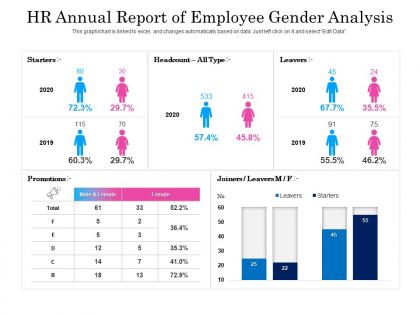
Hr Annual Report Of Employee Gender Analysis




Try Before you Buy Download Free Sample Product
 Impress Your
 Audience
 100%
100% Editable
 Save Hours
 of Time


Our HR Annual Report Of Employee Gender Analysis are topically designed to provide an attractive backdrop to any subject. Use them to look like a presentation pro.
People who downloaded this PowerPoint presentation also viewed the following :
Hr Annual Report Of Employee Gender Analysis with all 2 slides:
Use our HR Annual Report Of Employee Gender Analysis to effectively help you save your valuable time. They are readymade to fit into any presentation structure.
FAQs for Hr Annual Report Of
So yeah, it's pretty all over the place right now. Tech roles are still super male-heavy - like 70-30 split. But HR, marketing, customer success? Those have way better balance, sometimes even more women. Leadership improved since two years ago but it's still around 60-40 male dominated. Here's the cool part though - our new engineering hires are almost hitting 50-50! That quarterly diversity dashboard thing will show you everything broken down by department and level. Honestly way easier than trying to piece it together from random reports.
Honestly, mixed-gender teams just work better - I've seen it firsthand. Problem-solving gets way more creative when you have different perspectives bouncing around. Communication improves too because there's less of that echo chamber effect where everyone just agrees. The research backs this up with like 15-25% better performance, which is pretty solid. Starting with balance from day one is so much easier than trying to fix team dynamics later (learned that the hard way). Oh, and diverse teams are actually more fun to be on - probably sounds cheesy but it's true.
So the big thing is tracking your conversion rates by gender at each hiring stage - application to interview, interview to offer, all that. Compare your applicant pool breakdown against who you actually hire too. Most people forget about time-to-hire by gender, which is honestly pretty revealing. Oh and definitely check your job posting language for gendered terms - Textio's solid for that. The conversion rates will show you exactly where bias sneaks in though. Don't just look at one-time snapshots either, you need the trends over time to really see what's happening.
Look, here's the thing - when your team thinks the workplace treats everyone fairly, they actually give a damn about their jobs. But if they're seeing sketchy promotion decisions or pay gaps? Motivation tanks fast. I've watched this poison spread through entire offices honestly. People just check out mentally. Survey your team regularly about what they're experiencing - and yeah, you actually have to fix the problems they bring up. Can't just pretend everything's fine. The crazy part is perception hits almost as hard as reality here, so even if you think you're doing okay, ask them directly.
Start with standardized review forms - cuts down on all that subjective language that sneaks in. Train your managers to spot bias patterns (like how women get dinged for being "too direct" while guys get praised for the exact same thing). Honestly, it's crazy how predictable these patterns are. Try calibration sessions where multiple people discuss ratings before they're final. Gender-blind initial reviews help too. The real trick? Track your data. Pull quarterly reports on rating distributions by gender - you'll see the bias patterns jump out at you immediately. Makes it way harder to ignore.
So here's the thing - when you've got women in leadership roles, the decision-making just gets better. Different perspectives mean people actually think through more angles and catch stuff that would've been missed otherwise. I swear, every meeting I've been in with diverse leadership, someone brings up something the rest of us totally overlooked. The research backs this up too - these teams are way more innovative and thorough with big decisions. Honestly, if your company wants better outcomes, just look at who's actually sitting at the table when important calls get made. That's where you'll see the problem.
Look, having different genders on your dev team just makes sense - you'll catch stuff that would otherwise fly right over your head. Like if you're building a fitness app, women might point out safety features for outdoor runs that guys wouldn't even think about. It's honestly wild how many companies still don't get this. Teams with mixed perspectives spot more pain points and design for actual users instead of assumptions. Plus your product ends up appealing to way more people, which obviously means better sales. I mean, you're literally designing for humans of all types, so why wouldn't you want that input?
Yeah, this stuff gets weird at work sometimes! Older folks tend to be more formal when talking about gender stuff, while younger employees are super open about pronouns and pay gaps. Boomers and Gen X usually focus on breaking down the barriers they dealt with. Millennials and Gen Z? They want inclusive policies yesterday and aren't afraid to call out systemic problems. Makes for some awkward meetings, not gonna lie. None of these approaches are wrong though - just different life experiences. Maybe try getting people from different generations talking to each other more? Could help bridge the gap.
Honestly, mentorship programs can be game-changers for getting more women into leadership roles. You're basically giving them direct access to senior people who know how the promotion game actually works - all those unwritten rules nobody talks about. The trick is pairing women with higher-up sponsors (ideally men too, since they still hold most of the power, let's be real). Make sure those mentors get some unconscious bias training first though. I've watched this work at a few companies, but only when leadership actually takes it seriously. Find your rising star women and connect them with executives who can open doors.
Honestly, skip the boring PowerPoint lectures - they're useless for this stuff. What actually works? Role-playing real scenarios your team faces. Have them practice reviewing resumes or mock promotion discussions where they catch their own assumptions. I've seen this work way better than theoretical training. Give them concrete tools they can use right away - structured interview questions, maybe blind resume screening. The key is making it ongoing, not just a one-and-done workshop. Focus on everyday decision-making bias, not just the obvious discrimination stuff everyone already knows is wrong.
Honestly, unconscious bias is probably your biggest headache - it creeps into hiring and promotions without people even realizing. Then you've got leadership who resist changing how they've always done things. Creating psychological safety sounds easy but it's actually super tricky to nail. Oh, and don't get me started on balancing historical inequities without making people feel attacked or left out. Start with data to see where your gaps actually are, then focus on recruitment, mentorship, and leadership development policies. But seriously - don't try fixing everything at once. Pick like 2-3 things and actually track if they're working.
Look, workplace gender stuff changes massively depending on where you're operating. Nordic countries crush it with solid parental leave and pay equity laws - way better retention and balance than places with basically zero protections. Some regions force companies to do gender pay audits, others barely make you disclose anything (seriously, the gaps are insane). Your analysis approach needs to shift based on local laws too. What's just "good practice" here might be straight-up legally required somewhere else, so you can't use the same benchmarks everywhere.
Honestly, just start with Excel or Google Sheets if you're not dealing with massive datasets. Pivot tables are clutch for breaking things down by department or job level. Power BI and Tableau are solid if you need fancier visuals - executives love a good chart, what can I say. Python or R become worth it when you're crunching tons of data or need actual statistical tests. Your HR system might already have analytics built in too, so check there first. Don't overthink it though. Begin with whatever tools you've got, then upgrade when you hit their limits.
Track the numbers, but also dig into what's actually happening. Representation at every level matters - not just who you're hiring at the bottom. Check promotion rates by gender and pay gaps too. Honestly, the pulse surveys are where you'll get the real story about whether culture is shifting. People will tell you if they feel heard or if it's all just talk. Retention data and exit interviews are gold mines for this stuff. The test? Women staying AND moving up. Set quarterly check-ins on all this and tie it to leadership bonuses - suddenly everyone cares way more about making progress.
Don't let the loud talkers dominate every call - you know how that goes. Mix up who's running meetings and presenting stuff. Give people different ways to jump in too, like async brainstorming or breakout rooms for the quieter folks. I'd definitely track who's participating in what, just so you can spot any weird patterns early. The tricky part is replacing those random office conversations that actually mattered for building relationships. Maybe try virtual coffee chats or hobby channels? Honestly, sometimes the structured networking works better than the old "boys club" coffee runs anyway.
-
Great designs, Easily Editable.
-
Amazing product with appealing content and design.
-
Top Quality presentations that are easily editable.