


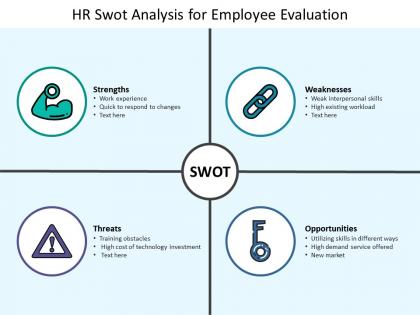
Hr swot analysis for employee evaluation




Try Before you Buy Download Free Sample Product
 Impress Your
 Audience
 100%
100% Editable
 Save Hours
 of Time


There's no need to be a killer presenter or to have design skills. Our readymade Hr Swot Analysis For Employee Evaluation are ready to use anytime you want it.
People who downloaded this PowerPoint presentation also viewed the following :
Hr swot analysis for employee evaluation with all 5 slides:
Our Hr Swot Analysis For Employee Evaluation make it difficult to equal you. Beating you will be far beyond them.




FAQs for Hr swot analysis
Common HR department strengths include talent acquisition expertise, employee development programs, compliance management, performance evaluation systems, and organizational culture development. These capabilities enhance operational efficiency by streamlining recruitment processes, improving employee retention, and ensuring regulatory adherence, with many organizations finding that strategic HR functions ultimately deliver competitive advantage through optimized workforce management and enhanced employee satisfaction.
HR teams leverage technology through applicant tracking systems, AI-powered candidate screening, video interviewing platforms, social media recruiting tools, and automated scheduling systems. These technologies streamline recruitment by reducing time-to-hire, enhancing candidate experiences, and improving quality of matches, with many organizations finding that automated processes deliver faster hiring cycles and significantly lower recruitment costs.
Common HR weaknesses hindering talent management include inadequate succession planning, limited data analytics capabilities, outdated recruitment processes, insufficient employee development programs, and poor performance management systems. These gaps often result in higher turnover rates, skills mismatches, and reduced organizational agility, with many companies finding that strategic HR technology investments and streamlined processes significantly enhance talent retention and competitive positioning.
HR strengthens its alignment with business strategy by developing workforce capabilities that support company objectives, creating talent acquisition strategies that match growth plans, and establishing performance metrics tied to business outcomes. Through strategic workforce planning, skills gap analysis, and leadership development programs, HR teams ultimately deliver competitive advantage while enabling organizational scalability and operational efficiency.
HR opportunities to enhance engagement and retention include flexible work arrangements, personalized career development programs, comprehensive wellness initiatives, recognition platforms, and mentorship opportunities. These strategic approaches streamline talent management by addressing individual employee needs, creating growth pathways, and fostering supportive workplace cultures, with many organizations finding that targeted engagement investments ultimately deliver reduced turnover costs and competitive talent advantages.
Company culture significantly influences HR's talent attraction capabilities by shaping employer branding, candidate perceptions, and competitive positioning in the market. Organizations with strong, authentic cultures streamline recruitment processes through enhanced word-of-mouth referrals, improved candidate experiences during interviews, and higher acceptance rates, with many companies finding that cultural alignment ultimately reduces hiring costs while attracting top-tier talent.
HR departments face threats including talent shortages, rising compensation expectations, remote work complexities, increased employee turnover, and evolving regulatory compliance requirements. These challenges, while presenting recruitment and retention difficulties, ultimately drive organizations to enhance their talent strategies, streamline HR processes, and develop more competitive offerings, with many companies finding that proactive HR planning delivers sustainable competitive advantage.
HR utilizes data analytics to drive better decision-making by analyzing employee performance metrics, predicting turnover patterns, optimizing recruitment processes, and identifying skill gaps across departments. Through advanced analytics platforms, organizations streamline talent acquisition, enhance workforce planning, and improve employee engagement strategies, with many companies finding that data-driven HR approaches ultimately deliver reduced hiring costs and stronger retention rates.
HR can implement technical skills bootcamps, leadership development programs, cross-functional training initiatives, mentorship systems, and digital learning platforms to address identified skill gaps. These programs enhance organizational capabilities by upskilling existing talent, reducing recruitment costs, and improving employee retention, with many companies finding that strategic training investments deliver measurable productivity gains and competitive advantage.
Regulation and compliance significantly shape HR's operational capabilities by requiring structured processes, comprehensive documentation, and continuous monitoring across recruitment, compensation, and employee relations. While compliance demands can initially constrain flexibility, they ultimately enhance organizational credibility, reduce legal risks, and streamline HR operations, with many companies finding that robust compliance frameworks enable more strategic workforce planning.
Leadership directly influences HR strategy effectiveness by setting organizational vision, allocating resources, modeling behaviors, and driving cultural transformation initiatives. Strong leaders enhance HR outcomes by championing talent development programs, supporting change management efforts, and ensuring strategic alignment between workforce planning and business objectives, with many organizations finding that executive commitment ultimately determines whether HR initiatives deliver sustainable competitive advantage.
HR fosters diversity and inclusion through comprehensive recruitment strategies, bias-free hiring processes, inclusive leadership training, employee resource groups, and equitable performance evaluations. These initiatives streamline talent acquisition from diverse backgrounds, enhance workplace culture, and improve employee engagement, with many organizations finding that inclusive practices ultimately deliver better innovation, reduced turnover, and stronger competitive advantage.
HR should consider flexible scheduling models, hybrid workspace requirements, digital collaboration tools, employee wellness support, and performance measurement adaptations when developing remote work policies. These trends enable organizations to enhance productivity, reduce operational costs, and improve work-life balance, with many companies finding that strategic remote policies deliver competitive talent acquisition advantages.
HR can measure initiative success in real-time through digital dashboards tracking employee engagement scores, turnover rates, recruitment metrics, performance indicators, and training completion rates. These systems enable continuous monitoring across departments like retail, healthcare, and manufacturing, with many organizations finding that real-time analytics streamline decision-making, enhance resource allocation, and ultimately deliver faster responses to workforce challenges while maintaining competitive advantage.
HR should adopt transparent communication strategies, employee engagement initiatives, structured training programs, phased implementation approaches, and continuous feedback mechanisms to effectively manage organizational change. These practices streamline transitions by building trust, reducing resistance, and ensuring skill development, with many organizations finding that proactive change management ultimately delivers higher adoption rates and sustained competitive advantage.
No Reviews