


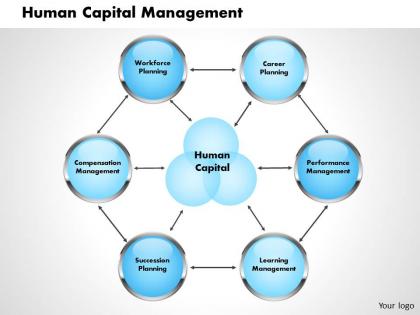
Human capital management powerpoint presentation slide template




Try Before you Buy Download Free Sample Product
 Impress Your
 Audience
 100%
100% Editable
 Save Hours
 of Time


Our Human Capital Management Powerpoint Presentation Slide Template emit the right frequency. They strike a chord with the audience.
People who downloaded this PowerPoint presentation also viewed the following :
Human capital management powerpoint presentation slide template with all 6 slides:
Stoke the embers with our Human Capital Management Powerpoint Presentation Slide Template. Your thoughts will soon be a rage.




FAQs for Human capital management powerpoint
Key components of an effective human capital management strategy include talent acquisition and retention, performance management systems, learning and development programs, succession planning, and employee engagement initiatives. These elements work together by aligning workforce capabilities with business objectives, optimizing resource allocation, and enhancing productivity, with many organizations finding that strategic integration delivers improved operational efficiency and competitive advantage.
Organizations align human capital management with business goals by integrating workforce planning with strategic objectives, establishing performance metrics that reflect company priorities, and ensuring talent development supports key business initiatives. This strategic combination enables companies to optimize resource allocation, enhance operational efficiency, and build competitive advantage, with many finding that aligned HCM practices ultimately deliver faster growth and improved organizational performance.
Technology revolutionizes modern human capital management by automating recruitment processes, enabling data-driven performance analytics, streamlining payroll and benefits administration, and facilitating remote workforce coordination. Through AI-powered platforms and cloud-based systems, organizations enhance employee experiences, minimize administrative overhead, and deliver strategic insights that optimize talent acquisition and retention across diverse industries.
Data analytics enhances human capital management decision-making by providing predictive insights into employee performance, retention risks, and skill gaps through comprehensive workforce data analysis. Organizations across industries, from healthcare systems to financial services, leverage these analytics to optimize recruitment strategies, identify high-potential employees, and reduce turnover costs, ultimately delivering more strategic talent management and competitive workforce advantages.
Best practices for talent acquisition include defining clear role requirements, leveraging data-driven recruitment analytics, implementing structured interview processes, building diverse candidate pipelines, and utilizing employer branding strategies. These approaches streamline hiring by reducing time-to-fill, enhancing candidate quality, and improving retention rates, with many organizations finding that strategic talent acquisition ultimately delivers competitive advantage and operational efficiency.
Organizations measure human capital ROI through productivity metrics, revenue per employee, retention rates, time-to-competency for new hires, and performance improvement tracking. Companies in finance and healthcare increasingly use analytics platforms to correlate training investments with business outcomes, ultimately delivering measurable returns through reduced turnover costs, faster project completion, and enhanced operational efficiency.
Effective employee retention strategies include competitive compensation packages, flexible work arrangements, professional development opportunities, recognition programs, and career advancement pathways. These approaches enhance workplace satisfaction by addressing work-life balance, skill growth, and employee value recognition, with many organizations finding that strategic investments in human capital development ultimately deliver reduced turnover costs and improved productivity.
Diversity and inclusion significantly enhances human capital management by expanding talent pools, fostering innovation through varied perspectives, and improving employee engagement and retention. Organizations with strong D&I initiatives typically experience better decision-making, reduced turnover costs, and enhanced brand reputation, with many companies finding that diverse teams deliver superior financial performance and competitive advantage.
Managing remote teams presents challenges including communication barriers, performance monitoring difficulties, maintaining company culture, ensuring employee engagement, and coordinating across time zones. These obstacles can impact productivity and team cohesion, though many organizations find that implementing structured communication protocols, digital collaboration tools, and regular virtual check-ins ultimately delivers improved flexibility and access to global talent pools.
Training and development significantly enhance human capital management by improving employee skills, boosting retention rates, and aligning workforce capabilities with strategic objectives. Through targeted learning programs, organizations streamline talent development, reduce recruitment costs, and accelerate internal promotions, with many companies finding that comprehensive training initiatives ultimately deliver higher productivity and stronger competitive advantage.
Organizations should track employee engagement scores, retention rates, time-to-productivity for new hires, internal promotion rates, and performance improvement metrics to assess human capital management effectiveness. These measurements enable companies to identify talent development gaps, optimize recruitment strategies, and enhance workforce planning, with many finding that comprehensive tracking ultimately delivers improved operational efficiency and competitive advantage in today's talent-driven marketplace.
Human capital management strengthens organizational resilience by maintaining workforce flexibility, ensuring continuity planning, and fostering adaptive leadership capabilities during disruptions. Through strategic talent deployment and cross-training initiatives, organizations can quickly reallocate resources, maintain critical operations, and pivot business models, with many companies finding that robust HCM systems enable faster recovery and competitive positioning post-crisis.
Employee feedback and surveys provide critical data for shaping human capital strategies by identifying skill gaps, measuring engagement levels, assessing training effectiveness, and revealing retention risks. These insights enable organizations to develop targeted recruitment plans, personalized development programs, and competitive compensation packages, with many companies finding that regular feedback cycles ultimately enhance employee satisfaction and reduce turnover costs significantly.
HR leaders can advocate for human capital management by demonstrating clear ROI through metrics, aligning workforce strategies with business objectives, and presenting data-driven insights to executive leadership. By showcasing successful implementations in companies like Google and Microsoft, these leaders can illustrate how strategic human capital initiatives enhance productivity, reduce turnover costs, and ultimately deliver competitive advantage in talent retention.
The future of human capital management involves strategic workforce transformation, AI-enhanced talent analytics, automated administrative processes, personalized employee development, and data-driven decision making. Organizations are increasingly leveraging these technologies to streamline recruitment, enhance performance management, and deliver personalized career experiences, while focusing human resources on strategic initiatives, ultimately creating more agile and competitive workforces.
-
Helpful product design for delivering presentation.
-
Qualitative and comprehensive slides.