


Human Resource Management Platform Pitch Deck Ppt Template




Try Before you Buy Download Free Sample Product
 Impress Your
 Audience
 100%
100% Editable
 Save Hours
 of Time


Human Resource Management Platform pitch deck caters solid fundraising strategy to ensure a reasonable chance of getting funded. It focuses on rendering customized professional training, employee data management, offering customized employee benefits, managing perks, and employee performance. The Human Resource Management Strategy ppt effectively attracts investors by distilling the company in a condensed and marketable message for potential investors. Take hold of investors attention through slides depicting opportunities vs. risks in managing human resources, challenges faced, and solutions rendered in managing HR, HRM software benefits in reducing HR processes complexities, innovative technology associated, critical deliverables of the platform, features associated, the pricing model for platform, progressive growth of HRM platform. The deck caters to investors attention through slides depicting global HRM software market assessment, profitable business model, competitive assessment of significant players existing, clients associated, key people involved, board members associated, and future initiatives. Book a free demo with our research team and customize this pitch deck based on your requirements.
People who downloaded this PowerPoint presentation also viewed the following :
Content of this Powerpoint Presentation
Slide 1: This slide displays title i.e. 'Human Resource Management Platform Pitch Deck'.
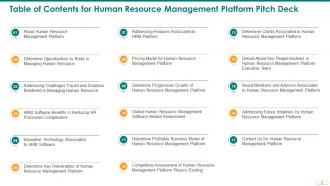
Slide 2: This slide presents table of contents.
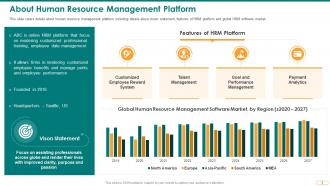
Slide 3: This slide caters details about human resource management platform including details about vision statement, etc.
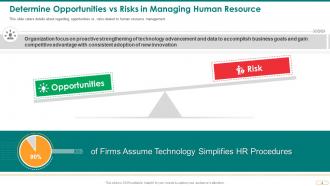
Slide 4: This slide caters details about regarding opportunities vs. risks related to human resource management.
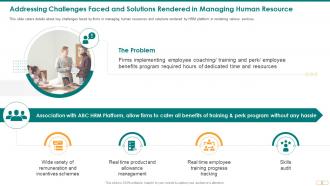
Slide 5: This slide caters details about key challenges faced by firms in managing human resources and solutions rendered by HRM platform in rendering various services.
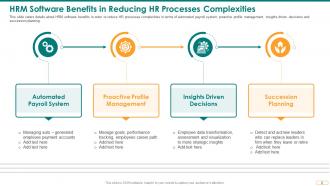
Slide 6: This slide caters details about HRM software benefits in order to reduce HR processes complexities in terms of automated payroll system, etc.
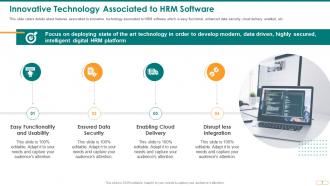
Slide 7: This slide caters details about features associated to innovative technology associated to HRM software which is easy functional, etc.
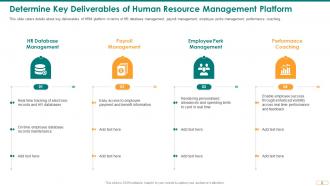
Slide 8: This slide caters details about key deliverables of HRM platform in terms of HR database management, payroll management, etc.
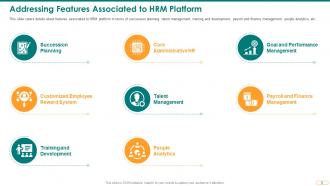
Slide 9: This slide caters details about features associated to HRM platform in terms of succession planning, talent management, training and development, etc.
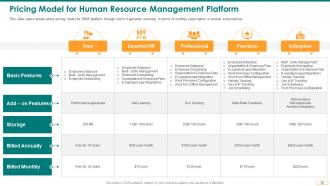
Slide 10: This slide caters details about pricing model for HRM platform through which it generate revenues in terms of monthly subscription or annual subscriptions.
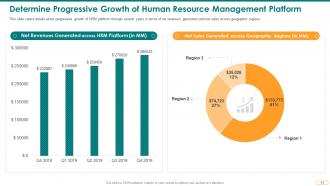
Slide 11: This slide caters details about progressive growth of HRM platform through several years in terms of net revenues generated and net sales across geographic regions.
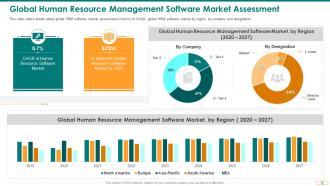
Slide 12: This slide caters details about global HRM software market assessment in terms of CAGR, global HRM software market by region, by company and designation.
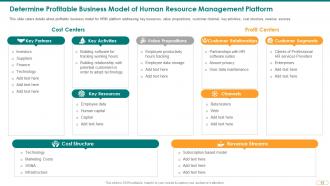
Slide 13: This slide caters details about profitable business model for HRM platform addressing key resources, value propositions, customer channel, etc.
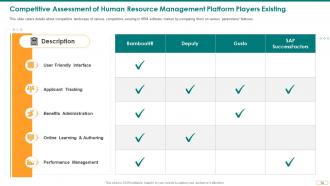
Slide 14: This slide caters details about competitive landscape of various competitors existing in HRM software market by comparing them on various parameters/ features.
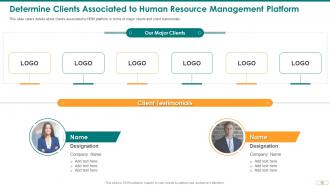
Slide 15: This slide caters details about clients associated to HRM platform in terms of major clients and client testimonials.
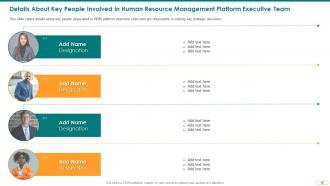
Slide 16: This slide caters details about key people associated to HRM platform executive team and are responsible in making key strategic decisions.
Slide 17: This slide caters details about board of members and advisors associated to HRM platform.
Slide 18: This slide caters details about future initiatives by HRM platform that will focus on leveraging connections across potential stakeholders.
Slide 19: This slide showcases contact details of the company.
Slide 20: This is the icons slide.
Slide 21: This slide presents title for additional slides.
Slide 22: This slide shows about your company, target audience and its client's values.
Slide 23: This slide presents your company's vision, mission and goals.
Slide 24: This slide shows details of team members like name, designation, etc.
Slide 25: This slide depicts 30-60-90 days plan for projects.
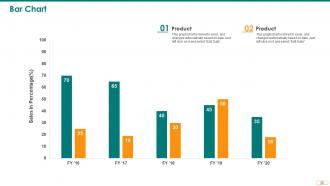
Slide 26: This slide exhibits yearly sales bar charts for different products. The charts are linked to Excel.
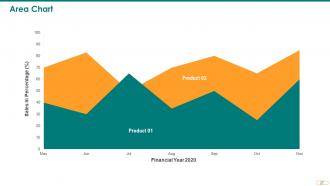
Slide 27: This slide shows monthly sales area charts for different products. The charts are linked to Excel.
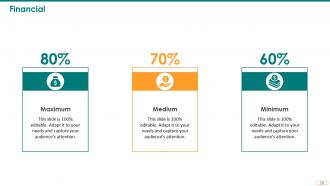
Slide 28: This slide showcases financials.
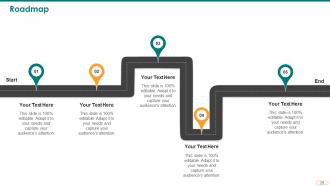
Slide 29: This slide shows roadmap.
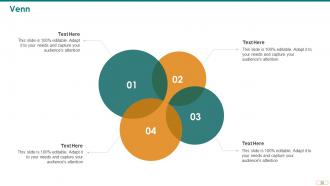
Slide 30: This slide displays Venn.
Slide 31: This is thank you slide & contains contact details of company like office address, phone no., etc.
Human Resource Management Platform Pitch Deck Ppt Template with all 36 slides:
Use our Human Resource Management Platform Pitch Deck Ppt Template to effectively help you save your valuable time. They are readymade to fit into any presentation structure.






FAQs for Human Resource Management Platform Pitch
Honestly, everything flipped after 2020 - remote work isn't going anywhere, and companies are using AI for recruiting now. Mental health support became huge too. Skills matter more than degrees these days, which is pretty refreshing actually. Data drives most HR decisions now, and everyone's obsessed with "employee experience" instead of just keeping people happy. DEI stuff is still major. Oh, and personalized career paths are big - people want development that actually fits them. Your team just needs to stay flexible and actually listen to what people want. Sounds obvious but most places still suck at it.
Honestly, tech can fix most of your HR headaches. Start with automated onboarding - it's a lifesaver for getting new people settled in quickly. Performance management tools with AI give instant feedback instead of waiting for quarterly reviews (which nobody likes anyway). Those employee engagement apps are clutch for remote teams trying to actually talk to each other. Analytics help you catch people thinking about quitting before they do. Oh, and self-service portals cut down on all that paperwork nonsense so your HR folks can do real work. Don't go crazy though - just pick one annoying manual process first and automate that.
Look, diverse teams just make better decisions - different perspectives stop everyone from thinking the same way. Candidates today will literally ghost you if your company doesn't walk the walk on this stuff. But here's where most places screw up: they hire diverse talent then wonder why people leave. It's not enough to just get people in the door. You need that inclusion part where everyone actually feels like they belong and can move up. I'd start by checking your hiring process for bias, then work on making sure people feel safe to speak up and do their best work.
Honestly, I'd start with monthly pulse surveys - just 3-5 quick questions can show you trends without annoying people. Exit interviews are super helpful but yeah, kinda late to fix anything at that point lol. Track your turnover rates and how often people get promoted internally. One-on-ones are clutch for getting real feedback. Don't sleep on the annual engagement surveys either. Absenteeism patterns tell you more than you'd think. Mix the numbers with actual conversations - that's where you'll spot problems before they blow up.
Do a proper needs assessment first - what skills are actually missing? Make content super relevant to their real jobs, not just theory. Interactive stuff beats boring presentations every single time (learned this the hard way). Get leadership on board early or you're screwed. Honestly, skip the basic satisfaction surveys - track real metrics instead. Mix it up with workshops, mentoring, online modules, whatever works. Oh, and here's the big one - follow-up is everything. Without reinforcement, they'll forget basically everything within a week. Build that in from day one.
First thing - actually understand what your company's trying to do strategy-wise. Can't align HR if you don't get the bigger picture, you know? Then match your programs to those goals. Innovation focus? Hire creative people, build learning stuff. Cost-cutting mode? Streamline processes, maybe restructure (ugh, the fun part). Talk to leadership first - figure out their real priorities. I'd probably grab coffee with a few execs if possible. After that, look at your current HR programs and see what's actually supporting those objectives versus what's just... there. Performance systems, talent management, culture initiatives - they should all connect back to business goals somehow.
Honestly, remote work flipped everything upside down for HR. Your whole recruitment process goes digital now. Onboarding happens through screens instead of conference rooms - weird adjustment but it works. Performance reviews get tricky since you can't just pop by someone's desk to check in. Building culture remotely? That's the real challenge. You lose those random coffee conversations that actually matter. So now you're scheduling "connection time" which sounds forced but whatever, it helps. Compliance gets messier too when people work from different states. The upside is you'll find some amazing HR platforms out there - just don't go cheap on the tech stack.
Okay so basically HR needs to step in when things get too heated for people to sort out themselves. I'd start by talking to each person separately - you get way more honest info that way. Then bring everyone together for an actual conversation, but keep it focused on moving forward instead of just letting people dump on each other. Write everything down because honestly, once emotions are involved people remember stuff completely differently. Don't worry about figuring out who's "right" - that's usually impossible anyway. Just get them to agree on how they'll interact going forward and check back in like a week later to see if it's actually working.
Look, anti-discrimination laws apply to everything - hiring, firing, the whole deal. Can't discriminate based on race, gender, age, religion, disability, all that stuff. Document EVERYTHING because honestly, paperwork saves your ass when lawyers get involved. Job postings should be inclusive, interview questions stick to actual job skills. Firing someone? Better have solid business reasons and apply policies consistently across the board. At-will employment doesn't mean you can axe people for illegal reasons though. My take? Get legal involved early, especially when things get messy.
Honestly, skip the annual review BS and just talk to people regularly. I do weekly one-on-ones with my team - sounds like overkill but people actually love it once they adjust. Your managers need better questions though. Instead of "how's it going?" try "what's blocking you that I can fix?" Way more useful. Oh and create some way for people to give feedback UP the chain too. Most places suck at this. The biggest thing? Actually do something with what you hear or people will just stop telling you stuff. I'd test it with one team first, see how it goes.
Honestly, start with pay - if you're underpaying people, nothing else matters much. Survey your team to see where you're falling short first. Career growth is huge too. People want to know they won't be stuck in the same role forever, so mentorship and clear advancement paths help a ton. Company culture stuff like flexible schedules and actually recognizing good work makes a difference. Oh, and listen when employees give feedback instead of just pretending to care. Most retention issues boil down to these three things, but figure out which one's your biggest problem before trying to fix everything at once.
Oof, that's rough. Be upfront with everyone from the start - I've watched companies keep it secret until the day of and it's a disaster. Figure out your criteria first, then talk to people honestly about what's coming. Don't forget the legal stuff like WARN Act requirements. The people staying behind are gonna feel survivor's guilt on top of extra work, so they need support too. Document literally everything. Proper severance and references for folks leaving is non-negotiable. Maybe bring in some external counselors? This whole thing sucks but transparency makes it way less awful.
Dude, emotional intelligence is what makes or breaks HR leaders. The best ones can read a room and stay calm when everything's falling apart. Picture this - you're handling layoffs or calling someone out for bad performance. People are watching every reaction you have. If you can't manage your own emotions while showing genuine empathy, you're toast. Trust goes out the window fast. Active listening is huge too - like actually hearing what someone's feeling, not just their words. Honestly, I've seen so many HR people miss this and wonder why their teams don't open up to them.
Look, data analytics just makes your hiring hunches way more solid. You know how you're always wondering why people keep quitting or which candidates will actually work out? Numbers tell the real story. Track training completion rates - turns out people who finish certain programs stick around 40% longer. Wild, right? It'll help you spot who's about to bail and figure out where your recruiting budget actually works. Honestly, I'd just pick one thing you're curious about first. Maybe turnover in that one department that's always a mess? Track it for a couple months and see what patterns show up.
Honestly, it's mostly about communication styles clashing. Boomers want face-to-face meetings, Gen Z lives on Slack - feels like different planets sometimes. Work-life balance is another big one, plus how fast people adapt to new tech. Best thing you can do? Ask your team what they actually prefer instead of guessing. Mix up communication options, create mentorship that goes both directions. Oh, and don't fall into the stereotype trap - I've met plenty of tech-savvy boomers who'd surprise you. Focus on individuals, not just their age group. Survey first, then adapt.
-
Appreciate the research and its presentable format.
-
Amazing product with appealing content and design.