

Human Resource Operation Management Flow Chart




Try Before you Buy Download Free Sample Product
 Impress Your
 Audience
 100%
100% Editable
 Save Hours
 of Time


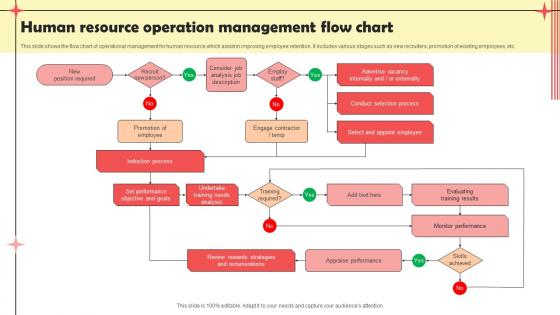
This slide shows the flow chart of operational management for human resource which assist in improving employee retention. It includes various stages such as new recruiters, promotion of existing employees, etc.
People who downloaded this PowerPoint presentation also viewed the following :
Human Resource Operation Management Flow Chart with all 6 slides:
Use our Human Resource Operation Management Flow Chart to effectively help you save your valuable time. They are readymade to fit into any presentation structure.





FAQs for Human Resource Operation
So you're looking at talent acquisition and performance management as your big pillars. Employee development matters too - people want to grow, right? Then there's all the boring compliance stuff you can't avoid. Compensation and benefits administration will eat up more time than you think. Employee relations helps when things get messy between coworkers. HR analytics is huge now - everyone wants data to back up decisions. Your HRIS pulls it all together instead of having random spreadsheets everywhere. Honestly, just audit what you have first and fix the worst gaps.
Honestly, tech saves your life in HR. Those applicant tracking systems and automated onboarding workflows eliminate so much busywork - no more chasing people for paperwork updates since they can handle it themselves through self-service portals. Analytics dashboards show you turnover patterns and performance stuff in real time, which is pretty helpful. Just don't go crazy buying random tools that don't talk to each other (learned that one the hard way). Pick whatever's driving you most insane right now and automate that first. You'll actually have time to think strategically instead of drowning in admin tasks.
Track turnover rate and time-to-fill for sure - those are non-negotiables. Employee satisfaction scores matter too, plus cost-per-hire since your boss will definitely ask about budget efficiency. Internal promotion rates show whether you're actually developing talent or just churning through people. Absenteeism and training completion rates are solid indicators too. Oh, and don't skip exit interview feedback - it's brutal but honest. Pick maybe 5-6 metrics tops that match your company's priorities. More than that and you'll drown in spreadsheets. Check them monthly and you'll start seeing patterns pretty quickly.
Dude, onboarding is huge for keeping people around - we're talking 25-50% better retention rates. I've seen it firsthand. New people who feel supported and actually understand their job from day one? They stay. But throw someone into chaos their first week and they'll bolt faster than you can say "we should've planned this better." Don't dump everything on them week one though - that's brutal. Spread it out over 90 days with actual check-ins. Map out what winning looks like at 30, 60, and 90 days so they're not wandering around wondering if they suck at their job.
Oh man, compliance is such a pain but you literally can't avoid it. Employment laws, safety stuff, wage rules - it's all there to prevent you from getting sued into oblivion. My advice? Document EVERYTHING. Seriously, every hire, review, disciplinary action. Get HR software that catches red flags before they become problems. Train your managers on current laws too because they're the ones who'll accidentally say something stupid. Oh and definitely buddy up with an employment lawyer - trust me on this one. Regular policy audits help too. It's boring work but beats dealing with lawsuits later.
Honestly, data analytics is a total game-changer for HR decisions. Instead of just guessing why people quit, you can actually see patterns months before someone walks out the door. Maybe it's always after workload spikes or issues with their manager - who knows until you look at the data, right? You'll spot which benefits actually keep people around and which recruiting sources bring your best hires. I'd say start simple though. Pick one problem you're dealing with and dig into whatever data you already have sitting around. Way better than making gut-feeling calls that might be completely wrong.
Honestly, start by looking at your current setup - I bet there are holes you haven't noticed yet. Three big things to nail down: talk to people regularly (not just about work stuff, remote workers get isolated), make sure your tech actually plays nice together instead of having everyone bounce between random apps, and train your managers differently. Managing remote teams is weird compared to in-person. Oh and create real policies for the boring stuff - expense reports, home office money, timezone drama when scheduling meetings. The manager training thing is huge though, most people have no clue how to lead remotely.
Honestly, culture and engagement are what make or break your HR stuff. Good culture means people actually show up for performance reviews and refer decent candidates - way less drama to deal with. Bad culture? You're constantly putting out fires. I learned this the hard way at my last job. Short sentences work better here. Start with pulse surveys to see where you stand, then figure out what's working and what's making your life harder. It's kinda like... when everyone's bought in, HR flows naturally instead of feeling like you're dragging people along.
Honestly, start with regular check-ins - they're way more effective than people think. Set up some cross-functional channels so teams actually talk to each other. Train your managers on active listening because, let's be real, most of them suck at it. Anonymous suggestion boxes work surprisingly well too, even though they sound old-school. Open-door policies help, plus team-building stuff that isn't completely cringe. Oh, and don't just throw new communication tools at people and walk away. You'll need to check engagement regularly and tweak things based on what's actually working for your specific groups.
So first thing - audit what you're doing now, that'll show you where bias creeps in. Structure your interviews better and source candidates from different places. Pay equity audits are a must too, honestly. Track all your demographic data for hiring, promotions, retention - sounds boring but you really can't improve without knowing the numbers. Also set up employee resource groups and rewrite those job descriptions (some of them probably sound super corporate anyway). Train your managers on unconscious bias. Start with the audit though, then build from there.
Ugh, HR ops is brutal when everything's moving fast. You're always behind on workforce planning and scrambling to update policies. Recruiting fast enough? Good luck with that. Compliance changes randomly and leadership waits forever to decide on headcount - drives me crazy honestly. What worked three months ago is probably useless now. Build flexible systems early if you can, and definitely stay tight with your hiring managers. That relationship saves you when priorities flip overnight. Oh, and don't get too attached to your processes because they'll change again soon anyway.
Honestly, just bake it into what you're already doing instead of creating some whole separate thing. During performance reviews, actually talk about development stuff. Map learning to career paths so people see the point. Your HRIS can probably track skill gaps and suggest training - most people don't even know that feature exists! I've watched companies blow money on these flashy learning platforms that nobody uses. Make it feel normal, not like extra homework. Figure out what skills each role really needs, then break learning into small chunks people can squeeze into their actual workday. Short bursts work way better than marathon sessions anyway.
Honestly, employee feedback is like having a mirror held up to your HR stuff. You think your onboarding process is great? Cool, but if new people are saying it's a mess, then you've got work to do. Their perspective shows you what's actually happening versus what you planned on paper. Performance reviews feeling weird? Benefits confusing people? They'll tell you. Sometimes it's stuff you'd never think of - like whether HR seems approachable or not. Regular surveys work, exit interviews too. Even just grabbing coffee and asking how things are going can give you solid info to fix what's broken.
Dude, global HR is such a nightmare compared to domestic stuff. You're juggling like 50 different employment laws, visa paperwork, and tax codes that change by country. Plus every culture has totally different ideas about work-life balance and how people should communicate. Honestly, I learned this the hard way at my last job. Don't try to manage everything from headquarters - you'll go insane. Get solid local partners who actually know their markets. And yeah, invest in decent HR software that won't break when you add new countries.
AI's gonna take over the boring stuff - resume screening, interview scheduling, you know the drill. Remote work isn't going anywhere, so managing distributed teams is huge now. Employee experience platforms are finally getting the attention they deserve (thank god). Everything's becoming data-driven. Predicting who's gonna quit, customizing benefits - it's wild how much we can track now. Skills matter way more than degrees these days. Continuous learning platforms are replacing those awful corporate training sessions we all hated. Honestly? Get comfortable with HR analytics and AI tools sooner rather than later.
-
Informative and engaging! I really like the design and quality of the slides.
-
Great designs, really helpful.