

Implementing Sales Risk Mitigation Planning Powerpoint Presentation Slides V





Try Before you Buy Download Free Sample Product
 Impress Your
Audience
 100%
Editable
 Save Hours
of Time


Check out our professionally curated presentation on Implementing sales risk mitigation planning. It identifies and minimizes risk factors leading to sales failure and poor financial performance. Our Sales risk management deck aims to provide a comprehensive understanding of the challenges faced by the sales team and how these risks can impact their performance. It emphasizes the importance of conducting sales risk assessments and highlights the skills required for practical analysis. Furthermore, our Risk assessment process PPT helps the company review existing risks in the sales process and implement strategies to mitigate their impact. Additionally, it includes discussing the drivers of sales risks, a threat management plan, a sales budget, team roles and responsibilities, organizational structure, an action plan, and risk identification tools. Lastly, our Monitoring market risk module provides valuable insights into key performance indicators KPIs and dashboards, such as opportunities, win rate, sales velocity, gross profit, revenue, and pipeline summary. Access this impactful presentation now and unlock valuable insights for your sales team.
People who downloaded this PowerPoint presentation also viewed the following :
Content of this Powerpoint Presentation
Slide 1: This slide introduces Implementing Sales Risk Mitigation Planning. Commence by stating Your Company Name.
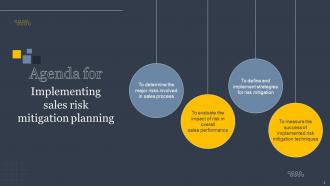
Slide 2: This slide depicts the Agenda of the presentation.
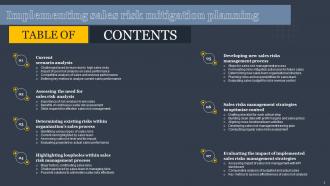
Slide 3: This slide includes the Table Of Contents.
Slide 4: This slide highlights the Title for the Topics to be covered further.
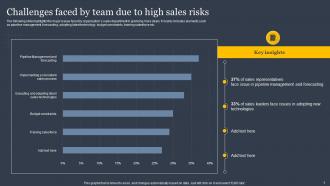
Slide 5: This slide showcases the major issues faced by organization’s sales department in grabbing more deals.
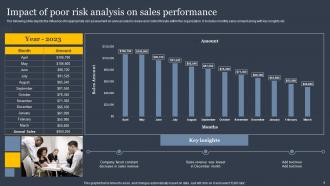
Slide 6: This slide depicts the influence of inappropriate risk assessment on annual sales to review and control threats within the organization.
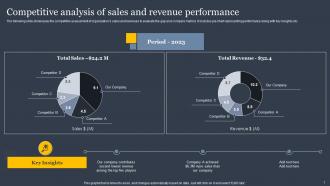
Slide 7: This slide portrays the competitive assessment of organization’s sales and revenues to evaluate the gap and compare metrics.
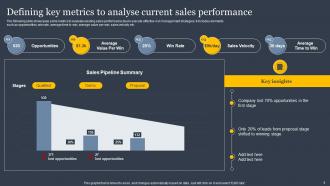
Slide 8: This slide showcases some metrics to evaluate existing sales performance due to execute effective risk management strategies.
Slide 9: This slide displays the Heading for the Contents to be discussed next.
Slide 10: The following slide covers the significance of sales risk assessment to determine and validate its need.
Slide 11: This slide highlights the advantages of sales risk analysis to integrate and implement process effectively.
Slide 12: This slide exhibits the Skills required for effective sales risk management.
Slide 13: This slide mentions about the Title for the Ideas to be covered further.
Slide 14: This slide illustrates multiple sales risks to highlight the major issues faced by the organization for formulate future response plan accordingly.
Slide 15: This slide depicts the existing issue pointed by sales department (strategic risk) to counter contributing factors.
Slide 16: This slide focuses on Assessing sales risks level and its impact.
Slide 17: This slide depicts the evaluation of existing sales performance to set future standards and determine opportunities for improvement.
Slide 18: This slide indicates the Heading for the Ideas to be discussed in the following template.
Slide 19: The following slide depicts some key drivers that elevate sales risks to define its scope and impact.
Slide 20: This slide showcases various problems countered by sales representatives to optimize results and target fulfillment.
Slide 21: This slide illustrates best solutions to manage sales risks to plan proactively for lost deals.
Slide 22: This slide depicts the Title for the Contents to be covered in the forthcoming template.
Slide 23: This slide illustrates some steps to optimize sales risk administration process improving organization’s overall financial performance.
Slide 24: This slide focuses on Formulating risks mitigation action plan for future sales.
Slide 25: This slide deals with Determining new sales team organizational structure.
Slide 26: This slide showcases the new roles and responsibilities of sales department to reduce ambiguity and ensure task clarity.
Slide 27: This slide depicts the projected five year sales revenue budget to evaluate company’s future performance.
Slide 28: This slide contains the Heading for the Topics to be discussed in the upcoming template.
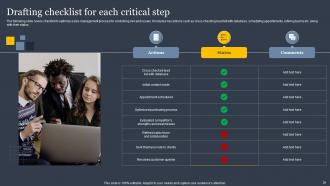
Slide 29: The following slide covers checklist to optimize sales management process for controlling risk and issues.
Slide 30: The following slide illustrates the steps to organize and maintain clean data for improved customer relationship management.
Slide 31: This slide reveals some tips to streamline cross-functional sales and marketing team activities to minimize miscommunication and future risks.
Slide 32: This slide depicts an employee training plan for sales risk management to prepare them with required skills and responsibilities.
Slide 33: This slide showcases the sales risk assessment grid to evaluate the impact and likelihood of sales risks.
Slide 34: This slide indicates the Title for the Contents to be covered in the forthcoming template.
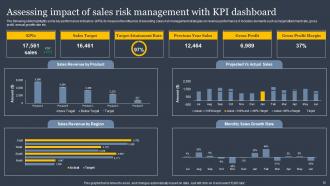
Slide 35: This slide focuses on Assessing impact of sales risk management with KPI dashboard.
Slide 36: This slide illustrates the Comparative analysis of budgeted and actual sales.
Slide 37: This slide highlights some key performance indicators to measure the effectiveness of sales risk evaluation on revenue performance.
Slide 38: This is the Icons slide containing all the Icons used in the plan.
Slide 39: This slide is used for depicting some Additional information.
Slide 40: This slide states the Steps to conduct sales risks assessment.
Slide 41: This slide indicates the Steps to draft sales team training plan.
Slide 42: This slide portrays the Sales risk log register with possible actions.
Slide 43: This slide showcases the SWOT analysis.
Slide 44: This is our Target slide. State your company-targets here.
Slide 45: This slide represents the Timeline process.
Slide 46: This is the About us slide. State your company-related information here.
Slide 47: This slide incorporates the firm's vision, mission & goal.
Slide 48: This slide displays the Roadmap.
Slide 49: This is the Thank You slide for acknowledgement.
Implementing Sales Risk Mitigation Planning Powerpoint Presentation Slides V with all 54 slides:
Use our Implementing Sales Risk Mitigation Planning Powerpoint Presentation Slides V to effectively help you save your valuable time. They are readymade to fit into any presentation structure.















FAQs for Implementing Sales Risk Mitigation Planning Powerpoint
Key components of an effective sales risk mitigation plan include comprehensive risk assessment frameworks, diversified revenue streams, robust pipeline management systems, customer retention strategies, and contingency response protocols. These elements work together by identifying potential threats early, reducing dependency on single revenue sources, and maintaining operational flexibility, with many organizations finding that strategic risk planning ultimately delivers improved forecast accuracy and sustainable growth momentum.
Businesses can identify potential risks in their sales processes through comprehensive pipeline analysis, customer segmentation reviews, competitive landscape assessments, and forecasting accuracy evaluations. These analytical approaches enable organizations to pinpoint vulnerabilities like customer concentration, market volatility, and process bottlenecks, ultimately delivering enhanced predictability and strategic resilience across diverse sales environments.
Data analysis plays a central role in sales risk mitigation by identifying patterns, predicting potential losses, forecasting market fluctuations, and enabling proactive decision-making across customer segments. Through predictive analytics and historical data modeling, organizations streamline risk assessment processes, enhance customer targeting accuracy, and optimize resource allocation, with many financial services and retail companies finding that data-driven approaches ultimately deliver faster response times and significantly improved sales outcomes.
Companies balance aggressive sales targets with risk management by implementing tiered approval processes, diversifying customer portfolios, establishing credit limits, and using predictive analytics to assess prospect viability. Through strategic risk assessment frameworks, organizations can pursue ambitious goals while maintaining quality standards, with many sales teams finding that disciplined qualification processes actually accelerate revenue growth by focusing efforts on higher-probability opportunities.
Sales risk assessment relies on CRM analytics, predictive modeling, pipeline analysis, competitor intelligence platforms, and financial forecasting tools to identify potential threats. These methodologies work by analyzing historical data, market trends, and customer behavior patterns, with many organizations finding that combining quantitative metrics with qualitative assessments delivers comprehensive risk visibility and strategic competitive advantage.
Sales risk mitigation plans should be reviewed quarterly and updated whenever significant market changes, new competitors, or internal restructuring occurs. This regular cadence enables organizations to adapt strategies proactively, address emerging threats like economic shifts or customer behavior changes, and maintain competitive positioning, with many sales teams finding that consistent reviews ultimately deliver improved forecast accuracy and sustained revenue growth.
Common pitfalls include inadequate risk assessment, lack of cross-departmental coordination, over-reliance on historical data, insufficient contingency planning, and poor communication of mitigation strategies across sales teams. These challenges often result from rushed implementation timelines, limited stakeholder buy-in, and failure to regularly update risk parameters, with many organizations finding that successful mitigation requires ongoing refinement and comprehensive training to deliver sustainable results.
Sales teams can be trained through scenario-based simulations, risk assessment frameworks, regular coaching sessions, and real-time monitoring tools that help identify warning signs early. These training approaches enhance decision-making by developing pattern recognition skills, establishing clear escalation protocols, and creating feedback loops, with many organizations finding that proactive risk training ultimately delivers faster deal resolution and improved sales performance.
Customer feedback contributes to sales risk mitigation by identifying potential objections, revealing market perception gaps, highlighting competitive weaknesses, and uncovering product-market fit issues before they escalate. Through systematic feedback analysis, sales teams can proactively adjust messaging, refine value propositions, and address concerns early in the pipeline, ultimately reducing deal losses and increasing conversion rates.
Cross-departmental collaboration enhances sales risk planning by integrating diverse perspectives from finance, operations, marketing, and customer service, creating comprehensive risk assessments that address market volatility, operational constraints, and customer behavior patterns. This strategic combination enables organizations to develop more robust mitigation strategies, streamline resource allocation, and respond faster to emerging threats, with many companies finding that collaborative planning reduces revenue losses by 25-40%.
Key metrics include conversion rate changes, deal velocity improvements, pipeline quality scores, customer acquisition costs, and revenue predictability indicators. These measurements enable sales teams to track risk reduction effectiveness across different stages, with many organizations finding that combining leading indicators like pipeline health with lagging indicators like closed-won rates delivers comprehensive visibility into mitigation strategy performance.
CRM systems assist in sales risk mitigation by centralizing customer data, tracking sales pipeline health, automating risk alerts, and providing predictive analytics to identify potential deal failures or customer churn patterns. These technologies enable sales teams to proactively address account vulnerabilities, optimize resource allocation, and maintain consistent follow-up protocols, ultimately delivering improved forecasting accuracy and higher conversion rates.
Customer relationship management directly supports sales risk mitigation by providing comprehensive customer data, transaction histories, and behavioral analytics that enable early identification of potential account risks, payment issues, and churn indicators. Through CRM systems, sales teams can monitor client engagement patterns, track payment behaviors, and implement targeted retention strategies, while simultaneously building stronger relationships that reduce the likelihood of contract cancellations, ultimately delivering improved forecast accuracy and revenue stability.
Scenario planning enables sales teams to identify potential risks by modeling various market conditions, competitive threats, customer behavior changes, and economic fluctuations that could impact revenue targets. Through systematic analysis of best-case, worst-case, and most-likely scenarios, organizations develop contingency plans, diversify sales channels, and allocate resources strategically, ultimately delivering greater resilience and maintaining competitive advantage during market uncertainties.
Companies can foster proactive sales risk management through regular training programs, cross-functional collaboration between sales and risk teams, implementing early warning systems, and establishing clear accountability frameworks with defined risk ownership. Many organizations find success by integrating risk assessments into sales processes, rewarding proactive risk identification, and creating open communication channels, ultimately delivering improved forecast accuracy and sustained revenue growth.
-
I want to thank SlideTeam for the work that they do, especially their customer service.
-
My search for complete decks ended with SlideTeam. Such a surplus collection of HD PowerPoints. Moreover, their standard and widescreen formats have helped me in delivering bullseye presentations.