

Industrial Robot Powerpoint Ppt Template Bundles





Try Before you Buy Download Free Sample Product
 Impress Your
Audience
 100%
Editable
 Save Hours
of Time


Our Industrial Robot Powerpoint Ppt Template Bundles are topically designed to provide an attractive backdrop to any subject. Use them to look like a presentation pro.
People who downloaded this PowerPoint presentation also viewed the following :
Industrial Robot Powerpoint Ppt Template Bundles with all 19 slides:
Use our Industrial Robot Powerpoint Ppt Template Bundles to effectively help you save your valuable time. They are readymade to fit into any presentation structure.









FAQs for Industrial Robot Powerpoint
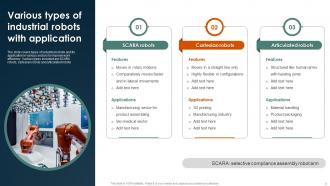
So there's a bunch of different types, but here's what you'll actually run into: articulated robots are basically robot arms with joints - they're everywhere in manufacturing for welding and assembly stuff. SCARA robots are crazy fast at horizontal movements, perfect for electronics work. Then you've got cartesian robots that just move in straight lines, great for 3D printing and heavy lifting. Delta robots are honestly impressive - they're lightning quick at pick-and-place tasks, which is why food packaging companies love them. There's also cylindrical robots but they're kind of old school now. Figure out what movements you need first, that'll narrow it down fast.
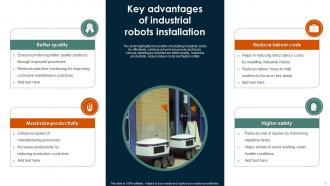
Honestly, robots are pretty game-changing for production. They'll run all day and night without getting tired or calling in sick - which is kind of wild when you think about it. Quality stays super consistent too since they do the exact same motions every time. No more human slip-ups or material waste from mistakes. Your workers can skip the dangerous stuff and focus on actual problem-solving instead. Speed-wise, they crush repetitive tasks way faster than people. If you're thinking about it, I'd look at whatever processes you do most often first - that's where you'll see the biggest impact.
So AI is basically giving robots a major brain boost. They don't just follow the same programmed steps anymore - now they adapt on the spot and learn from data. Machine learning is probably the coolest part since robots keep getting better at their jobs automatically. You've got predictive maintenance, computer vision for quality checks, and collaborative bots that won't accidentally crush you (thankfully). Pretty crazy how much smarter they've gotten. If you're thinking about upgrading, look for those boring repetitive tasks first - that's where adaptive robots really shine.
Honestly, robots are a game-changer for small businesses now. They'll boost your productivity and quality while cutting labor costs long-term. No more worrying about sick days or breaks either - though that sounds kinda dystopian when I say it out loud lol. The real win is competing with bigger companies since robots standardize everything and kill human error. Plus they're way cheaper and easier to program than like 5 years ago. Your team can ditch the boring repetitive stuff and do more meaningful work instead. I'd start by picking one tedious process that's driving everyone crazy - that's where you'll see the best return on investment.
Safety barriers and light curtains are absolutely critical - don't skimp on those. Emergency stops need to be everywhere operators can reach them quickly. Lockout/tagout during maintenance, obviously. Training your people is probably the most important thing though, they've gotta understand how these robots move and when it's safe to enter the work area. Oh and always slow down the speed in teach mode. PPE goes without saying. I've seen too many close calls when people get comfortable around these machines. Just stick to your safety protocols religiously.
Yeah, robots are definitely changing manufacturing but it's not like they're just wiping out all the jobs. More like they're shifting what kind of work people do. Sure, some assembly line stuff disappears, but then you need way more techs for programming and maintenance. The skills gap thing happened crazy fast too - my cousin works at a plant and they're scrambling to find people who know this stuff. Most workers just need retraining rather than losing their jobs completely. Honestly, if you're thinking about staying in manufacturing, I'd jump on some automation courses now before everyone else catches on.
Honestly, compatibility issues are gonna be your worst nightmare - old equipment never wants to talk to new robots properly. Your workflow's gonna get totally disrupted too. Space becomes a huge problem since you'll need to redesign everything for safety requirements. Plus your whole team needs retraining, which takes forever. Production basically stops during integration if you're not careful about planning. I'd definitely start small though - pick one tiny section for a pilot instead of going crazy and trying to automate everything. Way less stressful that way.
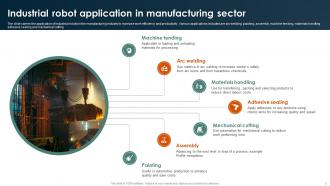
So basically every industry just figures out what sucks most about their work and throws robots at it. Car companies use them for the heavy stuff - welding, painting, assembly lines where speed actually matters. Electronics is all tiny precise work, so they've got these delicate little robots placing components on circuit boards. Pharma's wild though - they use robots in those crazy sterile rooms for packaging drugs and handling dangerous chemicals since humans would just contaminate everything. Honestly, if you're thinking about this for work, just look at whatever tasks make people want to quit first.
Yeah, robots are actually pretty good for the environment overall. They use way less energy and materials since they don't mess up like humans do - fewer defective parts means less waste. Plus they can run in dark facilities which saves tons on lighting costs. The manufacturing footprint is kinda hefty upfront, but honestly that usually balances out after 2-3 years of operation. When you're looking at models, just go for the energy-efficient ones. The waste reduction alone makes a solid business case, though I'd still factor in those long-term savings when you're pitching it.
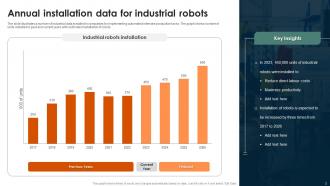
So you'll want to track your upfront costs - robot price, setup, training staff - against the actual savings you get. Think reduced labor, fewer screwups, higher output. Robots are weirdly reliable compared to humans (no sick days or smoke breaks). Most places break even within 1-3 years, honestly depends on what you're automating. Don't forget the softer benefits too - safer workplace, your team can focus on better work instead of repetitive stuff. My advice? Figure out what's driving you crazy first, then build your numbers around fixing that specific problem.
Dude, you've gotta watch AI integration - robots are getting crazy good at adapting on the fly. Cobots are huge too since they can work right next to people without safety cages everywhere. 5G connectivity is honestly nuts, and edge computing means decisions happen instantly on the floor instead of waiting for cloud processing. Oh, and programming interfaces are way easier now - your regular operators can handle setup without being coding wizards. Predictive maintenance is saving companies tons since nobody wants surprise downtime costs. Trade shows would be perfect for seeing this stuff live, by the way.
Dude, seriously - take care of your robot and it'll last 15-20 years instead of dying at 8-10. Daily checks are clutch. Weekly deep cleaning too, depending on how hard you're running it. Monthly calibrations if it's getting heavy use. I swear, lubrication and component inspections save you from those nightmare repair bills later. You know how expensive those emergency fixes get. My buddy at the warehouse learned this the hard way - skipped maintenance for months and ended up replacing half the damn thing. Keep a maintenance log and actually use it. Small problems become huge ones fast if you ignore them.
Safety training first, obviously - emergency stops, lockout procedures, all that stuff. Your people need to get how to actually work WITH the robot instead of just staying out of its way. Way too many companies rush through this part and then act surprised when things go sideways. Throw in some troubleshooting basics and maintenance tasks too. Honestly, the repetition thing is huge - one training session won't cut it. You'll want regular refreshers, maybe pair up newbies with someone who's been doing it for a while. That mentor approach works way better than just lecturing people.
Dude, cobots are changing everything for smaller manufacturers who could never afford regular robots. They work right next to people without all those crazy safety cages. Super easy to reprogram too - your maintenance guys won't hate you for it. The flexibility is insane compared to old-school automation that just focused on speed. Market's exploding right now, which honestly makes sense given how desperate everyone is for workers. If you're dealing with labor shortages, definitely look into them. Way less intimidating than I thought they'd be.
Honestly, vision systems are where it's at right now - 3D cameras and force sensors that let robots actually see what they're doing. The AI side is pretty wild too, machine learning means they can adapt instead of just running the same program forever. Oh, and cobots are huge now since they don't need those giant safety cages anymore. Your team can literally work right next to them. I'd probably start with vision if you're upgrading - best bang for your buck on quality control stuff. The whole tactile feedback thing makes them way safer around people too.
-
Use of different colors is good. It's simple and attractive.
-
Amazing variety of PowerPoint slides. Really helpful in designing professional presentations.