

Information Security Program Framework Key Components Risk Based Methodology To Cyber




Try Before you Buy Download Free Sample Product
 Impress Your
Audience
 100%
Editable
 Save Hours
of Time


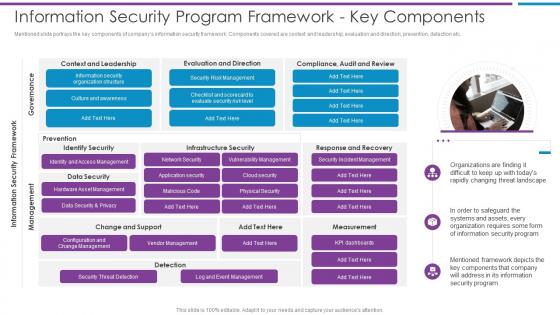
Mentioned slide portrays the key components of companys information security framework. Components covered are context and leadership, evaluation and direction, prevention, detection etc.
People who downloaded this PowerPoint presentation also viewed the following :
Information Security Program Framework Key Components Risk Based Methodology To Cyber with all 6 slides:
Use our Information Security Program Framework Key Components Risk Based Methodology To Cyber to effectively help you save your valuable time. They are readymade to fit into any presentation structure.






FAQs for Information Security Program Framework Key Components Risk Based
Key components of an effective information security framework include risk assessment protocols, access controls, data encryption standards, incident response procedures, and compliance monitoring systems. These elements work together by identifying vulnerabilities, restricting unauthorized access, and ensuring regulatory adherence, with many organizations finding that this comprehensive approach ultimately delivers enhanced operational security and competitive advantage.
Organizations can assess their current information security posture through comprehensive security audits, vulnerability assessments, penetration testing, compliance gap analyses, and risk evaluations across all systems and processes. These assessments enable businesses to identify vulnerabilities, evaluate existing controls, and benchmark against industry standards, with many enterprises finding that thorough baseline assessments streamline framework implementation while maximizing security investments.
Risk management serves as the foundational cornerstone of information security framework development, guiding threat assessment, vulnerability identification, control implementation, and resource allocation decisions. Through systematic risk analysis, organizations can prioritize security investments, establish appropriate safeguards, and create balanced protection strategies that align with business objectives, ultimately delivering cost-effective security postures.
Regulatory compliance requirements fundamentally shape information security frameworks by mandating specific controls, audit trails, data protection standards, and incident response protocols. Organizations in healthcare, finance, and retail must align their frameworks with regulations like HIPAA, SOX, and PCI-DSS, ultimately delivering enhanced security posture while avoiding costly penalties and maintaining customer trust.
Organizations face challenges including resource constraints, cultural resistance to change, complex compliance requirements, skills gaps, and integration with existing systems. While implementing frameworks like ISO 27001 or NIST requires significant investment in training and technology, many enterprises find that these standardized approaches ultimately streamline security operations, enhance regulatory compliance, and deliver competitive advantages through improved risk management and stakeholder confidence.
A layered defense strategy enhances information security frameworks by implementing multiple, complementary security controls across network perimeters, endpoints, applications, and data storage systems. This approach ensures that if one security layer fails, additional barriers protect critical assets, with many financial institutions and healthcare organizations finding that redundant security measures significantly reduce breach risks while maintaining operational continuity.
Organizations should evaluate their information security framework using metrics like incident response time, security awareness training completion rates, vulnerability remediation speed, compliance audit scores, and mean time to detection. These metrics enable businesses to measure operational efficiency, regulatory adherence, and risk reduction across departments, with many finding that regular assessment ultimately delivers improved threat resilience and competitive advantage.
Emerging technologies like AI and IoT are fundamentally reshaping information security frameworks by introducing new attack vectors, requiring adaptive threat detection, and demanding real-time response capabilities. These frameworks now incorporate machine learning-driven monitoring, zero-trust architectures, and automated incident response, with organizations in healthcare, manufacturing, and financial services finding that proactive, AI-enhanced security delivers faster threat mitigation and stronger operational resilience.
Employee training and awareness can be incorporated through regular security workshops, phishing simulation exercises, role-based access training, incident response drills, and policy update sessions. These programs enhance organizational resilience by reducing human error risks, improving threat detection capabilities, and fostering a security-conscious culture, with many companies finding that well-trained employees become their strongest defense against cyberattacks.
Strategies include regular security assessments, threat intelligence integration, employee training programs, incident response reviews, and performance metrics monitoring. Through automated vulnerability scanning and penetration testing, organizations streamline risk identification, enhance policy effectiveness, and accelerate threat detection, with many financial institutions and healthcare providers finding that continuous monitoring ultimately delivers stronger compliance and competitive advantage.
Organizations balance security with operational efficiency by implementing risk-based approaches, automated security controls, and integrated workflows that embed protection into daily operations rather than creating separate processes. Through strategic layering of technologies like single sign-on, automated compliance monitoring, and intelligent threat detection, companies streamline security management while maintaining robust protection, ultimately delivering faster user experiences and reduced administrative overhead.
Incident response plans should include clear escalation procedures, defined roles and responsibilities, communication protocols, evidence preservation methods, and recovery timelines. These guidelines ensure organizations can quickly contain breaches, minimize operational disruption, and restore normal operations, with many financial institutions and healthcare providers finding that structured response frameworks reduce incident resolution time by 40-60% while maintaining regulatory compliance.
Organizations ensure third-party vendor compliance through comprehensive security assessments, contractual security requirements, regular audits, and continuous monitoring of vendor practices. These measures include due diligence evaluations, mandatory security certifications, and performance reviews, with many enterprises finding that strategic vendor partnerships ultimately deliver enhanced security posture and reduced operational risk.
Integrating business continuity planning with information security frameworks ensures organizations can maintain critical operations during cyber incidents, data breaches, and system failures while protecting sensitive assets. This strategic combination enables faster recovery times, minimizes financial losses, and maintains customer trust, with many financial services and healthcare institutions finding that coordinated planning delivers both operational resilience and regulatory compliance.
Industries customize their information security frameworks by prioritizing sector-specific threats, regulatory requirements, and operational vulnerabilities through targeted controls and monitoring systems. Financial services emphasize fraud detection and transaction security, healthcare focuses on patient data protection and HIPAA compliance, while manufacturing prioritizes operational technology safeguards and supply chain security, ultimately delivering industry-appropriate risk mitigation.
-
Placing an order on SlideTeam is very simple and convenient, saves you a lot of your time.
-
The slides are remarkable with creative designs and interesting information. I am pleased to see how functional and adaptive the design is. Would highly recommend this purchase!