


Risk Management KPI Dashboard With Risk Based Methodology To Cyber




Try Before you Buy Download Free Sample Product
 Impress Your
 Audience
 100%
100% Editable
 Save Hours
 of Time


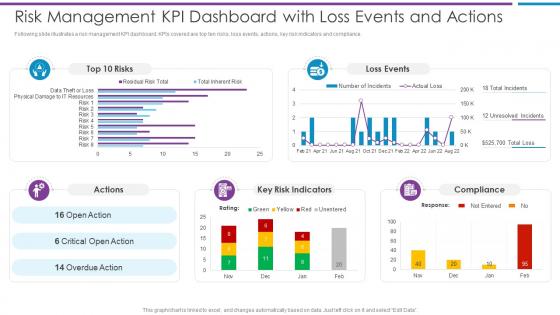
Following slide illustrates a risk management KPI dashboard. KPIs covered are top ten risks, loss events, actions, key risk indicators and compliance.
People who downloaded this PowerPoint presentation also viewed the following :
Risk Management KPI Dashboard With Risk Based Methodology To Cyber with all 7 slides:
Use our Risk Management KPI Dashboard With Risk Based Methodology To Cyber to effectively help you save your valuable time. They are readymade to fit into any presentation structure.





FAQs for Risk Management KPI Dashboard With Risk Based
Cybersecurity risk management dashboards should include incident response time, threat detection rate, vulnerability remediation time, security awareness training completion, and mean time to recovery. These KPIs enable organizations to monitor security posture by tracking threat landscape changes, measuring defensive effectiveness, and ensuring compliance requirements, with many financial services and healthcare institutions finding that comprehensive dashboards ultimately enhance operational resilience and regulatory compliance.
Organizations measure cybersecurity risk mitigation effectiveness through KPIs including incident response times, threat detection rates, vulnerability remediation speed, security awareness training completion, and mean time to recovery. These metrics enable businesses to track security posture improvements, identify operational gaps, and demonstrate ROI on security investments, with many financial institutions and healthcare organizations finding that comprehensive KPI dashboards ultimately deliver enhanced threat visibility and strategic risk reduction.
Real-time data transforms cybersecurity KPI dashboards by enabling immediate threat detection, instant incident response, continuous vulnerability monitoring, and dynamic risk assessment across network infrastructures. Through live data feeds, security teams can identify breach attempts within minutes, automatically trigger containment protocols, and adjust defensive strategies instantly, ultimately delivering faster threat mitigation and significantly enhanced organizational security posture.
KPI dashboards enable businesses to prioritize cybersecurity risks by providing real-time visibility into threat severity, vulnerability scores, incident response times, and compliance status across all systems. Through automated risk scoring and visual heat maps, organizations can strategically allocate resources to the most critical threats first, while tracking remediation progress, ultimately enhancing their security posture and minimizing potential business disruptions.
**INPUT**: Which metrics indicate the level of employee awareness and training effectiveness in cybersecurity? **OUTPUT**: Key metrics include training completion rates, phishing simulation click rates, security incident reporting frequency, policy compliance scores, and time-to-detection for social engineering attempts. These indicators help organizations assess employee preparedness by measuring behavioral changes, knowledge retention, and proactive threat identification, with many companies finding that regular assessment cycles ultimately enhance their human firewall effectiveness and reduce security vulnerabilities.
Common pitfalls include tracking too many metrics without strategic focus, measuring vanity metrics that don't reflect actual security posture, creating dashboards that lack real-time data integration, and failing to align KPIs with business objectives. These challenges often result in information overload and poor decision-making, with many organizations finding that successful dashboards prioritize actionable intelligence over comprehensive data collection, ultimately delivering clearer threat visibility and faster incident response capabilities.
Cybersecurity KPIs should be reviewed monthly for operational metrics and quarterly for strategic indicators, with immediate updates following security incidents, regulatory changes, or threat landscape shifts. This frequency enables organizations to maintain current threat awareness, adjust security postures dynamically, and ensure dashboards reflect evolving attack patterns, ultimately delivering proactive defense capabilities and regulatory compliance.
Visualizing cybersecurity KPIs in dashboards delivers enhanced situational awareness, faster incident response, simplified compliance reporting, improved resource allocation, and strengthened stakeholder communication across organizations. These visual frameworks enable security teams to identify threats more quickly, demonstrate ROI to executives, and streamline regulatory audits, with many enterprises finding that centralized KPI visualization ultimately reduces response times and enhances strategic cybersecurity decision-making.
A cybersecurity KPI dashboard integrates with existing risk management frameworks by aligning security metrics with organizational risk appetite, automating data feeds from SIEM systems, and mapping vulnerabilities to business impact assessments. Through real-time integration, organizations streamline threat visibility, enhance compliance reporting, and accelerate incident response workflows, ultimately delivering unified risk oversight and enabling proactive security posturing across enterprise operations.
Organizations should select cybersecurity KPIs based on their specific risk profile, regulatory requirements, business objectives, threat landscape, and available resources for monitoring and response. These criteria enable tailored dashboards that align with organizational priorities, with financial services focusing on fraud detection metrics while healthcare emphasizes patient data protection indicators, ultimately delivering actionable insights and strategic security advantage.
Organizations ensure KPI dashboard alignment through strategic mapping of cybersecurity metrics to business goals, regulatory compliance frameworks, and risk tolerance levels established by executive leadership. Regular stakeholder consultations with legal, compliance, and business units help validate that dashboards track meaningful indicators like incident response times, regulatory audit outcomes, and business continuity metrics, ultimately delivering transparency that supports both operational decisions and compliance reporting requirements.
**INPUT**: What tools and technologies are best suited for developing a comprehensive cybersecurity KPI dashboard? **OUTPUT**: Leading cybersecurity dashboard tools include Splunk, IBM QRadar, Microsoft Power BI, Tableau, and LogRhythm, which integrate seamlessly with SIEM platforms, threat intelligence feeds, and network monitoring systems. These technologies enable organizations to streamline incident response, automate threat detection, and enhance visibility across their security infrastructure, with many financial services and healthcare institutions finding that real-time KPI monitoring ultimately delivers faster remediation and stronger regulatory compliance.
Organizations balance quantitative and qualitative cybersecurity KPIs by combining measurable metrics like incident response times, vulnerability counts, and system uptime with subjective assessments including threat landscape analysis, employee security awareness, and vendor risk evaluations. This strategic combination enables comprehensive risk visibility, with many financial institutions and healthcare organizations finding that blending both approaches delivers more accurate threat assessments and informed decision-making.
Incident response time serves as a critical cybersecurity KPI that measures how quickly organizations detect, contain, and resolve security threats, directly impacting potential damage and recovery costs. This metric enables security teams to streamline response protocols, minimize system downtime, and reduce data exposure, with many financial institutions and healthcare organizations finding that faster response times ultimately deliver enhanced customer trust and regulatory compliance.
Cybersecurity KPIs inform long-term strategic planning by revealing threat patterns, vulnerability trends, and resource allocation effectiveness across organizational systems. These metrics enable executives to prioritize security investments, anticipate emerging risks, and align defensive strategies with business growth objectives, with many enterprises finding that data-driven insights ultimately deliver stronger resilience and competitive advantage.
-
Colors used are bright and distinctive.
-
Great product with effective design. Helped a lot in our corporate presentations. Easy to edit and stunning visuals.