

Risk Management Kpi Dashboard Showing Risk Distribution By Country Office




Try Before you Buy Download Free Sample Product
 Impress Your
 Audience
 100%
100% Editable
 Save Hours
 of Time


Expose the essential excellence with our Risk Management Kpi Dashboard Showing Risk Distribution By Country Office And Business Process. Take folks behind the glass and concrete.
People who downloaded this PowerPoint presentation also viewed the following :
Content of this Powerpoint Presentation
Description:
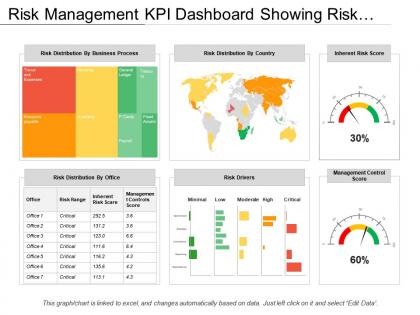
This image presents a detailed Risk Management KPI (Key Performance Indicator) Dashboard with various elements that monitor and analyze risk across different facets of a business.
1. Risk Distribution By Business Process:
This element uses a color-coded bar chart to represent risk levels associated with different business processes such as Travel and Expenses, Revenue, Accounts Payable, etc.
2. Risk Distribution By Country:
Depicted on a world map, it highlights countries in different colors, presumably corresponding to their risk levels, providing a geographic risk assessment.
3. Inherent Risk Score:
This gauge illustrates the overall risk score (shown here as 30%), indicating a low-to-moderate inherent risk within the organization.
4. Risk Distribution By Office:
This element shows a table listing various office locations with their respective Risk Range (all marked as 'Critical'), Inherent Risk Score, and Management Controls Score.
5. Risk Drivers:
It further breaks down risk by type and severity, categorized as Minimal, Low, Moderate, High, and Critical. This seems to analyze operational, compliance, financial, or reporting risks through a series of color-coded bars, with longer bars representing a higher number of risks.
6. Management Control Score:
This gauge displays the effectiveness of management controls in mitigating risk, scored at 60%, suggesting a moderately high level of control.
Use Cases:
This dashboard is adaptable and could be utilized in a variety of industries for performance monitoring and risk management purposes.
1. Banking:
Use: To assess and monitor financial and compliance risks across global operations.
Presenter: Risk Management Officer.
Audience: Executive Management Team.
2. Healthcare:
Use: To track patient safety and regulatory compliance risks.
Presenter: Healthcare Administrator.
Audience: Hospital Board Members.
3. Information Technology:
Use: To evaluate cybersecurity and data breach risks.
Presenter: Chief Information Security Officer.
Audience: IT Department Heads.
4. Manufacturing:
Use: To oversee operational risk and product quality across different facilities.
Presenter: Quality Assurance Manager.
Audience: Production Managers.
5. Retail:
Use: To examine supply chain and inventory risks, along with various store locations.
Presenter: Supply Chain Director.
Audience: Store Operations Managers.
6. Energy:
Use: To manage environmental and health & safety risks in operative sites.
Presenter: Environmental Health and Safety Officer.
Audience: Site Managers.
7. Insurance:
Use: To assess underwriting risks and control effectiveness in policies.
Presenter: Chief Actuary.
Audience: Underwriting Department Staff.
Risk Management Kpi Dashboard Showing Risk Distribution By Country Office with all 6 slides:
Institute carefree celebrations with our Risk Management Kpi Dashboard Showing Risk Distribution By Country Office And Business Process. Create an atmosphere of joie-de-vivre.

FAQs for Risk Management Kpi Dashboard Showing Risk Distribution
So basically you want four main things: figuring out what could go wrong, ranking how bad each thing would be, making plans to deal with the worst stuff, and checking back regularly. I'd start by listing out everything that keeps you up at night - money problems, operations failing, big picture strategy stuff. Rate each one on how likely it is and how much it'd hurt. Honestly, most people overthink this part. Focus your energy on building actual plans for your biggest 5-10 risks. Could be insurance, backup systems, whatever fits. Then just review it every few months since things change.
Honestly, just get your team together and brainstorm what could blow up. Go through each phase and ask "what if this goes wrong?" I'm obsessed with doing pre-mortems - basically pretend your project already crashed and figure out why. Way more useful than you'd think. Look at your old projects too, see what went sideways before. Don't forget to bug your stakeholders about their worries. External stuff matters - regulations, market changes, whatever. Being thorough now beats scrambling later when everything's on fire.
Look, stakeholder communication is huge for risk management - you literally can't get anything done without their buy-in. Different people need different info though. Executives want the big picture stuff like costs and business impact, while your operational teams need the nitty-gritty action plans. The thing is, stakeholders often catch risks you totally missed because they're in the trenches of their departments. Set up regular check-ins (don't wait for disasters). Keep everyone looped in on what could go wrong and how you'll handle it. They'll give you the resources and support you need when things actually hit the fan.
So basically, quantitative risk assessment is all about the numbers - you're calculating exact percentages and dollar amounts, like "15% chance we lose $50K." Qualitative is more like rating things as high/medium/low risk or using colors. Way less precise but honestly easier when you don't have tons of data to work with. Most people I know mix both approaches. You start broad with the qualitative stuff to spot your biggest problems, then get into the weeds with actual calculations for the risks that really matter. Makes sense since sometimes you just can't put a number on everything, you know?
Honestly depends what you're trying to fix. Monte Carlo tools like @RISK are pretty sweet for modeling uncertainty - way better than basic Excel. ServiceNow and MetricStream work great for big companies but they're probably overkill if you're on a small team. Sometimes just beefing up your spreadsheet game with decent risk matrices does the trick. Oh, and RiskyProject plays nice with other tools if you're doing project stuff mostly. I'd figure out what's actually driving you crazy first, then find something that fixes that specific mess instead of buying the fanciest thing out there.
Honestly, you've got to get everyone thinking about risk, not just the compliance folks. Leadership needs to actually talk about their screw-ups - sounds weird but it works. Regular training helps people spot problems in their day-to-day stuff. But here's the thing - you have to actually listen when they bring up concerns. I've watched companies where people just stopped talking because management ignored them anyway. Set up easy ways for people to report issues and celebrate the ones who speak up. The whole point is making risk-spotting feel rewarding instead of scary.
Honestly, most people way overthink this stuff. They build these crazy complex frameworks that just collect dust when actual problems hit. Classic mistake is obsessing over obvious risks while totally missing the random stuff - we once had our whole system crash because of a leap year bug, which nobody saw coming. Keep your risk assessments dead simple and review them every few months. Don't just tick boxes either. Actually think through what could realistically blow up in *your* specific setup. The weird edge cases are usually what get you, not the textbook scenarios everyone prepares for.
So I'd start with a risk matrix - just plot each risk on a simple grid showing likelihood vs impact. Attack the high probability, high impact stuff first. Then move down to high impact/low probability, followed by the low impact/high probability ones. The hard part is defining what "high impact" actually means for your company. Could be money, reputation hits, operations getting screwed up - basically whatever your bosses worry about most. Get people from different departments to help score these since they'll catch things you'd totally miss. Maybe start small and just rank your top 10 risks this week?
So a risk register is where you track everything that might mess up your project. Document each risk, figure out how likely it is and what damage it'd cause, then assign someone to own it and plan how to deal with it. The trick is actually maintaining the thing - I swear, most people create them and then completely forget they exist. Keep updating it in your regular meetings, add new risks when they pop up, and make sure your team actually looks at it when making decisions. Otherwise you're just doing paperwork for the sake of paperwork, which honestly drives me crazy.
Honestly, the new tech stuff can really change how you handle risks. AI algorithms are crazy good at spotting weird patterns - like fraud detection that catches sketches in real-time. IoT sensors let you monitor equipment and conditions 24/7 without thinking about it. Blockchain actually helps with keeping data clean and creating audit trails (yeah, I know, blockchain gets overhyped but this part's legit). Plus automation can kick in instantly when something hits your danger zones. My advice? Don't go crazy trying everything at once. Just pick one area where you're already tracking data and test how these tools might give you better heads-up warnings.
Honestly, most people treat risk assessments like homework they never have to touch again - big mistake. Set up monthly reviews for your scary risks, quarterly for the rest. Get some alerts going when your key indicators hit warning levels because nobody wants to stare at dashboards all day. Document stuff as it changes (and it will change constantly). Put actual calendar reminders in or you'll forget. Loop in your team for the reviews - they catch things you miss. Oh, and celebrate when risks go down! Sounds cheesy but it keeps people engaged. Start simple with a spreadsheet if fancy tools aren't in budget yet.
Oh, so scenario planning is basically playing out "what if" situations ahead of time. You map out different futures - worst case, best case, whatever's in between - then figure out how you'd actually handle each one. Think of it like those fire drills we used to hate in school, but for business stuff. Honestly, the best part is catching blindspots you didn't even know existed. Your team gets way more creative when they're brainstorming potential disasters. Start with maybe 3 or 4 scenarios that'd really mess with your business, then just workshop responses. Way better than panicking when things actually go sideways.
Figure out which regulations hit your industry first - SOX if you're public, GDPR for data stuff, banking/healthcare have their own mess of rules. Document literally everything because regulators are obsessed with paper trails. Your risk assessments need to cover legal liability, contracts, and whatever reporting you're stuck doing. Insurance requirements matter too, plus litigation risks (ugh). Honestly, just map out what laws actually apply to your business and build around those. Way easier than trying to backwards-engineer compliance later when you're scrambling.
Think of external factors as amplifiers for whatever risks you already have. Economy takes a hit? Suddenly your supply costs go through the roof, customers stop buying, and that business loan gets way more expensive. It's all connected - one shift can mess with everything else you've got going on. I've seen companies get blindsided because they didn't think about how different scenarios would actually play out. You really want to run through some "what if" situations regularly - like what happens if interest rates jump or inflation spikes again. Better to know now than scramble later.
Honestly, good risk management can bump your success rates up by like 20-30% - pretty solid numbers. You'll catch potential problems before they wreck your timeline or budget. I've watched too many projects implode because teams never asked "what could go wrong here?" It's brutal. But here's the thing - it's not just about dodging disasters. You actually find opportunities you'd otherwise miss. My advice? Do a quick risk assessment when you kick off your next project. Update it as you go. Seriously, even a basic one saves so much headache later.
-
Unique and attractive product design.
-
Wonderful templates design to use in business meetings.