


Information Security Program Cybersecurity Kpi Dashboard To Track Security Risk Events




Try Before you Buy Download Free Sample Product
 Impress Your
 Audience
 100%
100% Editable
 Save Hours
 of Time


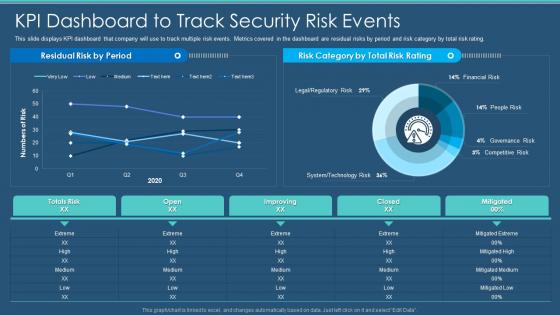
This slide displays KPI dashboard that company will use to track multiple risk events. Metrics covered in the dashboard are residual risks by period and risk category by total risk rating.
People who downloaded this PowerPoint presentation also viewed the following :
Information Security Program Cybersecurity Kpi Dashboard To Track Security Risk Events with all 7 slides:
Use our Information Security Program Cybersecurity Kpi Dashboard To Track Security Risk Events to effectively help you save your valuable time. They are readymade to fit into any presentation structure.





FAQs for Information Security Program Cybersecurity Kpi Dashboard To Track
Start with MTTD and MTTR - basically how fast you catch threats and fix them. Track security incidents by how bad they are, plus how quickly you're patching critical stuff. User training completion rates matter too since people click on literally everything. Failed login attempts are solid indicators of trouble brewing. Oh, and if you're in healthcare or finance, compliance scores will save your butt during audits. Vulnerability assessments should be on there obviously. Don't go crazy though - pick maybe 3 or 4 that match your actual risk areas first.
Look, MTTD and MTTR are your bread and butter here - how fast you catch problems and fix them. Track what percentage of incidents you contain within your target windows too. Most companies get way too fancy with this stuff when honestly, simple works better. Also measure user satisfaction after incidents and count any that lead to fines or breaches (yikes). I'd set monthly goals for each metric, then do quarterly reviews to see what's actually working. Oh, and don't forget tracking escalations - shows if your front-line team's getting overwhelmed.
Honestly, tracking user training metrics might be your best bet for actually improving security. I'd focus on completion rates for training modules and how people perform on phishing tests - like, are they still clicking suspicious links? The reporting speed matters too - how fast do employees flag sketchy emails? Bob in accounting will always be Bob, but you can at least measure if he's getting better at spotting scams. Set some baseline numbers first, then check quarterly. That way you'll know if people are actually learning or just going through the motions. Most breaches still happen because someone clicks the wrong thing.
Look, you'll want to track the obvious stuff first - direct costs like forensics, legal fees, fines, and getting systems back up. Downtime duration matters too, plus whatever revenue you lose during that mess. Customer churn is brutal after breaches - people just bail. Stock price takes a hit if you're public (assuming you're not a tiny startup lol). Media sentiment gets ugly fast, so monitor that. The one metric everyone uses for comparison is cost per compromised record. Honestly, set up dashboards for this stuff now before you actually need them. Last thing you want is scrambling to calculate damage when everything's on fire.
Look at SANS or NIST benchmarks to get started, but honestly those feel pretty cookie-cutter most of the time. Track your own baseline for like 3-6 months first - that's way more useful than some generic standard. Your risk tolerance matters too, plus whatever compliance stuff you're stuck dealing with. Don't just steal another company's targets since your threats are probably totally different anyway. Oh and make sure you've got the resources to actually hit whatever numbers you set. Better to start realistic and improve gradually than set impossible goals that'll just piss everyone off.
Honestly, start with the basics - MTTD and MTTR are your bread and butter metrics. Track how fast you're catching threats and responding to them. Also look at vuln remediation rates and training completion stuff. What really tells the story though? Escalation rates from your frontline people. Shows you if they actually know what they're doing or just panic-forwarding everything upstairs. False positive rates matter too - nobody wants to chase ghosts all day. Don't go crazy with metrics. Pick maybe 4-5 that actually connect to business impact, throw them on a monthly dashboard, and review trends with your leads. Simple.
Honestly, the biggest headache is that all your security tools speak totally different languages. Firewalls, SIEM, vulnerability scanners - they're all throwing data at you in different formats. The data's usually pretty messy too, so you'll spend forever cleaning it up before it's even usable. Getting leadership to agree on which metrics actually matter is another nightmare - half of it ends up being security theater anyway. Oh, and good luck establishing baselines when you don't have any historical data to work with. My advice? Pick 3-5 KPIs that actually move the needle, then build your whole data collection around just those. Way easier than trying to boil the ocean.
Monthly checks work great for the quick stuff like response times. But honestly? Save the deep dives for quarterly reviews - I've watched too many teams exhaust themselves trying to analyze everything weekly. Threats shift constantly, so those metrics from six months ago might be totally useless now. Set reminders for the first week of each quarter to see if your KPIs actually match current risks. The big question is whether these numbers help you make smarter decisions or if you're just hoarding data because it feels productive.
So for GDPR/HIPAA stuff, definitely track your incident response times and how fast you're catching data breaches. Access control compliance percentages are huge too. Failed logins, privileged access reviews, vulnerability patching speed - regulators eat that data up. Don't sleep on employee training completion rates either since people mess up way more than systems do. Track your data retention policy adherence and encryption coverage across everything. Honestly I'd start with maybe 3-4 KPIs that actually match your specific requirements, then build from there once you've got solid baseline numbers to work with.
Honestly, KPIs help you catch security gaps before they blow up into actual breaches. Track things like how fast you detect threats, false positive rates, and response times - that's what shows where your defenses actually work vs. just creating chaos. Pick maybe 3-5 metrics that match your biggest risks and check them weekly. So many teams I know are just drowning in alerts without knowing what's real. Set your baselines first, then use those trends to fine-tune everything. Oh and don't go crazy with too many metrics at first - you'll burn out.
Track your Mean Time to Detection and Response first - those tell you if threats are getting caught and handled faster. Security incident volume matters too. False positives will drive your SOC team absolutely insane, so definitely monitor that rate. ROI on security tools is huge - compare what you're spending versus breach costs you're avoiding. Oh, and user adoption rates, because honestly the best security tool is worthless if everyone hates using it. Those four will give you a pretty clear picture of what's actually working and what isn't.
Look, it really comes down to resources and how much you can actually handle. Big companies go nuts with detailed metrics - they're tracking security training completion by department, compliance scores for like 5 different frameworks, mean time to detection, all that stuff. Small businesses? They stick to the basics: backup success rates, patching, incident response times. Honestly though, smaller companies often see better returns because they're not buried under mountains of data they can't act on anyway. Pick maybe 3-5 metrics that actually make sense for your size instead of trying to be Google.
Look, external stuff can flip your cybersecurity KPIs upside down basically overnight. Say GDPR drops or some new industry rule kicks in - suddenly you're scrambling to track data protection metrics and breach timelines. Emerging threats? Even messier. Ransomware hits your sector hard and boom, now you need backup recovery speeds on your dashboard. I learned this the hard way at my last job, honestly. The trick is keeping your KPI setup flexible enough so you're not starting from scratch every time something changes. Otherwise you'll always be playing catch-up.
Look, you gotta tie your security metrics to stuff executives actually lose sleep over - revenue, keeping systems running, staying compliant. Don't get stuck measuring pointless things like patch counts. Instead, show "how much revenue is at risk" or "percentage of customer data we're protecting." Half the security teams I know do this backwards - they obsess over technical metrics that make zero sense to business folks. Chat with your business leaders first. Figure out what scares them most, then build metrics around those fears. Here's the test: if your CISO can't explain why a metric matters to the bottom line in under 30 seconds, ditch it.
Your cyber insurance metrics are actually perfect for KPIs - way better than most people realize. Insurers track the stuff that hits your wallet: detection time, how often incidents happen, recovery costs. These make way more sense as business KPIs than random technical numbers. The cool part? They benchmark you against similar companies, so you'll know if your 3-day recovery is decent or trash. Honestly, I wish more people figured this out sooner. Improving these metrics usually drops your premiums too, which is nice. Just ask your broker what they're measuring for risk assessment and build your KPIs around that.
-
Designs have enough space to add content.
-
Very unique, user-friendly presentation interface.