


Effective information security information security risk management dashboard




Try Before you Buy Download Free Sample Product
 Impress Your
 Audience
 100%
100% Editable
 Save Hours
 of Time


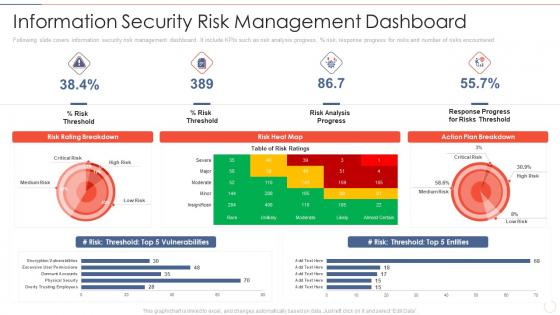
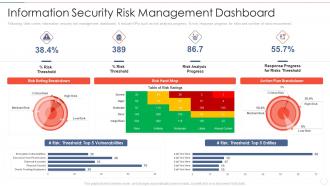
Following slide covers information security risk management dashboard. It include KPIs such as risk analysis progress, percent risk, response progress for risks and number of risks encountered.
People who downloaded this PowerPoint presentation also viewed the following :
Effective information security information security risk management dashboard with all 7 slides:
Use our Effective Information Security Information Security Risk Management Dashboard to effectively help you save your valuable time. They are readymade to fit into any presentation structure.





FAQs for Effective information security information security
Start with mapping out your assets and what could go wrong with them. Risk assessment comes next - figure out how likely each threat is and what damage it'd cause. Then you've got four choices: accept it, reduce it, pass it off (insurance, etc.), or avoid it entirely. Honestly, this is where most budgets start getting messy. Monitoring has to be ongoing though - risks shift all the time. Oh, and assign clear owners for each piece or it'll just sit there collecting dust. Regular check-ins are crucial too.
Honestly, start by just making a list of everything - all your data, systems, the whole mess. Figure out what could actually break or get stolen and how screwed you'd be if it happened. I kinda love this part because you get to think like a hacker (weird flex, I know). Map out what protections you already have, then spot the obvious holes. Don't forget about inside threats too - angry employees can do way more damage than some random hacker. Score everything on likelihood vs. how bad it'd hurt. Write it down somewhere and actually update it regularly since this stuff changes constantly.
Honestly, training your people is like 95% of cybersecurity right there. Most breaches happen because someone clicks the wrong thing or uses "password123" - you know how it is. But when you actually teach folks to spot sketchy emails and use proper passwords, they become your best defense instead of your weak point. Don't do those awful yearly PowerPoint sessions though. Regular stuff works way better. I'd start with fake phishing tests and getting everyone on a password manager. Those two things alone will save you so much headache down the road.
Honestly, you've got to ditch that old "fortress mentality" way of thinking about security. Cloud and IoT stuff is constantly shifting - new devices pop up, data's bouncing around everywhere, and you're splitting duties with your providers. Those static risk assessments? Pretty much useless now. Real-time monitoring is where it's at, plus you'll want automated threat detection baked right into your development process. Oh, and figure out that shared responsibility thing with your cloud provider - I've seen so many teams get burned because they didn't know who was supposed to handle what.
Honestly? Ransomware's probably your biggest headache right now, plus all the phishing emails flooding inboxes. Your own employees can be risky too - sometimes they're malicious, but usually just clicking the wrong stuff. Social engineering attacks are getting crazy sophisticated. They're targeting people instead of trying to hack through firewalls and whatnot. Supply chain hits are everywhere, cloud configs get screwed up constantly since everyone's moving fast. Oh, and the usual - malware, data breaches, DDoS garbage. Two things'll help immediately: train people to spot sketchy emails and turn on multi-factor auth everywhere you can. Blocks most attacks right there.
Honestly, just focus on the combo of "how likely is this to happen" plus "how badly would it mess us up." Make a simple grid - probability on one side, impact on the other. Whatever lands in the high-high corner gets tackled first. But here's the thing - don't ignore what you've already got protecting you. Like, ransomware might seem terrifying, but if your backups are solid, maybe it's not priority
-
Excellent template with unique design.
-
Nice and innovative design.