


Threat and dashboard effective information security risk management process




Try Before you Buy Download Free Sample Product
 Impress Your
 Audience
 100%
100% Editable
 Save Hours
 of Time


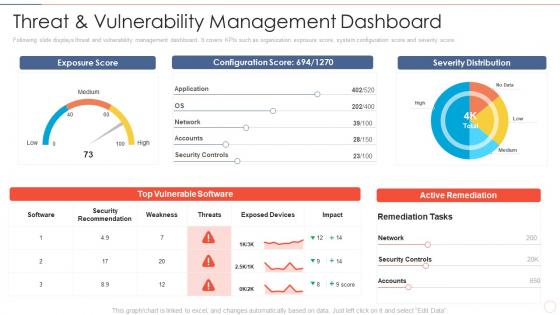
Following slide displays threat and vulnerability management dashboard. It covers KPIs such as organization exposure score, system configuration score and severity score.
People who downloaded this PowerPoint presentation also viewed the following :
Threat and dashboard effective information security risk management process with all 7 slides:
Use our Threat And Dashboard Effective Information Security Risk Management Process to effectively help you save your valuable time. They are readymade to fit into any presentation structure.






FAQs for Threat and dashboard effective information security
**INPUT**: What are the key components of an effective information security risk management framework? **OUTPUT**: Effective information security risk management frameworks include asset identification, threat assessment, vulnerability analysis, risk evaluation, and continuous monitoring processes. These components work together by establishing comprehensive security baselines, enabling proactive threat detection, and streamlining compliance reporting, with many organizations finding that integrated frameworks deliver enhanced operational resilience and competitive advantage. **Word count: 52 words**
Organizations identify and assess potential security threats through comprehensive risk assessments, vulnerability scanning, threat intelligence gathering, penetration testing, and continuous monitoring of network activities. These methodologies enable systematic evaluation by analyzing attack vectors, assessing asset criticality, and measuring potential business impact, with many financial institutions and healthcare organizations finding that regular threat modeling and security audits ultimately deliver enhanced protection and regulatory compliance.
Risk prioritization enables organizations to allocate limited security resources strategically by identifying which threats pose the greatest potential impact to critical business operations, data assets, and regulatory compliance requirements. This systematic approach helps IT teams focus investments on high-priority vulnerabilities first, ensuring maximum protection value while building comprehensive security frameworks that scale with organizational growth and evolving threat landscapes.
Organizations balance security with operations by implementing risk-based frameworks that prioritize critical assets, adopting layered security measures that don't disrupt workflows, and integrating security controls directly into business processes. Through automated monitoring and adaptive policies, companies in banking, healthcare, and retail streamline compliance while maintaining productivity, ultimately delivering enhanced protection without sacrificing operational efficiency or customer experience.
Best practices for implementing an information security risk management program include conducting comprehensive asset inventories, performing regular vulnerability assessments, establishing clear risk tolerance levels, implementing layered security controls, and maintaining continuous monitoring protocols. These practices enable organizations to systematically identify, evaluate, and mitigate threats across their digital infrastructure, with many enterprises finding that structured risk frameworks ultimately deliver enhanced operational resilience and regulatory compliance.
Regulatory compliance requirements significantly shape information security risk management by mandating specific controls, audit trails, documentation standards, and incident response protocols across industries. Financial institutions must meet SOX and PCI-DSS standards, healthcare organizations follow HIPAA guidelines, while manufacturers adhere to industry-specific frameworks, with many organizations finding that compliance-driven security programs ultimately deliver enhanced operational resilience and competitive advantage.
Risk quantification methodologies in information security include FAIR (Factor Analysis of Information Risk), Monte Carlo simulations, OCTAVE (Operationally Critical Threat Assessment), quantitative risk assessments, and asset valuation models. These approaches enable organizations to assign monetary values to potential threats, calculate probability distributions for security incidents, and prioritize resource allocation, ultimately delivering data-driven investment decisions and measurable security improvements.
Stakeholders can be effectively engaged through regular risk assessment workshops, transparent communication channels, defined roles and responsibilities, and collaborative decision-making frameworks. Financial institutions and healthcare organizations find that involving department heads, IT teams, and executives in quarterly reviews enhances risk visibility, accelerates incident response times, and ultimately delivers stronger security postures across the enterprise.
Emerging technologies significantly transform information security risk management by introducing new vulnerabilities, attack vectors, and compliance requirements, while simultaneously enhancing detection capabilities through AI-powered monitoring and automated response systems. Organizations across banking, healthcare, and retail increasingly find that strategic integration of these technologies delivers faster threat identification, streamlined incident response, and ultimately stronger competitive positioning in an increasingly complex digital landscape.
Organizations measure information security risk management effectiveness through key performance indicators, risk assessment metrics, incident response times, compliance audit results, and vulnerability remediation rates. These measurements enable businesses to track security posture improvements, demonstrate ROI on security investments, and identify areas needing enhancement, with many enterprises finding that regular metric analysis significantly strengthens their overall cybersecurity resilience.
Common pitfalls include inadequate risk assessments, insufficient employee training, delayed security updates, poor incident response planning, and limited budget allocation for cybersecurity measures. Organizations often struggle with siloed security approaches, underestimating human factors, and reactive rather than proactive strategies, ultimately leaving critical assets vulnerable to evolving threats and compliance failures.
Organizations should adapt their risk management practices by implementing continuous threat intelligence monitoring, conducting regular vulnerability assessments, updating incident response protocols, and establishing cross-functional security teams. Through adaptive frameworks, companies in banking, healthcare, and retail can anticipate emerging attack vectors, strengthen defensive capabilities, and maintain operational resilience, ultimately delivering proactive protection and competitive advantage in an increasingly complex threat landscape.
Regular risk assessments enable organizations to identify emerging threats, evaluate control effectiveness, and prioritize security investments before vulnerabilities become costly breaches. Most organizations conduct comprehensive assessments annually, with quarterly reviews for high-risk areas and continuous monitoring for critical systems, ensuring they maintain robust defenses while adapting to evolving cyber threats and regulatory requirements.
Employee training and awareness programs mitigate information security risks by educating staff on phishing recognition, password hygiene, social engineering tactics, data handling protocols, and incident reporting procedures. These comprehensive programs enhance organizational security posture through reduced human error, faster threat detection, and stronger compliance adherence, with many companies finding that well-trained employees become their most effective defense layer.
Incident response plans integrate into risk management strategies by aligning response procedures with identified vulnerabilities, establishing clear escalation protocols, and defining recovery priorities based on business impact assessments. Through strategic coordination, organizations streamline threat containment, minimize operational disruptions, and accelerate business continuity, with many financial institutions and healthcare providers finding that integrated approaches ultimately deliver faster incident resolution and reduced compliance risks.
-
Much better than the original! Thanks for the quick turnaround.
-
Out of the box and creative design.