


Risk And Vulnerability Management Dashboard Introduction




Try Before you Buy Download Free Sample Product
 Impress Your
 Audience
 100%
100% Editable
 Save Hours
 of Time


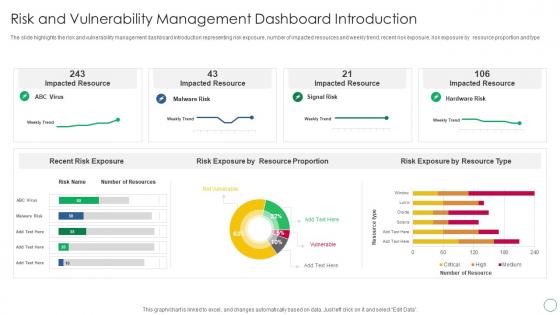
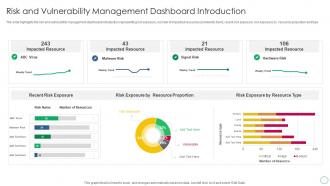
The slide highlights the risk and vulnerability management dashboard introduction representing risk exposure, number of impacted resources and weekly trend, recent risk exposure, risk exposure by resource proportion and type.
People who downloaded this PowerPoint presentation also viewed the following :
Risk And Vulnerability Management Dashboard Introduction with all 7 slides:
Use our Risk And Vulnerability Management Dashboard Introduction to effectively help you save your valuable time. They are readymade to fit into any presentation structure.





FAQs for Risk And Vulnerability
So you'll want to focus on five main things. Start by figuring out what could actually go wrong in your business - that's risk identification. Next, assess how likely each risk is and what damage it'd cause. Then decide your game plan: avoid it, reduce it, insure against it, or just live with it. The monitoring piece is huge because honestly, risks change all the time so you can't just set this up once and forget about it. Oh, and make sure everyone's talking throughout this whole process - communication keeps teams on the same page. I'd map out your biggest operational headaches first, then expand from there.
Start by listing out every possible thing that could mess with your business - cyber attacks, supply chain issues, new regulations, whatever. Honestly, this part's kinda fun if you embrace your inner pessimist. Then rank everything by how likely it is vs how bad it'd be. Use a simple grid for this. Don't do this alone though - other departments will catch stuff you totally missed. The key is making it ongoing, not just a one-and-done thing. I'd say quarterly check-ins work well to spot new risks as things change. Your business isn't static, so your risk planning shouldn't be either.
So risk appetite is basically your company's comfort zone with uncertainty. How much danger are you cool with to hit your targets? Every big decision gets filtered through this - do we go for it, tweak the plan, or bail completely? Your whole team needs to know where you stand on this stuff, otherwise everyone's just winging it. Think of it like having an internal GPS for sketchy situations. I've seen way too many companies skip this step and then wonder why their strategies are all over the place. It should honestly drive every major move you make.
Honestly, tech is a game-changer for catching risks early. AI can spot weird patterns in your data that you'd totally miss just eyeballing it. Real-time alerts are clutch too - no more finding out about problems three days later. Predictive stuff helps you see what's coming down the pipeline. Dashboards beat the hell out of Excel hell, trust me on that one. My advice? Pick one area where your data's already decent and start there. Don't try to boil the ocean right away. You can always expand once you've got something working smoothly.
Okay so the key is knowing your audience - executives just want bottom line stuff while tech people need all the details. Don't use jargon and focus on what actually matters to them. I learned this after way too many meetings where people just zoned out completely! Numbers help a ton - throw in dollars, timelines, whatever you can. Also don't just dump problems on people, give them options to choose from. Set up regular check-ins instead of only talking when everything's on fire. Oh and make it actually interactive - ask them what info they need to make real decisions.
So compliance basically becomes your starting point for risk management - you've got to hit those baseline requirements no matter what. Think mandatory risk assessments, documentation standards, incident reporting deadlines. Honestly, it can feel pretty restrictive at first. But here's the thing - those requirements actually help you spot gaps you might've missed otherwise. I always tell people to treat compliance as your floor, not your ceiling. Once you've got that covered, you can layer on whatever extra controls make sense for your specific situation. It's way better than starting from scratch, trust me.
Honestly, start with a basic risk register - just document everything first before getting fancy. Heat maps and SWOT analysis are solid for seeing the big picture. For handling risks, use the four T's: Transfer it (insurance), Treat it (add controls), Tolerate it (accept minor stuff), or Terminate it (just don't do it). Bow-tie analysis is pretty cool since it shows causes AND consequences visually. Monte Carlo sims work well for complex projects too, though that might be overkill depending on what you're doing. Simple beats complicated when you're starting out.
Honestly, start with the basic stuff - just multiply probability times cost for each risk, then add everything up. Risk matrices work great too, where you plot how likely something is against how much it'll cost you. Monte Carlo simulations sound intimidating but they're actually amazing if you've got complicated scenarios (though maybe overkill at first). The tricky part? Getting realistic probability estimates - that's where most people mess up. I'd say start simple with those probability x impact calculations. Document what you're assuming so you can tweak things later. You can always get fancier once you've got the basics down.
Honestly, you can't separate risk management from project management - they're pretty much the same thing. Every phase of your project involves spotting potential problems, figuring out how likely they are to happen, then planning what you'll do about them. Sounds boring, but it'll save your ass later. Your timelines, budgets, and even how you talk to stakeholders should all account for things that might go sideways. The trick is making it routine instead of just doing it once at the beginning and forgetting about it.
Culture totally changes how companies deal with risk. Some places need everyone's input before deciding anything - very consensus-heavy. Others? They're all about that "fail fast, move quick" vibe. Think Silicon Valley startups versus, I dunno, traditional Japanese corporations. Your company's background, what industry you're in, even how old your leadership is - it all affects whether you play it safe or take chances. Honestly, the tricky part is figuring out when these cultural tendencies are actually helping your business goals versus just holding you back from good opportunities.
Dude, the space is totally shifting right now. AI risk analytics are everywhere, plus ESG stuff is finally getting real attention. Those quarterly reviews we used to hate? Getting replaced by real-time monitoring, thank god. Climate risk is massive now too - can't pretend environmental factors don't matter anymore. Oh, and cyber security's going nuts with zero-trust models and supply chain assessments becoming the norm. Honestly, it's way more interesting than the old reactive approach we used to do. You should definitely check out automated risk scoring tools though - they'll spot threats way before they become actual problems. Makes everything so much easier.
Look, you can't predict every disaster that'll hit your business. What works is stress-testing against realistic worst-case stuff - losing your top client, supply chain going haywire, whatever keeps you up at night. Most businesses suck at this because they're way too optimistic about everything. Keep more cash around than feels comfortable. Diversify your revenue and suppliers so you're not screwed if one disappears. Oh, and don't do this planning once then forget it exists - check back quarterly because markets change fast. Having backup plans ready beats scrambling when things go sideways.
Track both leading stuff (training rates, near-misses, how well you're implementing controls) and lagging indicators like actual incidents and losses. Honestly, most people sleep on leading metrics but they're gold - you catch problems early. For the lagging side, focus on how often incidents happen, how bad they are, and what they cost you. Oh, and don't skip the softer stuff like culture surveys or response times to new threats. I'd start with maybe 3-5 metrics that actually matter to your business. You can always add more later once you get the hang of it.
Honestly, just start small with stuff that won't tank if it goes sideways. Give your team clear boundaries - like "you can spend X amount" or "try this for 2 weeks max" - so they know how far they can push it. The whole point is making failure less scary, you know? Nobody wants to be the person who broke everything. Pick some low-stakes projects first to get people comfortable with experimenting. Yeah, some attempts will flop, but that's how you figure out what actually works. Once your team gets used to taking those calculated risks, you can gradually let them try bigger swings.
Think of risk management like your business's safety net - spot problems before they blow up and you'll recover way faster. Map out your biggest weak spots first. Then build backup plans for each one. Sounds like overkill, but trust me, it's not when your main supplier suddenly disappears or whatever. Diversify everything so one disaster can't kill your whole operation. The bonus? You'll make smarter decisions because you've already thought through the "what if" scenarios instead of panicking when stuff hits the fan. Start with your most obvious vulnerabilities and work from there.
-
Making a presentation has never been this easy for me. Thank you SlideTeam for offering a splendid template library.
-
Amazing slides! Unique, attractive, and easy to understand.