


Cyber Security Key Performance Indicator Metrics Analysis




Try Before you Buy Download Free Sample Product
 Impress Your
 Audience
 100%
100% Editable
 Save Hours
 of Time


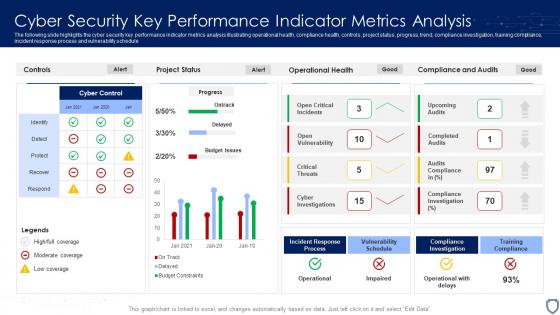
The following slide highlights the cyber security key performance indicator metrics analysis illustrating operational health, compliance health, controls, project status, progress, trend, compliance investigation, training compliance, incident response process and vulnerability schedule.
People who downloaded this PowerPoint presentation also viewed the following :
Cyber Security Key Performance Indicator Metrics Analysis with all 7 slides:
Use our Cyber Security Key Performance Indicator Metrics Analysis to effectively help you save your valuable time. They are readymade to fit into any presentation structure.





FAQs for Cyber Security Key Performance
Track Mean Time to Detection and Response first - how fast you spot threats and actually fix them. Patch management speed matters too. Oh, and definitely measure security training completion rates because people will click on literally anything suspicious if you don't train them properly. I'd also watch critical vulnerability fixes per month and whether the same incidents keep happening. Your security tools should have effectiveness scores you can pull. Honestly though? Pick maybe 3-4 metrics that actually connect to your business goals. Don't go overboard tracking every possible thing or you'll just drown in data.
Most companies go with frameworks like NIST or ISO 27001 - they've got these 1-5 maturity scales where 1 is basically "we're winging it" and 5 is "we predict problems before they happen." Track your progress by measuring stuff that actually moves the needle: how fast you fix vulnerabilities, incident response times, compliance rates. Don't stress if you're starting at level 1 or 2, honestly most places are a mess initially. Pick 2-3 areas to focus on instead of trying to fix everything at once. The trick is choosing metrics tied to real business risk, not just numbers that look impressive in PowerPoint decks.
Honestly, user training is way more measurable than people think. Track your phishing sim click rates and training completion - that stuff actually shows real behavior change. I've seen click rates drop from like 30% down to 5% with consistent training, which is pretty wild. Monthly phishing tests are your best friend here. Tie those results back to actual incidents and you'll spot which teams need extra help. Plus it makes proving ROI so much easier when you've got hard numbers showing people aren't falling for obvious scams anymore.
Break it down into stages - detection to acknowledgment, then acknowledgment to containment, and finally containment to resolution. Your ticketing system should automatically timestamp everything so you can track MTTD and MTTR. Automate the initial triage stuff first, that's usually the biggest time sink. Make sure everyone knows exactly who to escalate to - I can't tell you how many incidents drag on just because people are playing phone tag. Regular tabletop exercises actually help more than you'd think. Baseline where you're at now, then tackle whatever's slowing you down most.
Look, "threats detected" sounds impressive but it's basically useless. You could catch 10,000 threats and still get wrecked by the one that slips through. These metrics just make teams chase big scary numbers instead of actually reducing risk - which is backwards if you think about it. They're also super reactive, just measuring how much crap is already hitting your systems. Focus on prevention stuff instead: how fast you contain incidents, what percentage of attacks you stop before they reach anything important. Way better picture of whether you're actually secure or just... busy.
Start with NIST or ISO 27001 as your foundation. Then grab those annual security reports from vendors - half are just marketing fluff but they've got decent industry averages. CIS has solid benchmarks too, plus your industry associations probably publish stuff. Honestly? Don't go crazy tracking everything. Pick like 5-7 metrics that actually move the needle for your business. Mean time to detection, incident response speed, how fast you patch vulns - the basics that matter. Oh, and if you can swing it, join one of those cybersecurity consortiums where companies share metrics anonymously. Pretty helpful for real comparisons.
Think of TTD like a smoke alarm for hackers - how fast can you catch them once they're inside? Most companies take months to notice breaches, which is honestly pretty terrifying when you think about it. During that time, attackers are just chilling in your network, stealing stuff and setting up backdoors. So yeah, speed matters big time. Start by figuring out your current detection times for different attacks. Then work on making your monitoring tools faster and more accurate. The quicker you spot threats, the less damage they'll do before you can kick them out.
Stop drowning your executives in patch rates and CVE counts - they literally don't care. Ask your business leaders what actually scares them at night, then build your metrics around that stuff. Like, translate "47 critical vulnerabilities" into "this could cost us $500K in downtime." Focus on what hits the bottom line: revenue protection, keeping systems running, passing compliance audits. I made this same mistake for years, honestly. The trick is speaking their language - downtime costs, customer data breaches, audit failures. Way more effective than technical jargon nobody understands.
Check their security certs first - SOC 2 Type II, ISO 27001, that kind of stuff. How fast do they patch vulnerabilities and respond to incidents? That's huge when shit hits the fan. I'd also dig into their pen testing results and compliance audits. Security questionnaire scores matter too, though some vendors just phone those in. Monitor their uptime and breach history ongoing. Staff training completion rates are worth tracking - shows they actually care about security culture. Oh, and set up regular reviews with your critical vendors. You don't want any nasty surprises later.
Look, different threats need different metrics - you can't just use the same stuff for everything. Phishing? Track email click rates and how fast users report sketchy messages. Ransomware's where it gets scary though - focus on backup recovery times and how quickly you spot lateral movement. Honestly, malware detection is more straightforward - just watch your endpoint detection rates and quarantine speeds. The trick is figuring out what each threat actually does to your systems first. Then you can build metrics around those behaviors. Start mapping what you're dealing with next week and go from there.
Honestly, I'd start with the basic descriptive stuff first - dashboards tracking attack volumes, spotting trends, that kind of thing. Gets you a solid baseline. Machine learning for predictive analytics is where it gets interesting though - you can actually forecast threats based on what's happened before. Behavioral analytics are clutch for catching weird user or network activity that screams "breach incoming." Statistical analysis helps connect the dots between events too. You might miss attack patterns otherwise. Once you've got the descriptive analytics down, then you can start layering in the fancier predictive capabilities. Don't try to do everything at once or you'll just overwhelm yourself.
You've gotta speak their language, honestly. Executives want ROI and risk stuff - show how security protects their revenue streams. Board members? Keep it stupid simple with red/green dashboards tied to business goals. IT folks can handle the nitty-gritty like patch rates. Here's the thing though - tell a story with your data instead of throwing spreadsheets at people. Nobody wants to decode vulnerability scores all day. Always explain what those numbers actually mean and what you're doing about them. Context is everything when you're trying to get buy-in from different teams.
Hey! So AI and machine learning are totally reshaping cybersecurity metrics right now. You'll need new ways to measure threat detection accuracy and false positive rates - stuff that wasn't really on anyone's radar before. Cloud security's pushing metrics for container vulnerabilities too. Don't even get me started on IoT devices (the attack surface is honestly insane), but they're creating new measurements around device authentication and network segmentation. Zero-trust architectures? Completely different ballgame - you're measuring continuous verification instead of just perimeter stuff. Start tracking this stuff now or your dashboards will look ancient.
So basically you're comparing security spending against what breaches would've cost you. Track stuff like fewer incidents, less downtime, avoided fines. The annoying thing? Proving attacks that never happened - which is honestly weird to measure. Use industry averages for your sector as a baseline though. Before-and-after metrics help: how fast you catch threats, successful attacks, disruption hours. I'd start small - pick maybe 2-3 outcomes from your biggest security buys and build the ROI story from there. Way easier than trying to justify everything at once.
Track different stuff based on what regulations you're dealing with. GDPR means watching response times for data requests (30 days max), breach notifications, consent rates, and keeping your data processing inventory current. HIPAA's more about access controls - user activities, audit logs, risk assessments, incident response. The data collection part is honestly easy. What's annoying is staying consistent with measuring the right metrics over time. Start with automated dashboards for the urgent stuff like breaches, then quarterly reports for everything else. Trust me, it makes audits so much better when you're not scrambling.
-
Their templates are super easy to edit and use even for the one like me who is not familiar with PowerPoint. Great customer support.
-
Perfect template with attractive color combination.