


Cybersecurity and digital business risk management responsibility matrix to ensure effective




Try Before you Buy Download Free Sample Product
 Impress Your
 Audience
 100%
100% Editable
 Save Hours
 of Time


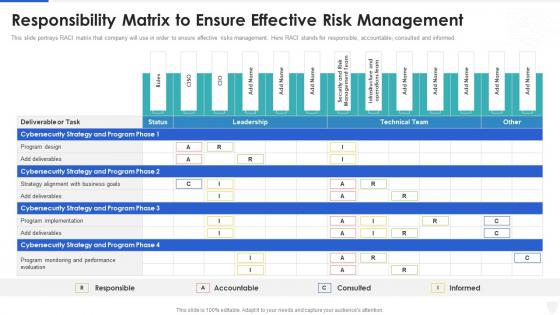
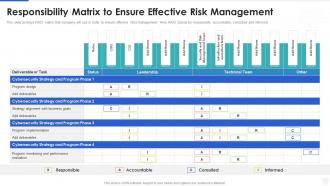
This slide portrays RACI matrix that company will use in order to ensure effective risks management. Here RACI stands for responsible, accountable, consulted and informed.
People who downloaded this PowerPoint presentation also viewed the following :
Cybersecurity and digital business risk management responsibility matrix to ensure effective with all 6 slides:
Use our Cybersecurity And Digital Business Risk Management Responsibility Matrix To Ensure Effective to effectively help you save your valuable time. They are readymade to fit into any presentation structure.





FAQs for Cybersecurity and digital business risk management responsibility matrix
So basically you're mapping out who handles what during security incidents. Start with your key people - incident commander, comms person, tech team, legal folks. Then figure out their specific jobs: who investigates, talks to customers, deals with media, all that stuff. Here's the thing though - you absolutely need clear escalation rules and decision-making authority. I've watched teams completely lose their minds because nobody knew who was actually calling the shots. Different incidents need different people too (data breach vs DDoS are totally different beasts). Honestly, just start by listing your stakeholders first and work backwards from there.
Okay so first figure out everyone who touches your systems or data - that's your starting point. Obviously IT security, but HR deals with employee stuff, finance has access to sensitive info, department heads make calls about security. Don't sleep on facilities either if they control physical access. I'd walk through your actual processes and think "who could mess things up here, accidentally or not?" Anyone making decisions about security tools or budgets needs to be on the list too. Then just rank them by how much damage they could do and how much authority they have. Honestly, most people forget about the non-tech roles but that's where things go sideways half the time.
Honestly, start with the NIST Cybersecurity Framework - it's super popular and maps to different roles pretty well. RACI matrices will save your life here because they spell out who's responsible, accountable, consulted, and informed for each control. COBIT 2019 has tons of governance detail if that's what you need. ISO 27001's solid for compliance stuff. Oh, and CIS Controls covers the more technical side of things. My advice? Go with NIST first, then add the RACI approach on top. That combo gets you ownership clarity really quickly without overthinking it.
When you're building your responsibility matrix, regulations have to come first - they're literally non-negotiable. Map out who handles what for compliance stuff before anything else. Like GDPR breach notifications or SOX controls - those roles are already decided for you. Super annoying but that's how it works! Then you can fill in the rest of your matrix around those fixed assignments. I'd start by pulling together all your key regulations and seeing what role requirements they actually spell out. Way easier than trying to retrofit compliance into an existing matrix later.
A responsibility matrix kills that "who does what" panic when incidents blow up. You get clear escalation paths and everyone knows their role - no more stepping on toes during the chaos. Honestly, it's night and day compared to watching people run around like headless chickens (been there, not fun). Plus you can spot coverage gaps before they bite you. Quick tip: look back at your messiest incident response. Where did handoffs go sideways? That's where you need the most detail in your matrix. Saves so much headache later.
Don't make roles super vague - words like "support" tell people absolutely nothing about who's doing what. Also, resist putting multiple people on every single task because then nobody owns it. Include people outside IT too since security affects everyone now. I made this mistake once where our RACI was like 20 pages long and guess what? Nobody read it. Keep it short and specific. Oh, and actually test it out with a real scenario - you'll quickly see where people get confused about their responsibilities. Trust me, it saves so much headache later.
Update it yearly at minimum, but that's honestly bare bones. Big changes trigger immediate updates - new regulations, company restructuring, major security incidents. I've watched teams mess this up badly by running outdated matrices with dangerous coverage gaps. Your threats and business processes change constantly, so responsibility assignments can't stay static. Set that annual calendar reminder (seriously, do it now), but also bake updates into your change management whenever roles shift or you deploy new systems. The alternative is pretty ugly when something goes wrong.
Honestly, a responsibility matrix just fixes that whole "not my department" mess. When shit hits the fan, nobody's pointing fingers because everyone already knows their role. I've seen IT and Legal just stare at each other during breaches - super awkward. The matrix makes teams hash things out during planning instead of panicking later. You'll catch those weird gaps where critical stuff isn't assigned to anyone (which happens more than you'd think). Just map out your current incident response first. I bet you'll find some holes that explain why everything feels so disorganized right now.
Check your response times first - that's the obvious one. But also survey your team about role clarity because confusion shows up there fast. The real tell though? Count how many times you hear "wait, whose job is this?" during incidents. Super annoying when that happens repeatedly. Track if people actually use the matrix when shit hits the fan or if they just ignore it completely. Oh, and measure decision delays too - you know those awkward moments when everyone's staring at each other waiting for someone to take charge. If the same ownership questions keep popping up month after month, something's broken.
Honestly, responsibility matrices are lifesavers for compliance stuff. When auditors show up asking about SOC 2 or ISO 27001 controls, you can just point to your chart and be like "Sarah handles that one." No more awkward meetings where everyone's looking around confused about who dropped the ball. List out all your standard's requirements first, then assign someone to own each piece. The matrix helps you catch blind spots too - like when you realize nobody's actually responsible for something super critical (oops). It's basically your cheat sheet that proves to auditors you've got your act together. Way better than scrambling to figure out ownership on the spot.
Honestly, communication is everything here. Your matrix means nothing if people don't actually understand it or follow through. You've got to spell out who owns what, when handoffs happen, all that stuff. I've watched so many of these fail because managers just assumed everyone would magically "get it" from glancing at some chart. Talk through it with your teams regularly - not just email blasts. Do quarterly reviews where people can actually ask questions and share what worked or didn't during real incidents. Roles change, new threats pop up. Keep everyone in the loop or you're basically wasting your time.
Totally! A responsibility matrix works great for cybersecurity training. People see exactly what they're supposed to handle - none of that "wasn't that Bob's job?" confusion anymore. You can build training around specific roles too. Finance learns about invoice scams while IT deals with patches and updates. Makes those dull compliance sessions actually useful when folks can connect it to their day-to-day work. I've watched companies turn theirs into hands-on workshops where teams practice with real scenarios - way better than PowerPoint slides, honestly. Map your current training against the matrix first though. You'll probably find some weird gaps you didn't know existed.
Build your matrix around solid core responsibilities that don't change - like who handles incident response. But keep the execution stuff flexible. I've watched way too many companies create these rigid frameworks that become totally useless when new threats pop up. The trick is nailing down clear ownership first, then giving teams wiggle room on how they actually do the work. Start with your most critical assets and figure out who's accountable for what. Then - and this part's key - let the processes evolve. Don't lock yourself into methods that'll be outdated in six months.
For basic stuff, just grab a RACI template in Excel or Google Sheets - works fine. Monday.com and Asana are solid if you want notifications and fancy updates. There's also enterprise platforms like ServiceNow, but honestly? I've seen teams crush it with simple shared spreadsheets. Don't overthink it. Pick whatever your team won't abandon after two weeks (you know how that goes). Start with something basic, then upgrade later if you need it talking to your other security tools. The tool doesn't matter as much as actually using the damn thing consistently.
Honestly, start with something basic like RACI and then tweak it for your specific mess - I mean, your specific company situation. Map out your biggest risks first since that's what actually matters. Healthcare vs fintech will obviously need totally different approaches. Don't let IT build this thing alone in their cave - you need people from every department weighing in or it'll just sit unused. Test it with some real scenarios before you push it company-wide. The whole point is matching roles to who can actually handle what in your organization, not following some generic template.
-
Excellent design and quick turnaround.
-
Top Quality presentations that are easily editable.