Innovation Funnel Management Process With Three Filter Gates Set 1 Innovation Product Development

Rating:
90%
Innovation Funnel Management Process With Three Filter Gates Set 1 Innovation Product Development
Slide 1 of 6
Favourites Favourites

Try Before you Buy Download Free Sample Product

Audience Impress Your
Audience
Editable 100%
Editable
Time Save Hours
of Time
The Biggest Sale is ending soon in
0
0
:
0
0
:
0
0
Rating:
90%
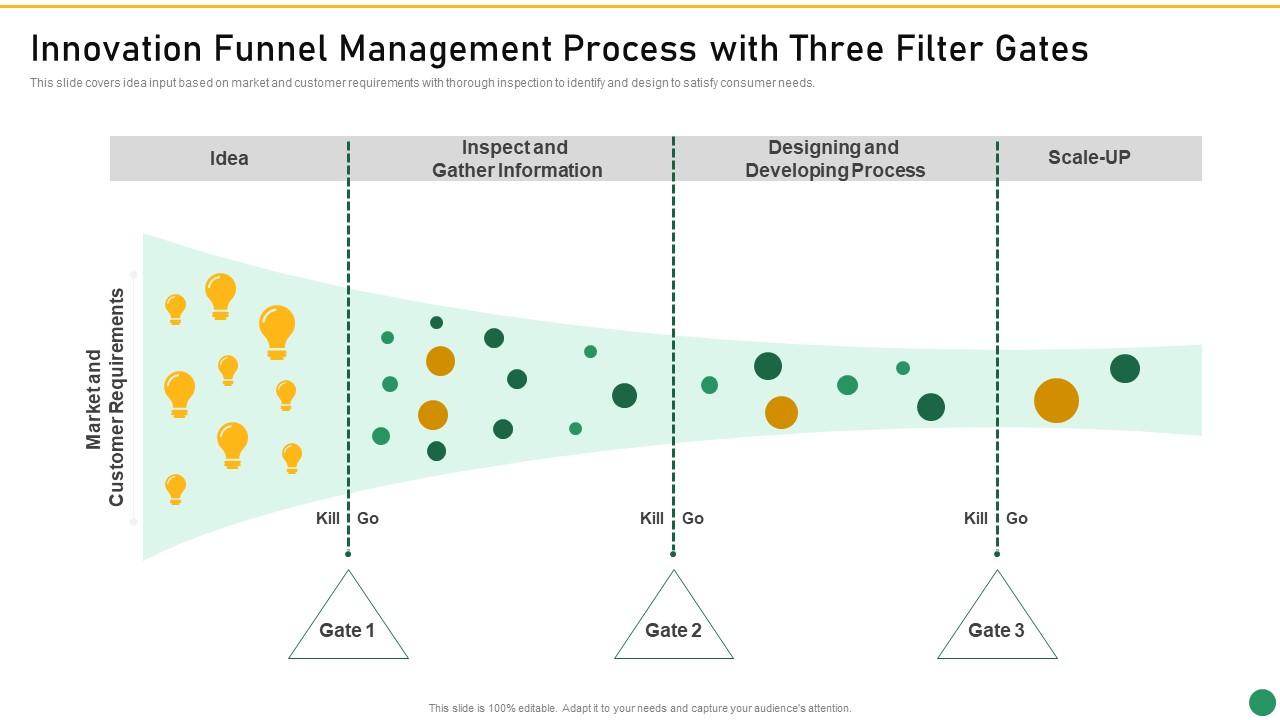
This slide covers idea input based on market and customer requirements with thorough inspection to identify and design to satisfy consumer needs. Introducing Innovation Funnel Management Process With Three Filter Gates Set 1 Innovation Product Development to increase your presentation threshold. Encompassed with three stages, this template is a great option to educate and entice your audience. Dispence information on Inspect And Gather Information, Designing And Developing Process, Filter Gates, using this template. Grab it now to reap its full benefits.
People who downloaded this PowerPoint presentation also viewed the following :

FAQs for Innovation Funnel Management Process With Three Filter Gates Set 1

So basically the innovation funnel has four stages that build on each other: ideation (brainstorm tons of ideas), concept development (polish the good ones), prototyping/testing (actually build stuff and see if it works), then implementation where you scale up. Picture it like a big filter. Start with everything, then narrow down based on what's actually doable and makes business sense. Here's what most people don't realize though - you'll probably bounce back and forth between stages when things don't pan out. Just make sure you've got solid criteria for deciding what moves forward at each step, otherwise you're just winging it.

Honestly, you've gotta nail down your criteria first - what aligns with strategy, market size, how much it'll cost you, whether it's actually doable. Score everything consistently against those factors. Too many places just go with whoever yells loudest (trust me on this one). Get different teams involved so you're not stuck in an echo chamber. Set up checkpoints where ideas have to hit certain marks to move forward. Oh, and kill stuff early if it's not working - way better than bleeding money later. I'd start by taking a hard look at what's already in your pipeline this week.

Don't just track one big metric - you need different ones for each stage. Ideas phase? Look at volume and quality of submissions. Development should be milestone completion and staying on budget/timeline. Testing is where I'd focus on user feedback scores and whether it's actually feasible. The conversion rates between stages are honestly the most revealing - they'll show you exactly where things fall apart. Final stage is adoption rates and ROI. Pick maybe 2-3 key metrics per stage that actually matter to your business goals. Otherwise you'll drown in data.

Dude, customer feedback literally changes everything about your funnel. It gives you new ideas and shows you what problems are actually worth fixing. When you're building features, that's when feedback helps you pivot before you go too far down the wrong path. Prototyping is huge for this - I can't tell you how much time it saves catching issues early. You don't want to launch something nobody wants, right? Then during testing and launch, it tells you if you've got real market fit or if you need to adjust. The trick is asking for feedback from day one and actually listening to the harsh stuff, not just the compliments.

Honestly, you can't manage an innovation funnel without cross-functional teams - I learned this the hard way at my last job. Different stages need different people: R&D for brainstorming, marketing for validating ideas, finance to check if stuff's actually doable. When teams work separately, good ideas just... die. It's frustrating to watch. Set up weekly meetings with reps from each department to review what's moving through your pipeline. Bi-weekly works too if weekly feels like overkill. This catches problems early and keeps everyone on the same page about priorities.

Dude, the right tech stack will totally change your innovation process. First thing - ditch those spreadsheets and get a digital platform for idea submissions. Game changer right there. These tools automatically screen based on your criteria and give you real-time dashboards to track everything. Workflow routing, scoring, feedback loops - all handled without you touching it. I'm probably biased since I hate admin work, but you'll actually have time to focus on the good ideas instead of drowning in paperwork. The automation alone will show you how much time you've been wasting on the boring stuff.

Dude, most companies just dump every random idea into their pipeline without thinking it through first. Then they act shocked when nothing actually works out. Here's what kills me - nobody wants to be the bad guy who says "this idea sucks, let's kill it." Way easier to just let stuff drag on forever. Oh, and they'll approve projects but won't give teams the budget or people to actually do anything with them. So everything just sits there dying a slow death. Learn from the failures too - most places just pretend they never happened. Be picky upfront, set real deadlines, and fund what you say yes to.

Run multiple innovation tracks at once - that's the secret. Put most of your resources (maybe 70%) into quick wins and improvements you can ship soon. Then about 20% goes to medium-term stuff, 1-2 years out. Save 10% for the wild moonshot ideas that'll take forever but could be huge. These percentages aren't set in stone, obviously. The hard part? When quarterly pressure hits, everyone wants to raid that long-term bucket. Don't let them! Set up separate budgets and review cycles so your future projects don't get sacrificed for this month's numbers.

Make failure feel safe - like actually celebrate when experiments don't work out. Give people time to mess around with ideas without asking permission for every little thing. Google does that 20% time thing for a reason. Mix up your teams too, since weird combinations usually spark the coolest stuff. Your managers have to walk the walk though, not just talk about innovation. Oh and set up some easy way for people to pitch ideas, then actually do something with the good ones fast. Nothing kills creativity like letting suggestions sit in some black hole forever.

Think of external factors like filters that mess with your innovation funnel at every step. Market trends will push some ideas forward while killing others - AI just made a ton of traditional software ideas totally obsolete overnight. Competition makes you either speed up promising projects or completely pivot when someone beats you to market. I've watched entire innovation pipelines get trashed because of one competitor launch! Honestly, it's brutal sometimes. These factors also change how you allocate resources and handle risk. Best thing you can do? Build regular market scanning into your process so you're constantly adjusting instead of getting caught off guard.

Honestly, just throw everyone together - different departments, experience levels, maybe even some customers if you can swing it. The 6-3-5 method is my jam: six people, three ideas each, five minutes, then pass the sheets around. Works every time. Try "How Might We" questions or basic mind mapping, but whatever you do, don't let people shoot down ideas immediately. Build on them instead with "Yes, and..." Oh, and this sounds counterintuitive, but give people constraints upfront. Too much freedom actually kills creativity. Set up some kind of simple system to capture ideas so those random brilliant thoughts don't disappear into the void.

Build risk checks into every stage of your innovation funnel. Flag technical stuff early during ideation. Market and competitive risks? Hit those during concept development. Once you're testing/piloting, focus on execution risks. Honestly, I think every project needs a "risk buddy" - someone constantly asking what could go wrong. Not to kill ideas, just make them bulletproof. Simple scoring templates at each gate work great for this. Teams can spot threats fast and actually plan around them instead of getting blindsided later. It's way better than discovering problems when you're already committed.

Think of innovation funnels as your green project filter system. Set up evaluation gates with sustainability criteria built right in - that way eco-friendly projects don't get pushed aside for quick profits. Kill the resource-heavy stuff early (seriously saves so much waste). Short sentences work. But you can also spot circular economy opportunities and renewable solutions that teams might miss otherwise. Honestly, I've seen companies completely overlook waste reduction innovations because they didn't have this kind of systematic approach. Prioritize based on environmental impact AND financial returns - both matter.

Honestly, keep everyone in the loop with regular updates at every stage. Don't just share the wins - the failures are way more valuable anyway. Set up some kind of visual dashboard (even a basic spreadsheet works) showing conversion rates, resources, timeline stuff. Monthly check-ins beat those brutal quarterly meetings where everyone zones out. Oh, and document your lessons right when they happen, not weeks later when you've forgotten half the details. Celebrate the small wins too - keeps people motivated. Seriously though, just start with a simple shared dashboard this week. You can always make it fancier later.

Honestly, your innovation process is probably too slow if each stage takes over 6 months. Shorten those feedback loops and add flexible checkpoints instead of rigid gates - that way you can kill dead-end projects fast or double down on winners. Get external tech experts involved in reviews, and don't be scared to fast-track breakthrough ideas that skip normal stages. Continuous market scanning helps too. I've watched so many companies stick with outdated cycles while competitors just blow past them. Quick pivots beat perfect planning every time.

Ratings and Reviews

90% of 100
Review Form
Write a review
Most Relevant Reviews
  1. 80%

    by Ed Lawrence

    I want to express my gratitude to SlideTeam’s presentation design services team for helping me create the best presentation of my life!
  2. 100%

    by James Lewis

    You guys are life-saver when it comes to presentations. Honestly I cannot do much without your services. Thank you!!!

2 Item(s)

per page: