


Open innovation funnel model showing idea development





Try Before you Buy Download Free Sample Product
 Impress Your
 Audience
 100%
100% Editable
 Save Hours
 of Time


The cause of ill fortune ceases to exist due to our Open Innovation Funnel Model Showing Idea Development. The jinx will come to an end.
People who downloaded this PowerPoint presentation also viewed the following :
Content of this Powerpoint Presentation
The most progressive idea a human being ever had was to step out of his/her comfort zone and opt for something unconventional. Because of this, man was able to unlock the hidden mysteries of the planet and the outside. Even his stay on earth has become so convenient. The credit, of course, is due to his innovations and crazy ideas that have bridged distances, condensed time, and everything is available at the flick of a facial muscle (sir Stephen Hawkings will agree to that.)
In the simplest to the most complex projects that humans have undertaken, there has been an innovation funnel model involved.
An innovation funnel is the passage from ideation to approval, especially one that requires teamwork, a decent budget, and regulatory approval in many cases. Once the ideas pass the feasibility and viability checks, among others, these will be developed further. In such cases, project managers or ideators need to familiarize themselves with the exact steps that converge in the project kick-starting. An open innovation funnel model, is a specific filtration technique that involves assessing ideas from sources that are external to an organization.
Generally the R&D and CRM departments will be responsible for fetching ideas that will be then subjected to discussion, evaluation, and approval, before being worked upon and refined further. To demonstrate the detailed process step-by-step to your project team, this funnel diagram can be deployed right away. This content-ready PPT Template is ideal for project managers and is also readily customizable. Lead your team through the filtration process that ideas will be subjected to before the best ones are accepted and approved for implementation. More about this PPT Layout is discussed below.
Template 1: Open Innovation Funnel Model Showing Idea Development
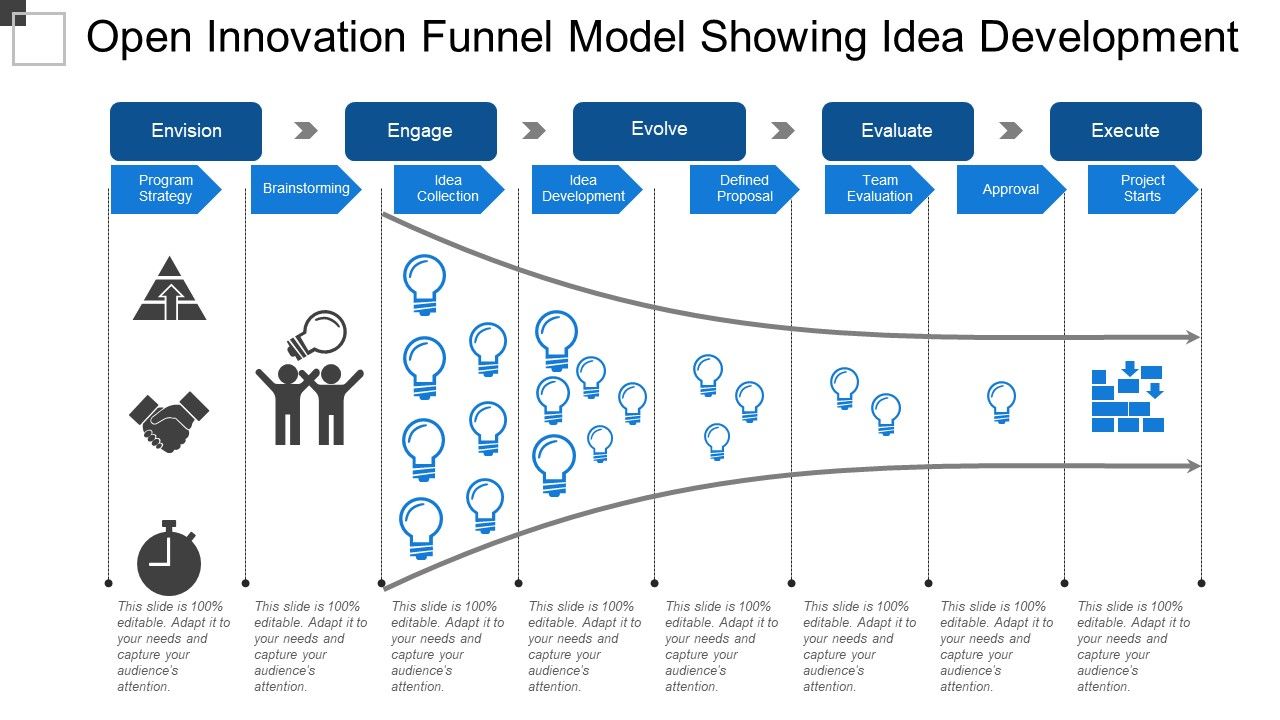
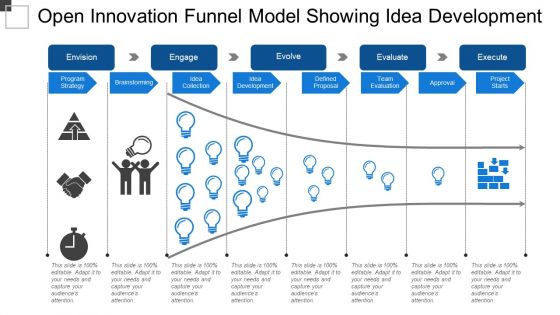
Demonstrate the journey of ideas maturing into execution with this funnel model.Identify the primary 5 Es of this open innovation funnel model namely: Envision, Engage, Evolve, Evaluate, and Execute. Further bifurcate these five Es into 8 sections that will direct the process of strategizing programs for idea generation to kick-starting approved ideas. Icons and infographics will enhance the understanding of this process and this is your sign to use this presentation design.
Process Feedback From Your Most Important Audience
Set a standard process of filtering suggestions from clients, partners, and stakeholders to implement the most profitable ones for your business. Use this PPT Framework to pilot those endeavors of entertaining feedback, keeping your important audience satisfied.
PS: Create a guided process of brainstorming and ideation for your staff to vent their creativity while working in a team with this PPT Presentation.
Open innovation funnel model showing idea development with all 5 slides:
Earn their devotion with our Open Innovation Funnel Model Showing Idea Development. Convince them of your deep faith.

FAQs for Open innovation funnel model
So there are four stages to wrap your head around: **Ideation** is when you're collecting ideas from outside sources - customers, startups, partners, whoever. Then **Selection** where you filter through everything and pick what actually fits your strategy. **Development** comes next - that's the fun part where you collaborate and build prototypes together. Finally **Implementation** for launching and scaling it all. Honestly, it's way cooler than regular innovation because you're tapping into all these external brains instead of just your internal team. The tricky bit? You're juggling outside relationships the whole time. I'd start by figuring out where you already get external input, then spot the gaps.
So basically, traditional innovation is like your R&D team working in a bubble - they handle everything from start to finish internally. Open innovation is the opposite. You're actively bringing in ideas from outside sources like partners, customers, universities, sometimes even competitors (which sounds weird but actually works). Here's the thing - keeping everything in-house is pretty limiting these days. When you open up the process, you get access to way more expertise and different perspectives than your team could ever have alone. Plus you can move faster and cut costs. I'd start small though - pick one project where outside input would actually help.
Dude, external partnerships are like having cheat codes for innovation. You get fresh perspectives and skills your team probably doesn't have. Startups bring wild new tech, universities have serious research chops, customers give you real-world feedback - the whole mix works. I've seen companies totally transform just by finding the right collaborators. Map out where you're weak in your innovation process first. Then hunt for partners who can actually fill those gaps. Don't just partner randomly though - be picky about alignment with your goals and have solid processes ready.
Honestly, you've gotta cast a pretty wide net here. Map out who's in your innovation space - universities, startups, suppliers, maybe even competitors for pre-competitive stuff. InnoCentive and NineSigma are decent for specific challenges, but the real magic happens at industry conferences where you can actually have conversations. Don't be that company that just takes though - good external innovators want real partnerships. Shared IP, co-development deals, licensing paths. Oh, and set up some simple intake process so promising ideas don't disappear into your company's black hole of bureaucracy.
Look at three main areas: what comes in, how you handle it, and what actually happens. Track submission volume and idea diversity for inputs. Time-to-decision is huge - ideas dying in committee hell kills momentum. Also watch your conversion rates between stages. Output-wise, implementation rates matter most, plus revenue from launched stuff and any partnerships. ROI is obviously the big one, but don't sleep on softer wins like brand boost or attracting better talent. Honestly, just pick 3-5 metrics that match your actual goals. You'll go crazy trying to measure everything at once.
Here's what I'd expect: your team will probably push back hard on outside ideas - that whole "we know better" thing runs deep everywhere. Getting flooded with suggestions becomes overwhelming fast, and honestly, most companies suck at filtering through them. IP stuff gets messy since you're sharing confidential details with partners. Your current workflows weren't designed for this either, so expect some growing pains there. Oh, and decision-making slows to a crawl when you can't figure out which ideas are actually worth pursuing. Get your leadership on board first though - that's non-negotiable.
Honestly, tech makes the whole innovation thing way less painful. Collaboration platforms let you pull ideas from everyone - your team, outside partners, whoever. Then AI tools sort through all the submissions and figure out what's actually doable vs. total pipe dreams. Real-time dashboards are weirdly satisfying to watch (I spend way too much time staring at mine). Analytics help you see which innovations actually work instead of just the ones that sound flashy. My advice? Start simple with basic idea management, then add fancier stuff later.
Honestly, leadership has to actually walk the walk here, not just talk about it in meetings. Give your people real time and budget to partner with startups or universities - even competitors sometimes. I've watched so many companies freak out the second IP sharing comes up! Build clear processes for filtering external ideas through your system. Here's the thing though: you've got to reward folks for bringing in outside insights, not just internal wins. That whole "we didn't invent it so it sucks" mentality? Kill it. Celebrate when someone finds brilliant stuff elsewhere.
Honestly, IP management can make or break your whole open innovation thing. Map out your IP landscape first - trust me on this one. You've gotta protect your core stuff while still being open enough that partners actually want to work with you. It's this weird balancing act. Too restrictive? Partners bail. Too loose? You lose your competitive edge. Set up clear collaboration frameworks before jumping into external projects. Otherwise licensing deals and joint ownership gets super messy later. The ideas that flow through your funnel basically depend on getting this right from the start.
Honestly, you need dedicated channels - innovation portals, hackathons, partner stuff. Don't just wait for ideas to magically appear. Here's the thing though: external ideas die super fast without someone internal fighting for them. Each idea needs an "adopter" who'll push it through your system. Simple scoring helps too, otherwise you'll debate forever. Oh, and this is huge - actually tell people what happened to their suggestions. Nothing kills future submissions like radio silence. I'd start by looking at where you currently get external input and figure out what you're missing. Most companies are terrible at the feedback part.
Start with a 70/30 split - internal to external innovation. Map out what you're already working on internally first. Then figure out where you actually need outside help instead of trying to build everything yourself (which honestly just burns money). You'll want separate teams since the skill sets are totally different. Internal folks stick to what you do best while external scouts hunt for the cool breakthrough stuff you can't develop. Oh, and don't forget regular check-ins where both sides share what they're learning. Your internal progress should guide what external partnerships you're looking for, and vice versa.
Tech and pharma companies absolutely crush it with open innovation funnels. But really, any industry wrestling with complicated R&D stuff can make it work. Automotive, consumer goods, energy - they're all seeing solid results. The magic happens when you've got long development cycles and need outside brains to crack tough problems. Manufacturing, biotech, even financial services should be all over this. Traditional industries that ignore it? They're basically shooting themselves in the foot. My advice - pick one specific challenge where fresh eyes could speed things up. That's your starting point.
Honestly depends what you're working with budget-wise. IdeaScale and Brightidea are pretty good for collecting external ideas, and HYPE Innovation does the whole pipeline thing. But real talk? You can totally start with just surveys and spreadsheets - not sexy but it gets the job done. InnoCentive's cool if you want to tap into their network of innovators. For coordinating internally, Slack or Teams work fine. The thing is, don't get caught up in all the bells and whistles. Pick whatever actually makes sense for how your team operates. I'd say start basic and build from there as you figure out what you actually need.
Think of customer feedback as your reality check for the innovation funnel - it helps you figure out what's actually worth pursuing. Get feedback early and often, not just at the end when pivoting costs a fortune. Honestly, early insights are brutal but they'll save you from wasting months on garbage ideas. Later feedback helps polish the good stuff before you go all-in on development. The trick is setting up regular touchpoints where customers can react to prototypes or even just problem concepts. Don't go in blind - those systematic feedback loops are what keep your pipeline from becoming a money pit.
Definitely check out P&G's Connect + Develop program first - they've gotten over 50% of their innovations from outside sources, which is honestly pretty impressive. Starbucks did something similar with My Starbucks Idea where customers submitted thousands of suggestions and they actually used hundreds of them. LEGO's platform is fun too since fans can submit designs that become real products. GE did open innovation for their ecomagination thing, and NASA uses platforms like HeroX to find external problem-solvers. But yeah, start with P&G - their numbers don't lie.
-
Informative design.
-
Excellent template with unique design.