Open innovation funnel model showing creative process

Rating:
90%
Open innovation funnel model showing creative process
Slide 1 of 5
Favourites Favourites

Try Before you Buy Download Free Sample Product

Audience Impress Your
Audience
Editable 100%
Editable
Time Save Hours
of Time
The Biggest Sale is ending soon in
0
0
:
0
0
:
0
0
Rating:
90%
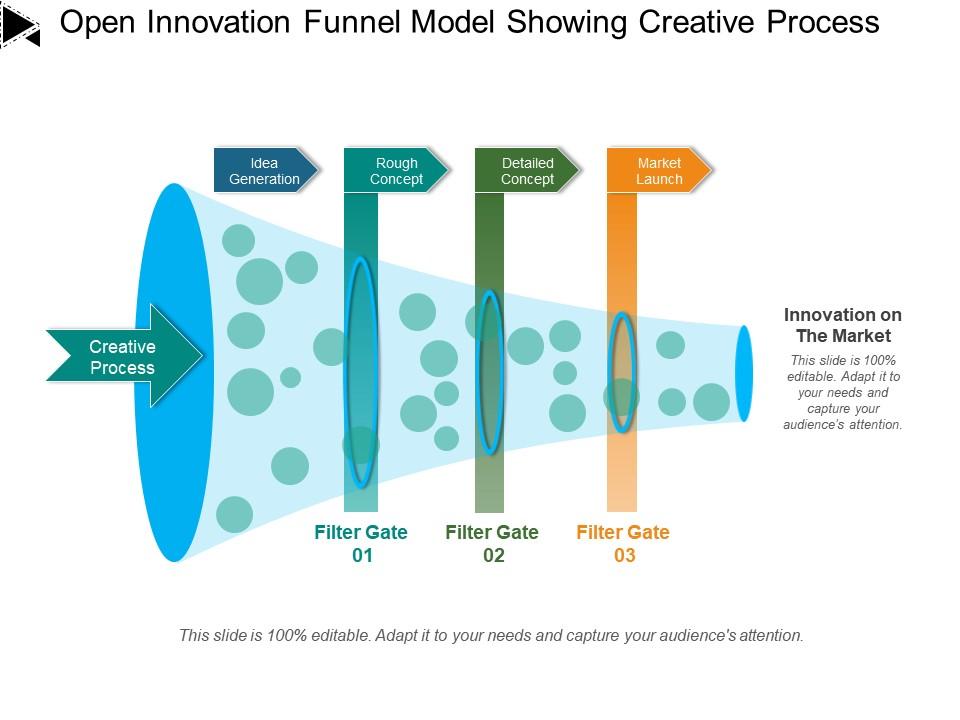
Presenting open innovation funnel model showing creative process. This is a open innovation funnel model showing creative process. This is a three stage process. The stages in this process are open innovation, innovation management, crowdsourcing.

People who downloaded this PowerPoint presentation also viewed the following :

FAQs for Open innovation funnel model

So basically the open innovation funnel has three stages - ideation where you source ideas from outside, development through external partnerships, and commercialization (licensing out or co-launching stuff). What makes it different from traditional approaches? You're not keeping everything locked down internally. Instead of just filtering your own ideas, you're actively bringing in outside perspectives and even sharing your innovations with partners. Honestly, it's messier than the old "we invented everything ourselves" approach, but way more dynamic. I'd start by looking at your current innovation process and figuring out where external collaboration could actually help strengthen things.

You'll want to hit up universities and industry conferences obviously. Patent databases are goldmines too - most people ignore them. Set up hackathons or innovation challenges, but honestly? Some of my best discoveries came from random coffee shop conversations or weird LinkedIn rabbit holes. Keep tabs on startups in your space. Talk to customers about what's driving them crazy. Oh, and get your employees scouting too - they stumble across cool tech all the time. Just make sure someone's actually assigned to track each channel, otherwise it becomes a mess fast.

So here's the thing - collaboration is what actually makes open innovation work. You've gotta build real relationships with partners, customers, startups, sometimes even competitors (I know, sounds crazy). Most companies screw this up by being too controlling. Make it stupid easy for outsiders to work with you. Set up innovation challenges, partner with universities, create those sandbox spaces where people can mess around safely. Give your teams actual authority to make decisions - not everything needs to go through legal first, you know? Fast feedback and clear processes are everything. Otherwise you're just collecting ideas that'll sit in a spreadsheet forever.

So each funnel stage needs its own metrics, right? For ideation, track how many ideas you're getting and where they come from - diversity usually means better innovation. Screening is where you focus on quality - measure how many concepts actually make it through. Development stage is honestly where things get messy, so watch your timelines and resources like a hawk. Most projects die here if you're not careful. Then commercialization is all ROI and market impact stuff. Oh, and don't go crazy trying to measure everything - just pick 2-3 key things per stage or you'll drown in data.

Look, you're gonna run into three main headaches. First up - your legal team will lose their minds about IP stuff, and honestly they've got a point. Set up solid agreements early and create safe spaces for sharing ideas. The "not invented here" thing is real too - your internal folks will hate outside suggestions. Get them involved in picking which ideas to pursue. Oh, and you'll drown in too many concepts if you're not careful. Use some screening tools and stick to clear criteria for what's worth your time. Start with small pilots to show it actually works before going big.

Honestly, crowdsourcing is like having this massive brain trust you can tap into whenever you're stuck. You get ideas from customers, random experts online, even competitors sometimes - way more creative than anything your team would think of internally. Here's what actually works: be crystal clear about the problem you're solving. Don't just throw out vague "we need innovation" requests. Also, real incentives matter - I'm talking cash or actual opportunities, not some crappy $25 gift card. Oh and definitely assign someone to wrangle all the responses because it gets messy quick. Start with something small first to test the waters.

Honestly, there's a crazy amount of platforms to choose from. IdeaScale and Brightidea are solid for managing ideas, while InnoCentive and NineSigma work great if you're crowdsourcing challenges. Basic collaboration? Just stick with Slack or Teams - why overcomplicate it. My advice: match the platform to where you are in the process. Starting with ideation? IdeaScale's pretty straightforward. Got complex R&D stuff? Maybe look at HeroX instead. I'd definitely start small though. Test something simple first, see how your team actually uses it, then expand from there. No point investing big if people won't even adopt it.

Be smart about what you share and when. Start with big-picture problems, not your actual solutions - then slowly reveal more as you build trust. NDAs help, but also look into defensive publications so competitors can't patent the obvious stuff. Honestly, joint IP agreements at the beginning will save you so much drama later. Keep your core secret sauce locked down while sharing the peripheral stuff. Oh, and decide upfront what's off-limits vs. what you're cool sharing - saves arguments down the road when things get messy.

Look at conversion rates between each stage - ideation to evaluation, evaluation to pilot, etc. Time matters too since ideas dying in limbo is the worst. Mix up your sourcing so you're not just getting suggestions from the same people over and over. Track ROI on the stuff you actually implement - honestly, this is where most companies totally drop the ball. Resource usage per stage helps too. Don't go crazy measuring everything though. Pick 3-4 metrics that match what you're trying to accomplish and throw them on a weekly dashboard. You'll get way better insights than drowning in data.

Honestly, start with getting your executives to actually practice what they preach - if they're not collaborating externally, nobody else will follow suit. Break down internal silos first though (seriously, how do you expect external innovation when departments won't even talk to each other?). Create safe spaces for experimenting with outside partnerships without the fear factor. Reward teams who bring external insights, even when things flop. Regular showcases help too - let teams present their external collabs. Oh, and fix your incentive systems so they reward sharing instead of hoarding knowledge. Pilot programs work best to build that initial confidence.

P&G's Connect + Develop thing is probably your best bet to study - they get like 50% of their innovations from outside sources now. LEGO Ideas is cool too, where people submit designs and they actually make the good ones. Netflix kills it with their developer APIs and hackathons that feed into their roadmap. The key difference? These companies don't just collect ideas and forget about them - they have clear processes and actually build stuff. Oh, and they're super specific about what they're looking for rather than asking for random suggestions. You should probably start with one focused challenge area instead of opening the floodgates to everything.

Honestly, it's all about your industry's regulations and how fast you can move. Pharma companies get stuck with these crazy long validation periods because of FDA stuff, but tech can just prototype and pivot super quickly. Manufacturing? They're usually hunting for ideas from suppliers and universities right at the beginning. Healthcare is probably the worst - clinical testing takes forever and feels like jumping through endless hoops. Oh, and financial services need compliance checks at basically every step. I'd start by figuring out where your regulatory headaches are gonna hit, then just build your funnel around those timing constraints from day one.

Honestly, customer feedback is like your safety net throughout the whole innovation process. Don't just slap it on at the end - build it right into each stage. I learned this the hard way watching teams burn through budgets on stuff nobody wanted! You'll want surveys and interviews early on during brainstorming, then switch to prototypes and beta tests as things get more real. Make it systematic too, not just random asks here and there. Set up regular check-ins with customer groups and actually pay attention when they complain about problems or ask for specific features. Trust me, it saves you from those "why didn't we ask sooner" moments later.

Honestly, being small is your superpower here. Big companies get stuck in endless meetings while you can just call someone and make a deal happen. Other startups actually want to work with you because you're not gonna make them jump through corporate hoops for six months. Here's the thing though - you gotta be proactive about finding these partnerships. Don't just sit around hoping someone notices you. Scout constantly. And take those weird risks that Fortune 500s would never touch. That's where the real opportunities hide anyway.

Honestly, everything's getting way more networked these days. AI screening is huge, plus all these virtual collaboration tools are changing how teams work together. Your innovation funnel? It's gonna look less like that old-school linear pipeline and more like... I dunno, a web where ideas can jump in anywhere and ping around between stages. Companies are letting external partners in way earlier too, not just at the end during development. It's messier for sure, but you get so much more flexibility. I'd map out where you're hitting bottlenecks now - those spots will probably need the biggest overhaul first.

Ratings and Reviews

90% of 100
Review Form
Write a review
Most Relevant Reviews
  1. 100%

    by Chase Howard

    Great designs, Easily Editable.
  2. 80%

    by Daron Guzman

    Designs have enough space to add content.

2 Item(s)

per page: