

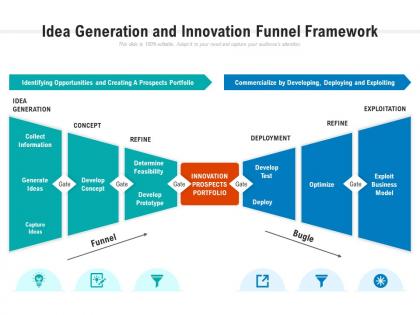
Idea generation and innovation funnel framework




Try Before you Buy Download Free Sample Product
 Impress Your
 Audience
 100%
100% Editable
 Save Hours
 of Time


Enable folks to experience immense happiness with our Idea Generation And Innovation Funnel Framework. It will foster intense joy.
People who downloaded this PowerPoint presentation also viewed the following :
Idea generation and innovation funnel framework with all 2 slides:
Our Idea Generation And Innovation Funnel Framework are a joy to behold. The designs can be immensely inspiring.
FAQs for Idea generation and
Okay so design thinking is basically this structured approach where you solve problems by actually understanding what users need first. Pretty genius, right? You empathize with real pain points, define the actual problem, then prototype and test solutions super quickly. Way better than just throwing ideas at the wall randomly. The best part? You fail fast and cheap instead of spending months building something nobody even wants. Honestly once you get into the rhythm it's not as chaotic as it sounds. Just try one workshop for your next project - I bet the solutions will feel totally different than your usual stuff.
Make failing feel safe first - that's honestly the biggest thing. Protect time for weird projects (Google's 20% thing actually works if you don't let urgent stuff kill it). I've watched so many innovation programs crash because people were scared to pitch anything remotely odd. Celebrate attempts, not just wins. Your managers might be accidentally shutting down risk-taking without realizing it. Oh, and actually DO something with the good ideas that come up. Nothing's more demoralizing than pitching something decent and watching it vanish forever. Start with small pilots though - easier to get buy-in.
So incremental innovation is basically tweaking what already exists - like how iPhones get slightly better cameras each year. Disruptive innovation? That's when something totally new comes along and changes everything. The original iPhone was disruptive because it killed off BlackBerry and flip phones. Most companies stick with incremental stuff since it's predictable and won't tank your budget. Disruptive innovation can pay off huge, but honestly, it's a gamble. You might want to do both though - keep improving what you've got while maybe experimenting with some wild ideas on the side.
Look, AI and blockchain are basically speeding up how fast we innovate while creating totally new problems to solve. Data analysis, content creation, even coding - AI's making stuff accessible that used to need massive teams. Blockchain's doing the same thing but for trust systems. Here's what gets me excited though: when these technologies combine with other tech, you get these crazy unexpected results. Honestly, your innovation strategy can't just think about gradual improvements anymore. You need to plan for exponential jumps. Start by figuring out which processes these could completely flip, not just make slightly better.
Track both money stuff and the softer metrics. ROI and revenue from new products are key, but they take forever to show results - super frustrating. Meanwhile, things like idea generation numbers, how fast you're getting to market, and whether employees actually care about your innovation programs tell you way more in real time. Customer satisfaction with new stuff matters too. Oh, and definitely watch your innovation pipeline - like how many projects are stuck vs. moving forward. Honestly though? Pick 3-4 metrics that actually match what you're trying to accomplish. Don't go overboard tracking everything.
Working with different people honestly makes such a huge difference for innovation. You get all these varied backgrounds attacking the same problem, which means way more creative solutions. I've noticed the best ideas come from those chaotic brainstorming sessions where someone throws out a random "what if" and suddenly another person has this lightbulb moment. It's like having multiple quality checks built in too - people catch mistakes you'd totally miss on your own. The bouncing ideas back and forth thing really speeds everything up. Next time you're stuck on something innovative, definitely mix up who's in the room. You'll be surprised what happens.
Honestly? Money's gonna be your biggest headache - bootstrapping while competitors throw cash around like confetti. Customer acquisition is rough when they can undercut your prices and outspend you on ads. People are naturally suspicious of new stuff too, which never really goes away. Talent's another nightmare since Google can offer stock options you definitely can't match. But here's the thing - find something the big players are too slow or stubborn to tackle. Move fast, own that weird little corner of the market, then expand once you've got some momentum going.
Dude, you absolutely need customer feedback - it's basically your roadmap for not screwing up. I've watched so many teams build stuff they thought was genius, only to have it totally bomb because they never asked users what they actually wanted. Real talk: your assumptions are probably wrong. Customers will straight up tell you what sucks and what they'd pay for. Start collecting feedback from day one, not after you've already built everything. The best products come from solving actual problems, not the ones you think exist. Trust me on this one.
Honestly, trying new stuff in your marketing makes such a difference for how people see your brand. Customers actually pay attention when you take risks - way more than brands playing it safe with the same boring campaigns. New channels, weird creative formats, better personalization... whatever gets you standing out from competitors. The buzz you'll get from innovative campaigns spreads organically too, which is pretty sweet. Just don't chase every shiny trend that pops up (I've seen that backfire). Pick something bold that actually fits your brand values. Test one big idea this quarter and see how it moves the needle on perception.
Look at Apple - they didn't just make better phones, they completely reimagined what a phone could be. Same with Tesla making electric cars cool instead of just... responsible, I guess? Netflix keeps doing this too, jumping from DVDs to streaming to creating their own shows before anyone else saw it coming. The pattern? These companies don't ask "how do we make this 10% better." They ask "what's our customer actually trying to accomplish here?" Then they're willing to kill their own successful products when something better comes along. That's honestly the hardest part - letting go of what's working now.
Honestly, sustainability is pushing innovation everywhere right now. You literally can't launch products without thinking about environmental impact and resource efficiency first. Companies are completely redesigning how things work from start to finish - not just throwing green stickers on old stuff. The whole circular economy thing is actually creating wild new materials and business models I'd never heard of before. Like, product-as-a-service wasn't even a concept five years ago. Short sentences work better sometimes. What's cool is how these constraints are forcing people to get really creative. Just don't treat it as an add-on later - build that thinking in from day one.
So open innovation is basically when you pull in outside talent instead of doing everything in-house. You're grabbing ideas from partners, customers, startups - sometimes even competitors which feels weird but works. It's like suddenly having this massive R&D team without paying for it. Pretty genius, right? You can run multiple projects at once and tap into expertise you don't have. Plus you'll spot market shifts way faster. The trick is being picky about partnerships though. Don't just team up with everyone - make sure they actually fit what you're trying to accomplish.
Think of it like investing - spread your bets across safe projects, risky ones, and total wildcards. I made the mistake once of betting everything on one "revolutionary" idea (spoiler: it wasn't). Set up checkpoints where you can kill stuff early if it's not working. Teams need freedom to think big, but you can't just throw money at everything. Small experiments work better than massive commitments. Oh, and decide upfront what success looks like - saves arguments later. You'll lose some battles, but that's how you win the war.
Dude, policy can make or break innovation - it's wild how much impact it has. Direct funding helps (grants, tax credits), but the regulatory stuff matters more than people think. Strong IP laws mean you can actually make money off your ideas, which is kinda the whole point. Silicon Valley literally exists because of government defense spending back in the day. Oh, and watch where the money's flowing in your industry - that'll tell you everything. Some short-sighted regulations can totally scare off investors too. It's all connected in ways that aren't super obvious until you really dig into it.
Honestly, it works because you're mixing totally different brains on the same problem. Healthcare + tech = telemedicine, right? Agriculture teams up with AI for precision farming. Each industry has their own weird expertise and ways of thinking that others would never dream up. I saw this example where a shipping company's logistics wizards completely transformed how food banks distribute meals - like, who would've thought? The cool part happens when you smash together knowledge from different worlds and question all your industry's sacred assumptions. Look for industries dealing with similar headaches as yours, then just reach out.
No Reviews