


Key accomplishments in business ppt background




Try Before you Buy Download Free Sample Product
 Impress Your
 Audience
 100%
100% Editable
 Save Hours
 of Time


Increase the degree of acceptance of diverse cultures with our Key Accomplishments In Business Ppt Background. Get communities to interact.
People who downloaded this PowerPoint presentation also viewed the following :
Content of this Powerpoint Presentation
Description:
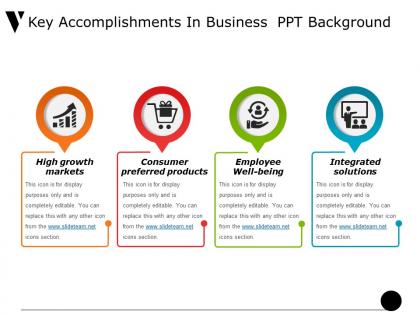
The image is a PowerPoint slide titled "Key Accomplishments in Business PPT Background." It features four key business accomplishments, each represented by a different icon and color, suggesting a variety of strategic success areas for a business:
1. High growth markets:
Represented by a graph icon, indicating the company's success in expanding into or growing within high-growth markets.
2. Consumer preferred products:
Shown with a shopping cart icon, suggesting that the company's products are favored by consumers.
3. Employee Well-being:
Illustrated with a smiley face and gear, representing the company's focus on and achievements in employee satisfaction and well-being.
4. Integrated solutions:
Depicted by a gear merging with a document, symbolizing the company's ability to provide comprehensive and integrated solutions to problems.
Each section has a note stating "This icon is for display purposes only and is completely editable. You can replace this with any other icon from the www.slideteam.net icons section," highlighting that the slide is customizable and the icons can be changed to better suit the presenter's specific accomplishments.
Use Cases:
This type of slide is versatile and can be used in various industries to showcase business achievements:
1. Technology:
Use: Highlighting market innovation and employee engagement initiatives.
Presenter: CEO
Audience: Investors, employees
2. Retail:
Use: Showcasing consumer popularity and range of product solutions.
Presenter: Marketing Director
Audience: Partners, stakeholders
3. Healthcare:
Use: Demonstrating growth in new healthcare markets and commitment to staff well-being.
Presenter: Healthcare Administrator
Audience: Healthcare professionals, board members
4. Finance:
Use: Illustrating consumer trust in products and employee satisfaction within the company.
Presenter: CFO
Audience: Shareholders, financial analysts
5. Manufacturing:
Use: Presenting expansion into new markets and integrated manufacturing solutions.
Presenter: Operations Manager
Audience: Suppliers, clients
6. Education:
Use: Reporting growth in educational program offerings and focus on staff welfare.
Presenter: Educational Consultant
Audience: Educators, administrative staff
7. Hospitality:
Use: Emphasizing the popularity of services and focus on employee and customer satisfaction.
Presenter: Hotel Manager
Audience: Staff, guests
Key accomplishments in business ppt background with all 5 slides:
Activate the inefficient with our Key Accomplishments In Business Ppt Background. Get them to attempt to improve.
FAQs for Key accomplishments in
Honestly, just pick 3-5 metrics that actually move the needle - revenue growth, profit margins, customer acquisition costs, and retention rates are solid. Market share's decent too, but can get weird to measure sometimes. Don't track everything though, that's a rookie mistake. Focus on stuff you can actually influence through your work, not some random number that updates once a year. I'd start by figuring out what "winning" looks like in your role first. Then work backwards to find metrics that prove you're crushing it. Way easier than trying to boil the ocean with data.
Honestly, when you pull off something actually innovative, it's like dominoes falling in the best way. New customers start paying attention. Your team gets pumped because they're doing cool stuff instead of the same boring routine. Word spreads naturally - way better than any paid ads, trust me. Innovation usually makes your operations smoother too, which obviously helps profits. Oh, and you'll discover opportunities you never saw coming. That's probably the most exciting part. My advice? Pick one annoying customer problem or clunky process this month and brainstorm a completely different approach. Start small but think weird.
Honestly, tech isn't just nice to have anymore - it's make or break. Start with whatever's eating up most of your time and find tools to fix that mess first. CRM systems help you actually remember customer details, automation handles the boring stuff, and you can reach people through channels that barely existed when we were in school. My friend's tiny coffee shop does better on TikTok than some big chains now, which is wild. The whole point is making your team better at what they already do well. Don't overthink it though - pick one problem and solve it before moving on.
Dude, just show the data that actually matters. Charts and graphs work great for growth trends or before/after stuff. I swear, half the presentations I sit through have microscopic text nobody can see past row two. Make it bold and simple. Your biggest wins - revenue spikes, customer scores, whatever - should jump off the slide immediately. People need to get your impact in like 3 seconds and remember it after lunch. Oh, and don't cram everything onto one slide just because you can.
Honestly, start with what you already have - update your website, social media, email stuff. Press releases are still worth doing if it's a big deal, especially for industry publications. Don't forget to actually celebrate with your team too! That part gets overlooked way too often. Case studies work better than just announcing "hey we won something" because they show the actual impact. Oh, and here's the thing - only focus on channels where your people actually hang out. No point blasting it everywhere if nobody's listening there.
Look, when your teams crush their goals, it directly boosts revenue and keeps customers happy. That momentum spreads everywhere too - other departments start performing better. Celebrating those wins? Game changer for morale. Your people stay motivated and honestly, everything runs smoother. Strong performance also makes your company look good externally - clients stick around and top talent wants in. The trick is tracking what actually matters and recognizing achievements when they happen. Don't be that company that lets wins slide by unnoticed - such a waste.
Look, testimonials are basically your customers doing the bragging for you. People don't trust what you say about yourself - they trust what other people say about you. Way more effective than any marketing copy you'll write. Happy clients will mention specific stuff like "saved us 30% on costs" or "fixed our biggest headache" - that's the gold you want. Those details prove you actually deliver results, not just make promises. Honestly, most businesses are terrible at collecting these. Just ask your best clients directly - most are happy to help if you made their life easier. Don't overthink it.
Oh man, the worst thing is being super vague - like "we boosted efficiency" without any real numbers. Some teams go nuts documenting every tiny 2% improvement that literally nobody cares about. Others do the opposite and downplay actual wins because they don't want to seem braggy. But here's what really kills me - people forget the "so what?" factor. Your win needs to connect to real business impact, not just some internal metric. Always grab the specific numbers, explain what problem you actually solved, and show how it helped customers or revenue. Context is everything.
Yeah definitely! Past wins are like your credibility card with investors. Pull together 2-3 of your best achievements with real numbers - revenue jumps, user growth, whatever actually mattered. Case studies work great here. Show the problem, what you did, results. Keep it tied to what you're raising for though - like if it's Series A, prove you crushed those seed goals early. Numbers beat fancy slides every time, trust me. One thing I learned the hard way: pick wins that actually relate to your current pitch. Don't just throw random successes at them.
Honestly, awards are like getting a stamp of approval that you're not just talking a big game. Potential clients see those industry recognitions and immediately trust you more than your competitors without any shiny certificates. Your marketing team will be thrilled too - they're always hungry for new content to brag about. But here's the thing: don't chase every random award out there. Pick the ones your actual target audience cares about, not just whatever sounds impressive. Oh, and once you win? Actually use them in your messaging. I've seen companies win great awards then forget to mention them anywhere.
Oh man, this is so true from my experience! Different cultures totally view business success in wildly different ways. Like, Americans love individual wins and fast growth, but Asian markets? They're all about relationships and saving face - way more than just hitting profit targets. Scandinavian countries actually measure success by work-life balance and social impact, which honestly makes sense. I bombed my first international presentation because I didn't get this at all. Now I always research what actually matters to my audience first. Quick wins might impress Silicon Valley but tank in Tokyo, you know?
Track the hard stuff first - energy cuts, waste diverted, carbon reductions. Those numbers don't lie. But honestly? The soft metrics matter too. Get feedback from employees and customers about how they feel about your green efforts. I'd say pick maybe 3-5 key things to measure instead of going overboard with data. Set your baseline before you start anything, then check progress every quarter. The trick is making sure whatever you're tracking actually connects to what your business cares about. Otherwise you're just collecting random data that looks impressive but doesn't mean much.
Stop putting diverse voices in as an afterthought when you're celebrating wins. Your success stories need people from different backgrounds, departments, and levels—not just the same C-suite faces we see everywhere (honestly, it gets old). Mix in team members who actually did the work. Skip the industry jargon that makes people feel left out. Quick reality check: look at your current testimonials and case studies. See any gaps? Fix them. The language you use matters too, so keep it accessible for everyone.
Dude, engaged employees are seriously your best bet for crushing business goals. When people actually care about their work, productivity jumps 18% and profits go up 23% - those numbers are wild. Your team becomes way more innovative too, plus they won't jump ship during crunch time (which always happens at the worst possible moment, I swear). They'll solve problems you didn't even know existed and turn into genuine customer advocates. If you're missing targets, honestly check how connected everyone feels to the actual mission first. That's usually where things fall apart.
Talk about results that actually solve your audience's problems - stuff like revenue growth or cutting costs. Skip the feature lists and focus on real value: "we cut their processing time by 40%" sounds way better than "we have advanced AI tech." Numbers are everything, even small ones matter. Get testimonials and case studies with actual metrics. Make a simple one-pager with your top 3-4 wins that you can prove with data. Honestly, people buy results, not promises. Show them what you've done for others and they'll picture what you can do for them.
-
great template and easy to use
-
Great presentations
-
Good
-
good
-
Easily to use
-
Really like the color and design of the presentation.
-
Easily Editable.
-
no