


KPMG Business Canvas Model Analysis Comprehensive Guide To KPMG Strategy SS




Try Before you Buy Download Free Sample Product
 Impress Your
 Audience
 100%
100% Editable
 Save Hours
 of Time


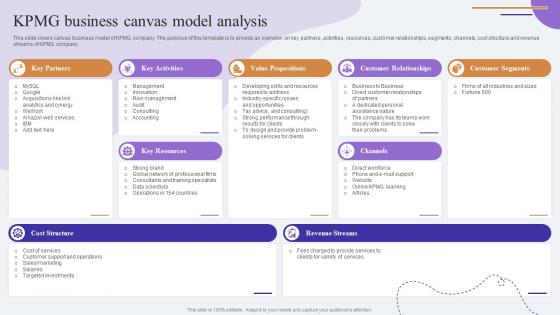
This slide covers canvas business model of KPMG company. The purpose of this template is to provide an overview on key partners, activities, resources, customer relationships, segments, channels, cost structure and revenue streams of KPMG company.
People who downloaded this PowerPoint presentation also viewed the following :
KPMG Business Canvas Model Analysis Comprehensive Guide To KPMG Strategy SS with all 6 slides:
Use our KPMG Business Canvas Model Analysis Comprehensive Guide To KPMG Strategy SS to effectively help you save your valuable time. They are readymade to fit into any presentation structure.





FAQs for KPMG Business Canvas Model Analysis Comprehensive Guide To
So there are nine main pieces to KPMG's business canvas thing - value propositions, customer segments, channels, customer relationships, revenue streams, key resources, key activities, key partnerships, and cost structure. Honestly, it's just their version of the regular business model canvas with some digital transformation stuff thrown in. I'd start with value propositions and customer segments first, then work through the rest. The cool part is seeing how everything connects - like how your partnerships can cut costs or whatever. Kind of nerdy but actually pretty useful for mapping out business models.
So the KPMG model is basically built around digital stuff - data, automation, tech channels, all that. Regular business canvas models just map out the basics like revenue and costs. This one actually puts digital transformation front and center instead of treating it like some add-on later. Nine building blocks, but they're all connected and focused on where technology can actually make you money. Way more useful than old-school models if you're trying to figure out your digital strategy. Honestly, most traditional frameworks feel pretty outdated now. I'd probably use it with whatever model you're already working with to catch any tech gaps you missed.
So the KPMG Business Canvas basically puts your whole strategy on one page - super helpful for catching things you missed. What I love about it is how you can actually see connections between stuff, like your value prop and who's paying you. Those endless strategy meetings? Way more productive now. Short sentences, visual format, keeps people on track. You can test different ideas quickly without getting lost in the weeds. Oh and definitely use it for quarterly planning - I swear it cuts meeting time in half. No more random tangents about office snacks when you're trying to discuss revenue streams.
The KPMG Business Canvas is perfect for this - just go through each section looking for gaps. Customer segments and value propositions are where you'll find the best stuff usually. Hunt for underserved groups or needs you're missing in current segments. Your existing skills might work in totally different markets too. Don't sleep on the revenue streams and partnerships boxes either, they're goldmines for expansion ideas. Honestly, I'd run these opportunity sessions quarterly with your team. Way better than those random brainstorming meetings that just eat time. The canvas keeps everyone actually focused on what matters.
Honestly, stakeholder analysis is like the groundwork for your whole KPMG Business Canvas. You can't just treat it as one random box to check off. Map out who matters first - their needs, how much influence they have, all that stuff. Otherwise you're just shooting in the dark with your value props and customer segments. It's kinda like trying to plan a party without knowing who's coming, which never works out well. Once you nail down your stakeholders, everything else flows way better. The revenue streams, the partnerships - it all makes more sense when you actually know your players.
Honestly, the KPMG canvas works great as a reality check for your current strategy. Just map out what you're already doing onto it - you'll probably spot some weird gaps you didn't notice before. I'd use it during your quarterly reviews or when you're doing annual planning stuff. Fill it out with where you are now, then make another version showing where you want to be. That way you can see if your customer segments actually match up with your revenue streams and all that. It's surprisingly helpful for catching things that don't quite fit together anymore.
Yeah, KPMG's canvas model works across tons of industries - tech, healthcare, finance, retail, manufacturing. Companies love it during digital transformations or big restructures. I've seen healthcare orgs use it for patient journey mapping, and fintech companies for new services. Pretty flexible honestly. What makes it work everywhere is the focus on value creation instead of industry-specific stuff - though I feel like that's both its strength and weakness sometimes? Anyway, if you're thinking about trying it, maybe start small with just one business unit first. See how it fits before going all-in.
So KPMG's canvas thing basically makes you figure out your customer segments first, which honestly makes way more sense than doing it backwards. You map out who you're actually serving, then craft value props that speak to their specific problems. Smart move - stops you from building something nobody wants. The whole point is validating that your value propositions actually hit the mark with real data, not just assumptions. I'd start by listing your segments, then write one clear value prop for each group. You'll probably spot some obvious gaps pretty quickly. Way better than the usual spray-and-pray approach most people do.
So KPMG has these digital templates that are way better than the old sticky note chaos - definitely grab those first. Run workshops with your key people using their facilitation guides. The data analytics tools are solid for checking if your assumptions actually make sense. Their proprietary platforms handle scenario modeling pretty well too, though honestly some of that stuff feels a bit overkill sometimes. Getting the right stakeholders involved matters more than any fancy tool. I'd test it on a smaller project first before you go all-in company-wide - learned that the hard way with other frameworks.
So the KPMG Business Canvas basically lets you track performance across all nine sections of your business model. Pick 2-3 key metrics for each block - stuff like customer acquisition costs or revenue per channel. Way better than measuring random things separately, honestly. The visual setup makes it super obvious which areas suck and how they're connected. I'd probably review quarterly? You can also compare against competitors or just see how you're improving over time. Just don't overthink it at first.
Honestly, most people get stuck on two big things - getting everyone to agree on what you're actually selling and finding revenue streams that aren't just pipe dreams. Teams waste SO much time breaking down customer segments into tiny little boxes when they should just start broad and focus on how people behave. Also, that partnerships section? Yeah, it usually turns into a wishlist of companies you'll probably never work with. The whole thing looks easy but it forces you to make tough choices about what matters most. My advice - pick one customer type and nail that first. You can always expand later.
So the KPMG Business Canvas thing is pretty smart - you map out your entire business model on one page. All nine pieces. Makes it super easy to spot where you're missing opportunities or being inefficient. Like maybe your value prop isn't resonating with certain customers, or you could diversify revenue streams better. Honestly, I've seen teams have total lightbulb moments when everything's laid out visually like that. Connections just jump out at you that'd be buried in regular planning docs. You should totally run a workshop with your team around it. Aim for finding 2-3 solid innovation areas to focus on.
Honestly, going digital with your Business Canvas is a total game-changer. Tools like Miro let your whole team jump in and edit stuff in real-time - way better than those Post-it disasters we've all dealt with. What's really cool is you can actually validate your hunches with real data instead of just winging it. Remote teams can collaborate without the usual headaches, and you'll have proper version control so nothing gets lost. The best part? Some platforms pull in live data feeds, so your canvas doesn't just sit there collecting dust like most strategy docs do. Trust me, it's worth the switch.
Look at both money stuff and operations - revenue growth, customer acquisition costs, profit margins, obviously. But the operational metrics hit first and tell you more. Customer satisfaction, employee engagement, how fast you're getting products to market. That's where you'll actually see if it's working. Track innovation too - new revenue streams, partnerships you've built. Honestly though, don't go crazy measuring everything. Pick 3-5 metrics that directly connect to what you're trying to do with the canvas. Less is more here.
Here's the thing - startups need to prove people actually want what they're building before getting fancy. Focus hard on problem-solution fit and customer validation first. Enterprises already have that figured out, so they can dive into optimization and digital transformation stuff. Way different approaches. Keep it scrappy as a startup and iterate fast. Enterprises? They need way more stakeholder approval and risk analysis. I've watched so many early-stage companies overthink this when they should just nail their value prop. But honestly, both should start with customer interviews. That's where the real insights are.
-
My team has been relying on SlideTeam’s professional PPT designs for a while now. It has greatly sped up quality work at my organization. So thanks!
-
The visual appeal of the templates is just unparalleled! I was so worried about the design of my presentation but SlideTeam made it all so easy.