


Lead scoring model powerpoint presentation slides




Try Before you Buy Download Free Sample Product
 Impress Your
 Audience
 100%
100% Editable
 Save Hours
 of Time


In general, most of the leads are not leveraged properly resulting in huge marketing program dollars loss. This template is about optimizing lead scoring mechanism by assessing leads based on their fit, demographics, behaviors, buying tendency. Leads to be qualified, prioritized and scores assigned to leads help sales representatives in focusing on leads with highest scores as it helps in improving sales effectiveness. Marketing team will collect leads and their crucial information through various promotional events and website registrations. The information comprises of lead s demographics and behavioral. The team will analyze the information and assign scores associated to leads. It will implement two types of scoring model explicit and implicit scoring model. Explicit scoring comprises of information which prospect shares directly in the form of job title, name, company name, contact information, etc. Implicit scoring comprises of information that team will observe and infer about lead in the form of online behaviors associated to lead. With the help of lead scoring model, firm will be able to deliver value to their leads and will help in identifying different types of leads and emphasis on them through different mechanisms. The model helps in understanding the conversion chances. It helps in identifying qualified leads that are ready to engage with salesforce team, leads that are to be nurtured and rest leads that needed to be disqualified.
People who downloaded this PowerPoint presentation also viewed the following :
Content of this Powerpoint Presentation
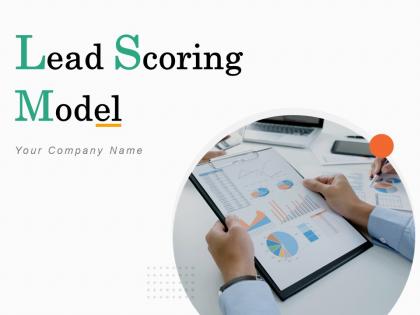
Slide 1: This slide displays Lead Scoring Model. State your Company name and begin.
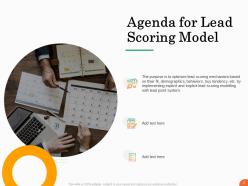
Slide 2: This slide displays Agenda for Lead Scoring Model.
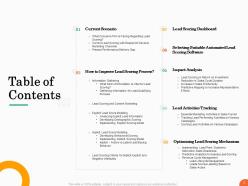
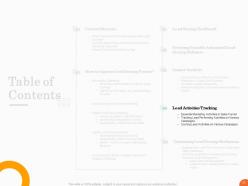
Slide 3: This slide displays Table of Contents.
Slide 4: This slide depicts Table of Contents.
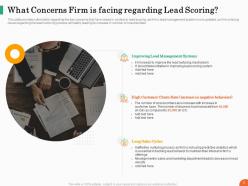
Slide 5: This slide provides information regarding the key concerns that have raised in context to lead scoring, as firm’s lead management system is not updated, so firm is facing issues regarding the lead nurturing process ultimately leading to increase in number of unsubscribes.
Slide 6: This slide provides information regarding lead scoring that firm provides to its prospects based on their activities on various marketing platforms.
Slide 7: This slide provides information regarding the present delivery gap that firm is facing in terms of its performance as compared to the industry standards.
Slide 8: This slide displays the Table of Contents.
Slide 9: This slide depicts What kind of information is vital for Lead Scoring?
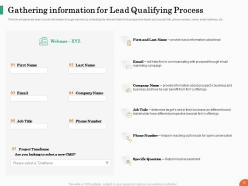
Slide 10: This slide describes Gathering information for Lead Qualifying Process.
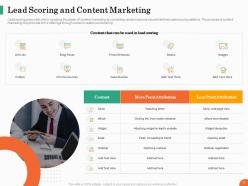
Slide 11: This slide showcases Lead Scoring and Content Marketing.
Slide 12: This slide displays Table of Contents.
Slide 13: This slide showcases Analyzing Explicit Lead Information.
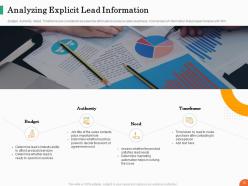
Slide 14: This slide depicts Analyzing Explicit Lead Information.
Slide 15: This slide showcases Developing Demographic Scoring.
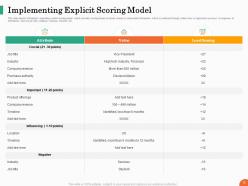
Slide 16: This slide depicts information regarding explicit scoring model which provides scoring based on leads shared or observable information which is collected through online form or registration process. It comprises of information such as job title, company revenue, location, etc.
Slide 17: This slide displays Table of Contents.
Slide 18: This slide showcases Developing Behavioral Scoring.
Slide 19: This slide showcases Implementing Implicit Scoring Model.
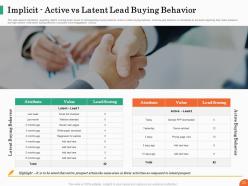
Slide 20: This slide depicts information regarding implicit scoring model based on distinguishing buying behavior active or latent buying behavior. Active buying behavior is considered as hot leads depicting their sales readiness and high interest while latent buying behavior concludes lower engagement activity.
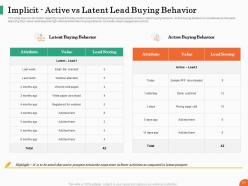
Slide 21: This slide depicts information regarding implicit scoring model based on distinguishing buying behavior active or latent buying behavior.
Slide 22: This slide displays Table of Contents of the presentation.
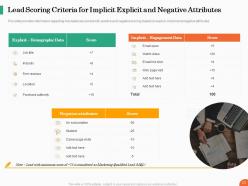
Slide 23: This slide provides information regarding how leads are scored with positive and negative scoring based on explicit, implicit and negative attributes.
Slide 24: This slide displays Table of Contents of the presentation.
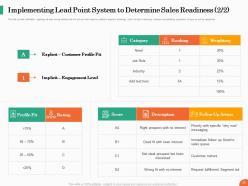
Slide 25: This slide depicts Implementing Lead Point System to Determine Sales Readiness.
Slide 26: This slide showcases Implementing Lead Point System to Determine Sales Readiness.
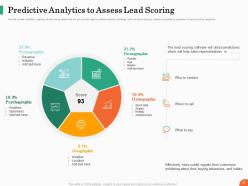
Slide 27: This slide provides information regarding the lead scoring software the firm will use which caters to predictive analytics technology which will help in improving revenues and optimizing experience of buyer as well as salesperson.
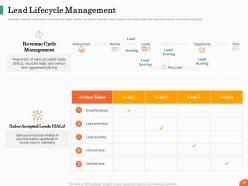
Slide 28: This slide showcases Lead Lifecycle Management.
Slide 29: This slide is continued with Lead Lifecycle Management.
Slide 30: This slide showcases Leads Scores Labeling based on Sales Action.
Slide 31: This slide displays Table of Contents of the presentation.
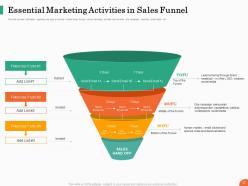
Slide 32: This slide displays Essential Marketing Activities in Sales Funnel.
Slide 33: This slide depicts Tracking Lead Performing Activities on Various Campaigns.
Slide 34: This slide presents Scoring Lead Activities on Various Campaigns.
Slide 35: This slide displays Table of Contents.
Slide 36: This slide showcases Impact Analysis - Lead Scoring on Return on Investment.
Slide 37: This slide shows Impact Analysis - Reduction in Sales Cycle Duration.
Slide 38: This slide showcases Impact Analysis - Increase in Sales Productivity.
Slide 39: This slide showcases Impact Analysis – Predictive Mapping to Increase Representative Efforts.
Slide 40: This slide displays Table of Contents.
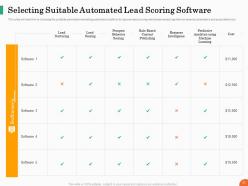
Slide 41: This slide showcases Selecting Suitable Automated Lead Scoring Software.
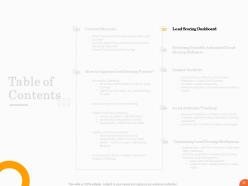
Slide 42: This slide displays the Table of Contents.
Slide 43: This slide showcases Lead Scoring Dashboard. The dashboard will provide overall scenario of all leads and track various leads based on the grading(point) assigned to them.
Slide 44: This slide showcases Lead Scoring Dashboard. This slide provides information regarding the dashboard that depicts lead ranking information with leads qualification rating, leads interest level, etc.
Slide 45: This is Lead Scoring Model Icons Slide.
Slide 46: This slide is titled as Additional Slides for moving forward.
Slide 47: This is Our Team slide with names and designations.
Slide 48: This is About Us slide to showcase Company
Slide 49: This is Our Mission slide with Vision, Mission and Goal.
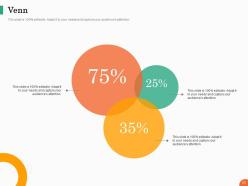
Slide 50: This is Venn slide with related imagery.
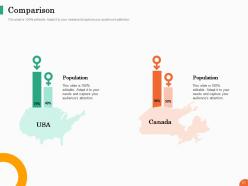
Slide 51: This is Comparison slide.
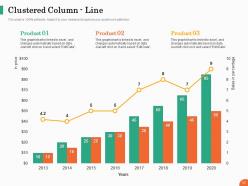
Slide 52: This slide displays Clustered Column - Line chart with product comparison.
Slide 53: This slide displays Clustered Bar Chart with product comparison.
Slide 54: This slide depicts Timeline process.
Slide 55: This slide displays Roadmap process.
Slide 56: This is 30 60 90 Days Plan slide.
Slide 57: This is Thank You slide with Address, Contact number and Email address.
Lead scoring model powerpoint presentation slides with all 57 slides:
Use our Lead Scoring Model Powerpoint Presentation Slides to effectively help you save your valuable time. They are readymade to fit into any presentation structure.






















FAQs for Lead scoring model
So you'll need demographic stuff first - job titles, company size, that kind of thing. Pretty easy to set up. Then there's behavioral tracking, which is honestly where most people mess up. Track email opens, site visits, downloads, all that. Give each action point values based on actual buying intent (not just random numbers). Oh and don't forget negative scoring for unsubscribes or when people change jobs. I'd start with maybe 5-10 key actions, test it for a month, then adjust based on what your sales team says about lead quality. They'll tell you real quick if you're sending them garbage leads.
So B2B scoring is all about company stuff - their size, industry, job titles, who actually has buying power. Makes sense since those sales drag on forever with like 5 people making decisions. B2C is totally different though. You're looking at individual behavior instead - what they bought before, how they engage, personal interests. Way faster cycles too, so you can be more aggressive with scoring immediate buying signals. Honestly, B2B leads get babied longer while B2C you're pushing for quick conversions. Just map out how your buyers actually behave first - that'll tell you what signals matter.
Focus on engagement stuff first - opens, clicks, downloads. That shows they actually care. Job titles and company size matter too since you don't want to waste time on people who can't even buy your thing. Behavioral signals are gold though - pricing page visits, demo requests, how long they hang out on product pages. Mix what people tell you directly with what they actually do. Honestly, I'd start with maybe 3-4 simple metrics, see what connects to real sales, then build from there. Don't overcomplicate it right away.
Dude, you should totally try machine learning for lead scoring - it's actually crazy how much better it gets. Traditional scoring only looks at basic stuff like job title and company size. But ML? It can crunch behavioral data, timing patterns, what content they click on, literally dozens of signals at once. The coolest part is it keeps learning from your actual conversions and tweaks itself automatically. No more manual rule updates every quarter (thank god). Just dump your historical conversion data into an ML platform and watch what happens. Most people see improvements pretty fast, like within a month. Worth testing for sure.
Look, customer behavior is what really matters for lead scoring - way better than just demographics. Track stuff like email opens, site visits, content downloads, demo requests. Oh and pricing page visits are gold. Someone who's hit your pricing page three times and grabbed a couple whitepapers? That's your money lead right there. Much hotter than a random newsletter signup. Short sentences work too. The trick is figuring out which behaviors actually match your closed deals. I mean, there's no point scoring someone high if they never convert, right?
Honestly, monthly is way better than quarterly if you've got decent lead volume. Your conversion rates shift faster than you'd think - market changes, customer behavior evolves, new channels come online. I learned this the hard way when our "high quality" leads started converting terribly because we hadn't updated our model in months. Track which scored leads actually turn into customers, and definitely listen when your sales team complains about lead quality (they're usually right). Set a calendar reminder now or you'll totally forget. Trust me on this one.
Don't overcomplicate your scoring - that's the biggest mistake I see. Teams get excited and start tracking like 20 different behaviors when honestly 5-8 work way better. Short sentences hit harder anyway. Talk to your sales team BEFORE you build anything though. So many people skip this step and wonder why their leads get ignored. Sales knows what actually converts, and if they don't trust your scoring system, you're screwed. Start simple, get their input early, then track the right metrics to see if it's actually working. Way easier to add complexity later than fix a broken system.
Honestly, I'd go like 65% quantitative stuff - email opens, site visits, downloads, whatever's easy to track. Then 35% for the softer things like whether their job title actually makes sense or if they seemed engaged on that demo call. I know scoring "gut feelings" sounds dumb, but just use a 1-5 scale for the qualitative bits. Works better than you'd think. Start there and see how it goes - if your sales people keep complaining the leads suck, maybe flip it to 60/40 or something. The split isn't set in stone.
Honestly depends on your budget and how tech-savvy your team is. HubSpot's pretty solid for beginners - their lead scoring is straightforward to figure out. Pardot's decent too. Want something more advanced? Salesforce Einstein or Marketo, though fair warning - Marketo's interface is kind of annoying to navigate sometimes. Your team good with data? Python with scikit-learn lets you build custom models, or even Tableau works. I'd start with whatever scoring features your current CRM already has. No point overcomplicating things right away. You can always upgrade later when you actually need the fancy stuff.
So basically lead scoring gives your sales and marketing teams a way to actually agree on what counts as a good lead. No more marketing dumping random contacts while sales complains they're all garbage. You set the scoring rules together upfront - marketing aims for those target scores, sales knows which leads are worth their time. Honestly, it's kind of genius when everyone's looking at the same data. The key is having regular check-ins to tweak your criteria because what worked six months ago might be totally off now. Makes everything way less chaotic.
So most people go with demographic stuff first - job titles, company size, that kind of thing. Then there's behavioral scoring which tracks website visits and email opens. BANT is still everywhere even though it's ancient at this point, honestly. Predictive scoring with machine learning is getting really popular too. It digs through your old data to spot patterns you'd probably miss. Companies usually start simple with basic point systems then add more complex stuff later. I'd say go with demographic plus behavioral first since it's easy to set up and you'll get decent baseline data. Way better than jumping into the deep end right away.
Think of demographics as your scoring shortcuts - they help you spot leads that look like your best customers. Your top clients are usually CTOs at mid-size companies? Bump up scores for those titles and company sizes. Job level, industry, location all factor in. Company revenue tends to matter way more than personal stuff for B2B though, just saying. You'll want to check your scoring weights against real conversion numbers pretty regularly. I'd start simple - find 3-5 traits your best customers actually share, then weight those heavily in your model.
Honestly, lead scoring is a total game-changer - you'll see conversion rates jump 20-30% easy. Track your current numbers first, then try basic scoring for a month. The whole point is focusing on prospects who actually want to buy instead of wasting time on everyone. High-scoring leads are the ones downloading your stuff multiple times or obsessing over your pricing page (those are the goldmine ones). Don't worry, cold leads still get nurtured until they warm up. Sales efficiency goes through the roof because you're not chasing random people anymore.
Basically you just track what happens to your scored leads and use that data to make the scoring better. So like, which ones actually converted, which ones were duds, how long sales took - all that stuff goes back into the model. Most companies are terrible at this part honestly, they set it up then never look at it again. But if you stay on top of it, the algorithm starts picking up on your specific patterns and gets way more accurate over time. I'd probably start with monthly check-ins where you compare your scores against what actually happened. It's kind of tedious but totally worth it.
Show them real examples first - how sales can jump on hot prospects, how marketing sees which campaigns actually work. I'd run workshops with actual CRM data so they can watch it happen live. Seriously, nothing convinces people like watching a high-scored lead convert right in front of them! Make simple one-pagers explaining the scoring breakdown. Share wins constantly too. The whole point is making it feel genuinely helpful instead of just another system to figure out. People hate learning new tools unless they immediately see what's in it for them.
-
Amazing product with appealing content and design.
-
Illustrative design with editable content. Exceptional value for money. Highly pleased with the product.
-
Very unique and reliable designs.
-
Excellent Designs.
-
Top Quality presentations that are easily editable.