


Lead management process powerpoint ideas





Try Before you Buy Download Free Sample Product
 Impress Your
 Audience
 100%
100% Editable
 Save Hours
 of Time


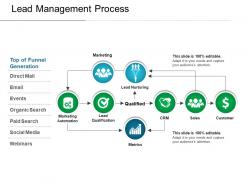
Introducing Lead Management Process PowerPoint Ideas. This PPT slide can be very helpful for an organization for the initiation of consumer interest or inquiry into its products or services. Using this PowerPoint presentation for sales management enables you to create marketing leads and generate revenue which brings more profit. The lead management process slide template includes an attractive flow diagram depicting the entire procedure of the generation of leads for an organization. It includes various icons depicting marketing automation, lead qualification, sales, customers, etc. which are very easy to understand and can help you create the best marketing strategies. Using this PowerPoint slide for customer acquisition you can explain the significance of generating consumer interest for your brand in order to grow. Therefore download this ready to use PPT for lead management and obtain maximum possible customers.
People who downloaded this PowerPoint presentation also viewed the following :
Lead management process powerpoint ideas with all 5 slides:
Develop the habit of being correct with our Lead Management Process Powerpoint Ideas. Their design is driven by facts.

FAQs for Lead management
So there's five main stages you gotta nail down. First, generate leads through whatever channels work for you. Then qualify them - seriously, this step saves you so much headache later because you're not chasing dead ends. After that, nurture the good ones with relevant content until they're actually ready to buy. Obviously the conversion part is where you close deals. But here's what people mess up - the follow-up stage is huge for getting repeat customers and referrals. Oh, and make sure marketing and sales actually talk to each other during handoffs, or you'll lose leads left and right.
Honestly, start with your actual conversion data - see which lead traits actually turn into sales, not what sounds good on paper. Check demographics, how people behave on your site, engagement levels of customers who bought. Weight your scoring based on that real stuff. Too many teams build these elaborate scoring systems that look impressive but don't work in practice. Your sales team needs to help define what counts as qualified - they see things your marketing data misses completely. Test different score thresholds and track what happens. Also, keep tweaking the scores based on results.
Honestly, think of your CRM like mission control for all your leads. It tracks every call, email, whatever - plus shows you exactly where each prospect is in your pipeline. The best part? You'll see the whole story from hello to handshake. Mine saves my butt when I'm managing like 30 different people at once. Auto follow-ups are clutch too. Your team stays on the same page so leads don't just... disappear into the void. Having everything centralized means you can finally figure out what actually converts. Oh, and set up your pipeline stages first - trust me on that one.
Honestly, start with your main conversion rate - leads to actual customers. That's what really matters at the end of the day. Break it down by where they're coming from too (social, email, ads, whatever you're doing). How long it takes to convert is super important because cold leads are basically useless. Also track conversion rates based on lead quality - like are your "hot" leads actually converting better? If you're paying for ads, definitely measure cost per converted lead or you'll burn through cash fast. The whole point is tracking from first contact to closed deal. These basics will show you exactly where people are dropping off.
Honestly, automation just handles all the boring stuff you hate doing anyway. Your hottest leads get flagged automatically through lead scoring, and email sequences run themselves while you're actually selling. No more awkward "whose turn is it?" moments either - leads get routed to the right person based on whatever rules you set up. The best part? Way fewer leads fall through the cracks since everything's tracked. I'd start with something simple like lead assignment first. Don't try to automate everything at once or you'll drive yourself crazy.
Honestly, the biggest pain points are usually crappy lead quality and slow follow-up. Marketing dumps a ton of leads on sales, but half are garbage - so your sales team gets burned out chasing dead ends. Super annoying for everyone. What's worked for me: score your leads first so you know which ones are actually worth calling. Set up some automated follow-up so nothing sits around for days. Oh, and make sure sales and marketing actually talk to each other about what's working. Start by figuring out where you're losing people in your current process - that'll show you the biggest leaks.
So basically you've got to match your approach to where they are mentally. Early on? Share helpful stuff like blog posts and industry insights - just build trust first. When they're actually looking around at options, that's when you bring out case studies and demos. Honestly, timing is everything here. Hit them with a sales pitch too early and they'll peace out immediately. Save the heavy stuff like personalized proposals and trials for when they're really ready to buy. I always watch how much they're engaging with emails to figure out when to turn up the heat.
Honestly, timing is everything - hit them back within 24-48 hours while you're fresh in their mind. After that, space things out over 2-3 weeks with maybe 5-7 touches total. Mix it up with email, calls, LinkedIn messages because some people are weirdly loyal to just one platform (seriously, why?). Don't just ping them randomly though. Share something actually useful each time - industry insights, relevant articles, stuff that shows you get their specific problems. If they go cold after your sequence, toss them into a longer nurture campaign. Oh, and track what's working so you can do more of that.
Honestly, social media's pretty solid for managing leads. You can grab them straight from platform forms or engage with people commenting on your stuff. LinkedIn crushes it for B2B - that's where the decision makers actually hang out. Facebook and Instagram work better if you're going after regular consumers though. The trick is setting up decent tracking so you know which posts are bringing in real leads, not just likes and shares. Oh, and respond fast to messages - people get annoyed waiting around on social platforms. Track their whole journey from that first comment to actually buying something.
Honestly, I'd start with the obvious stuff - industry, company size, job titles. That's your foundation. Then add behavioral data like who's opening emails, downloading content, visiting your site multiple times. Lead scoring is clutch here because it separates the tire-kickers from actual prospects. Don't forget geography if you've got regional teams or products. My advice? Begin with 3-4 basic segments max. You can always get fancier later once you see what works. Test different messages on each group - the patterns become pretty clear fast. I learned this the hard way by overcomplicating things initially.
Honestly? It makes or breaks everything. When sales and marketing aren't on the same page, leads disappear into black holes and nobody knows why the numbers suck. Both teams end up blaming each other - marketing says they're delivering leads, sales says they're garbage. You'll waste so much time on this back-and-forth drama. Get them together to hash out what a good lead actually looks like first. Then figure out the handoff process. I've watched companies lose entire quarters because these teams were basically working against each other instead of together.
Honestly, AI lead scoring is huge right now - it actually helps you figure out which prospects are worth your time. Most platforms are adding chatbots that work around the clock too, which is pretty sweet for catching leads when you're not available. The personalization stuff has gotten way better lately (thank god, because it used to be so robotic). Everything's moving toward these unified platforms where your CRM talks to email, social media - basically stops the data silos nightmare. I'd start by checking what AI tools you're already paying for but not using. Then figure out where leads are falling through the cracks.
Honestly, the secret is just treating people like actual people, not numbers in a spreadsheet. Break down your leads by their behavior and industry first - what they're clicking on tells you everything. Then customize your emails with their company name and pain points they've actually shown interest in. I always track what content someone's engaging with, then follow up on those exact topics. Makes the whole conversation feel way more natural. Oh, and timing matters too - hit them up when they're actually active. The whole point is making each message feel like you wrote it just for them, not some mass email blast everyone gets.
Honestly, analytics will blow your mind once you see what's actually happening vs what you assumed. Track where your best leads come from and where people bail out of your process. I got obsessed with this stuff last year - there's something satisfying about finding patterns in customer behavior. You'll figure out which leads deserve your attention first and what actually pushes people to buy. Don't overcomplicate it though. Just pick 2-3 things to watch consistently. Conversion rates by source is solid, plus how long deals take to close.
Look, feedback loops are basically your reality check system. You'll want to track stuff like conversion rates and lead quality, then actually use that data to fix what's broken. Your marketing and sales teams need to talk regularly - I'm talking monthly sit-downs where you review the numbers together. Pick 2-3 metrics that matter and watch how they trend. When something's off, tweak your messaging or follow-up timing. It's like GPS for your sales process, honestly. The whole point is catching problems before they tank your results.
-
Excellent Designs.
-
The content is very helpful from business point of view.