


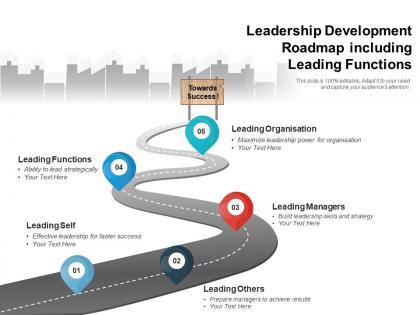
Leadership development roadmap including leading functions




Try Before you Buy Download Free Sample Product
 Impress Your
 Audience
 100%
100% Editable
 Save Hours
 of Time


Our Leadership Development Roadmap Including Leading Functions allow individuals to indulge their fancies. It caters for idiosyncracies.
People who downloaded this PowerPoint presentation also viewed the following :
Leadership development roadmap including leading functions with all 2 slides:
Assess the invention with our Leadership Development Roadmap Including Leading Functions. Figure out how to improve it further.
FAQs for Leadership development roadmap
Honestly? Adaptability and emotional intelligence are huge right now - way more than just being good at the technical stuff. Everything changes so fast that you've got to roll with ambiguity. Reading people matters too, plus managing your own emotions when things get messy. Communication skills are non-negotiable. Strategic thinking is another big one since you can't just react to everything anymore. Oh, and difficult conversations - you'll have them whether you like it or not. I'd say get some feedback on your strengths first, then pick one area to work on at a time.
Honestly, start with a solid leadership assessment - get 360-degree feedback, performance data, and a skills gap analysis. Survey your leaders, their teams, and stakeholders to see what's really happening. So many companies I've worked with completely skip the upward feedback part and wonder why their programs fail. Then look at succession planning - are you actually prepping people for jobs that'll exist in a few years? Compare what you have now against future business needs and industry standards. Here's the thing: you've got to be brutally honest about the gaps. Focus on whatever hits your strategic goals hardest first.
So EQ is huge for leadership, honestly. You've gotta read the room and manage your own stuff before you can connect with anyone else. I've watched some really smart leaders completely flame out because they couldn't pick up on emotional cues or handle their stress well. The good news? You can totally work on it. Try reflecting on what sets you off and notice how that impacts your choices. Ask people how you come across - might be awkward but super helpful. Oh, and actually listen when others talk instead of planning what you'll say next. Start with tracking your triggers this week.
Match your high-potential people with senior leaders who actually complement their skills - not just whoever's free that week. Here's what I'd do: set clear goals around specific leadership skills they want to build over 6-12 months. Most programs tank because they're basically aimless coffee dates. Monthly check-ins work well, and honestly? Give mentors some kind of framework so they're not winging it. The cool part is making it go both ways - mentees should challenge their mentors with fresh ideas too. I'd start with a small pilot group first, see what sticks, then expand from there.
Honestly? The hardest part is going from doing everything yourself to actually managing people - totally different game. At first you'll want to just do tasks yourself because it seems quicker. Don't fall for that, you'll burn out fast. Then there's all the awkward stuff like giving feedback and having tough conversations. Plus figuring out how to be friendly but still respected is... weird at first. Oh and suddenly you're doing performance reviews which nobody prepares you for. Start practicing delegation now even though it feels uncomfortable. Those conversations get easier, trust me.
Honestly, psychological safety is huge - people won't take risks if they think you'll roast them for failing. Give your team actual time to mess around with ideas, not just when they're "done" with real work. Celebrate the experiments that don't work out. I've seen too many managers say they want innovation but then micromanage everything. Ask open questions instead of telling people what to do. Bring in different voices and actually listen to what they say. Oh, and try asking your team what they'd attempt if failure wasn't scary. Actions matter way more than whatever's in your mission statement.
So here's the thing - diverse teams with inclusive leaders actually perform like 35% better than homogeneous ones. Makes total sense when you think about it. Different backgrounds mean you get way more creative solutions and avoid that groupthink trap where everyone just nods along. People feel safe throwing out their wildest ideas instead of playing it safe. But honestly? Don't just hire for diversity and call it a day. The magic happens when you create that psychological safety thing - where everyone genuinely feels heard. That's when performance really takes off.
Honestly, tech can totally transform leadership training if you use it right. VR simulations are amazing - your leaders can practice tough conversations without real consequences. Mobile apps work great too since people actually learn better grabbing quick lessons during their commute or whatever. AI platforms will create personalized paths based on everyone's specific weaknesses and strengths. Video calls make mentoring possible across different locations. Analytics show you what's actually moving the needle. My advice? Don't go crazy at first. Just pick one tool that fixes your biggest headache and build from there.
Honestly, timing is everything - don't sit on feedback for weeks. I always focus on what they did, not who they are as a person. Like "your presentation jumped around" vs "you're scattered," you know? The SBI thing actually works pretty well (Situation, Behavior, Impact) though it sounds kinda corporate when you say it out loud. Mix in some praise with the tough stuff too. Most emerging leaders want feedback way more than we think they do, so you're probably overthinking it. Make it a back-and-forth conversation. Ask what help they need instead of just telling them what's wrong.
Honestly, measuring ROI on leadership training is kinda tricky but doable. I'd track engagement scores, retention rates, and how many participants get promoted afterward. Revenue per employee works too if you can connect the dots. The annoying part? You can't always tell what's from the training vs. other stuff happening at your company. Set your baseline metrics first - like, actually measure before you start anything. Then check back at 6 and 12 months. Don't overcomplicate it though. Pick 2-3 metrics that actually matter to your business goals and stick with those.
Honestly, I'd start with mentorship - that's where the magic really happens. Find 2-3 people with potential and pair them up with your best leaders. Stretch assignments work great too, just throw them into something challenging where they have to figure stuff out. Oh and formal training programs are solid, but don't make it a one-and-done thing. Keep it going for at least 6 months. I've seen companies do this backwards though - they pick random people instead of actually identifying who has leadership potential first. Map out individual plans for each person you're developing.
Look, you've gotta keep learning as a leader or you'll get left in the dust. Everything changes so fast now. Podcasts are perfect for commutes - I'm obsessed with leadership ones lately. Books work too, even just 15 minutes a day. Executive coaching is amazing if you can swing it budget-wise. Peer groups are underrated honestly. LinkedIn Learning's decent, though sometimes feels a bit corporate-y. Oh, and mastermind groups are clutch for bouncing ideas off other leaders. Don't try everything at once though. Pick one thing that actually fits your crazy schedule and stick with it. Better to be consistent with something small than burn out trying to do it all.
Try the STOP thing - stop, breathe, look around at what's actually happening, then decide. Sounds basic but that little pause is everything. Oh and prep some decision frameworks beforehand when you're not stressed out of your mind. Like, think through scenarios during normal moments so you're not scrambling later. Here's what really helped me though - being okay with 80% certainty instead of needing perfect info (which never happens anyway). Practice this stuff on small decisions first. Your brain needs to build the habit before the big moments hit.
Dude, working across departments is honestly like a masterclass in leadership. You'll deal with totally different communication styles and priorities every day - builds your adaptability like crazy. Learning to translate between teams and find middle ground when everyone wants different things? That's pure influence training right there. Your company benefits too because you're literally tearing down those annoying silos that make everything slower. Innovation dies when departments don't talk to each other, so you become part of the solution. Start easy though - just grab coffee with someone from another team this week. Ask what's driving them nuts lately.
Look, self-reflection is what separates good leaders from the ones who keep making the same mistakes over and over. I'd start by blocking out 15 minutes every Friday - sounds boring but hear me out. Ask yourself the hard stuff: what worked this week? Where'd I screw up? You can journal if that's your thing, or just record voice memos during your drive (honestly works better than I expected). The trick isn't doing it perfectly, it's doing it consistently. Most people only reflect when everything's on fire, but you'll get way more out of it if you make it routine.
No Reviews