


Learning and development cycle powerpoint slide background




Try Before you Buy Download Free Sample Product
 Impress Your
 Audience
 100%
100% Editable
 Save Hours
 of Time


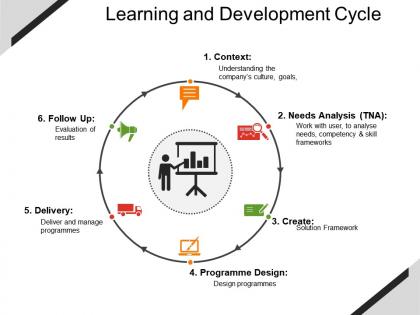
Educate your employees the important strategy of learning and development with the help of our Learning And Development Cycle PowerPoint Slide. In order to make use of most of its resources it is vital for an organization to keep developing in the right way. Define the ways of developing the important assets of the organization including the human resource, technology, capability and other important resources in order to achieve the organizational objective. This PowerPoint template can be employed by business analysts, strategists, project managers, educators and other related professionals. Elucidate different methods of training and provide a stepwise training process by incorporating this PowerPoint template. Cover the basics of training and development, the learning culture, the overall learning and development process and the other development related activities with the assistance of this readymade PPT slide. Mention the learning objectives and the plan for personal development by downloading this training plan template.
People who downloaded this PowerPoint presentation also viewed the following :
Learning and development cycle powerpoint slide background with all 5 slides:
Grapple with insecurities with our Learning And Development Cycle Powerpoint Slide Background. Enhance the degree of assuredness existing.
FAQs for Learning and development cycle
So there's basically four stages to think about: assessment, design, delivery, and evaluation. First, figure out what skills your team's actually missing. Design some training around those gaps - could be workshops, online stuff, whatever clicks with your people. Then comes delivery, which is the obvious part where learning happens. Here's what drives me crazy though - most people totally skip evaluation! Don't be that person. You need to know if it worked. Oh, and treat this as a real cycle. Your evaluation results should loop back into your next assessment so you're constantly getting better at this whole thing.
So there's this three-level thing most companies do - organizational, task, and individual analysis. First you'd check your company's big goals and see where there are gaps. Job roles come next - what skills are actually needed vs. what people have. Then get down to individual performance through surveys, interviews, reviews, that whole deal. Honestly feels more like guesswork half the time! Pull info from everywhere - managers, employees, even customers if you can. Performance data too obviously. Oh and definitely rank everything by what'll actually move the needle for your business before you start building training stuff.
Dude, feedback is what stops your L&D from being a total waste of time. You can't just throw training at people and hope it works - you need to actually check if they're learning anything or just zoning out. Get input from learners while they're in sessions, ask managers how things are going after, and track performance later on. Programs that collect feedback properly actually stick around. The ones that don't? Forgotten by next week, honestly. Don't just wait for people to speak up either - you'll be waiting forever. Build in specific times to gather their thoughts.
Start with AI skills gap analysis to see what your team actually needs. Then grab adaptive learning platforms that adjust based on progress. VR training is honestly incredible for hands-on stuff - think practicing surgery without, you know, accidentally killing someone. Microlearning apps work great for delivery. Analytics dashboards help track if people actually retained anything afterward. The trick? Don't just pick shiny tools that look cool. Pick ones that solve real problems. I'd start small with maybe two technologies and build up from there. Way less overwhelming that way.
Honestly, the hardest part is convincing leadership when they can't see immediate results - they want ROI like, yesterday. Resource constraints are brutal too. Then there's figuring out if your training actually works or if people just liked the snacks, you know? Getting buy-in from employees who are already drowning in work is another nightmare. Oh, and keeping everything updated takes forever - way longer than anyone budgets for. My take? Start with small pilot programs first. Prove it works on a smaller scale, then connect everything back to business goals that executives actually care about. Makes your life so much easier.
Honestly, you've gotta track this stuff on like four different levels. Get immediate feedback first - did people think it was useful or total garbage? Then actually test if they learned anything through demos or whatever. Here's where it gets tricky though: are they using this back at work? Manager check-ins and follow-up surveys help here. Business metrics come last - think productivity, retention, sales numbers. Oh and definitely set up your tracking plan before you launch everything. Trust me on this one - trying to measure success after the fact is a nightmare.
So for tracking skills, pre/post assessments are your go-to - they actually show if people learned anything. Performance reviews and 360 feedback cover the soft skills stuff. But honestly? Leadership only really cares about the hard numbers - sales figures, project completion rates, that kind of thing. Those show if training actually works in the real world. Oh, and tracking how fast people pick up new skills is pretty telling too. Internal promotion rates are another good one. I'd start with whatever's easiest to measure in your current setup, then add more later.
Oh yeah, this actually works really well! Survey your team first about how they like to learn. Then mix it up within each phase - throw in diagrams for visual people, add some role-playing for hands-on learners. Podcasts and group discussions work great for auditory types. I honestly think the mixed approach is way better than trying to pick just one method. We've done this with teams where everyone learns totally differently and it's night and day. Just don't make everyone sit through identical training - that's brutal.
Culture is honestly everything when it comes to L&D programs. People will actually use what they learn if they feel safe to mess up and ask questions. But in places where admitting you don't know something feels risky? Forget it - even amazing training becomes a waste of time. The feedback culture matters too since that's how you know if anything's actually working. I've seen companies dump money into fancy programs while their culture basically kills any chance of success. Before you roll out training, take a hard look at whether your environment will actually support learning or just pay lip service to it.
Okay so continuous learning is what actually makes L&D work instead of being a total waste of time. You know how most training ends after the workshop? This approach keeps going - people practice, update their skills, apply stuff regularly. It threads through your whole cycle, from spotting skill gaps to measuring results and starting over. Traditional training = one-time event that everyone forgets. Continuous learning = ongoing touchpoints and refreshers that stick. Honestly, it's the difference between companies that develop real talent versus those just going through the motions. When you design programs, build in ways for people to keep using what they learned instead of cramming everything into one session.
Mix things up - don't just do those marathon hour-long sessions that put everyone to sleep. Rotate between live stuff, self-paced modules, and actual hands-on work. Here's the thing though: it HAS to connect to what they're dealing with day-to-day or you've lost them. Generic training is basically useless. Throw in discussion forums or peer groups so people can actually talk to each other. Progress badges work surprisingly well too. But honestly? Just ask your current learners what sucks and what doesn't. Their feedback will tell you way more than any expert advice.
Psychological safety is huge - your team won't take risks if they're scared of getting roasted for mistakes. Check in regularly about what they want to learn and clear out stupid barriers like "we don't have time for training" nonsense. The good leaders I know? They share their own screw-ups openly. Celebrate when people try new things, even if it doesn't work perfectly. Quick feedback helps too. Connect them with mentors or give them stretch projects. Oh, and actually ask what's blocking their growth right now - then fix it instead of just nodding along.
Honestly, informal learning is a game changer for L&D. Coffee chats with people from other departments, mentoring sessions, job shadowing - that stuff works. I've learned more from random conversations than some formal training sessions, not gonna lie. It fills those gaps between official programs and keeps skills fresh. People can learn when it actually makes sense for them instead of being stuck in scheduled workshops. Way cheaper too. Lunch-and-learns are perfect for this, or just setting up peer sessions where people share what they know.
Honestly, it's way easier than you'd think! Start by having mentors spot skill gaps during your needs assessment - they see this stuff daily anyway. Get them involved when you're building programs too. They've got the best real-world examples that actually stick with people (way better than boring case studies). Pair up formal training with mentor sessions during delivery. Oh, and mentors are perfect for ongoing feedback since they watch how people apply new skills back on the job. Just don't treat mentorship like some separate thing you tack on later. Weave it through everything.
Honestly, AI personalization is where everything's heading - platforms that actually adjust to how each person learns best. Microlearning is already huge, breaking stuff into tiny chunks people can grab exactly when they need it. VR training costs are finally dropping (thank god), so you'll see way more immersive practice for hands-on jobs. The whole model's shifting from those awful annual training sessions to continuous learning that just flows with daily work. You should start testing this stuff now, even small experiments. People already expect personalized experiences everywhere else, so why not training?
-
Qualitative and comprehensive slides.
-
Awesome presentation, really professional and easy to edit.