

Learning and development dashboard employee professional growth ppt download




Try Before you Buy Download Free Sample Product
 Impress Your
Audience
 100%
Editable
 Save Hours
of Time


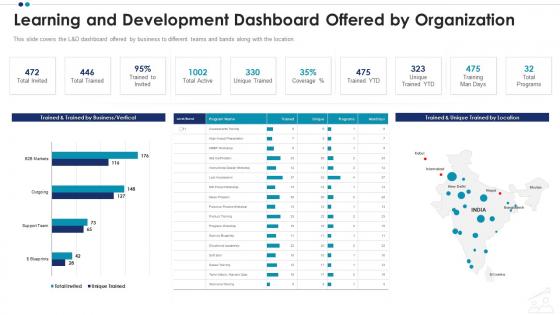
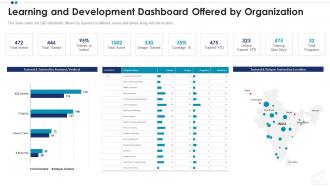
This slide covers the L and D dashboard offered by business to different teams and bands along with the location.
People who downloaded this PowerPoint presentation also viewed the following :
Learning and development dashboard employee professional growth ppt download with all 7 slides:
Use our Learning And Development Dashboard Employee Professional Growth Ppt Download to effectively help you save your valuable time. They are readymade to fit into any presentation structure.






FAQs for Learning and development dashboard employee professional
Key performance indicators for an Employee Development Dashboard include training completion rates, skill progression metrics, performance improvement scores, career advancement tracking, and employee engagement levels. These KPIs enable organizations to measure learning effectiveness, identify skill gaps, and optimize development investments, with many companies finding that comprehensive tracking ultimately delivers higher retention rates and improved organizational capability.
Employee feedback shapes development dashboard features by identifying critical learning gaps, preferred interface designs, and essential tracking metrics that align with actual career aspirations. Through surveys and focus groups, organizations can prioritize features like skill mapping, personalized learning paths, and progress visualization, while feedback reveals which mentoring tools and performance indicators truly drive engagement, ultimately creating dashboards that enhance both employee satisfaction and organizational talent retention.
Employee Development Dashboards can integrate learning management systems, performance tracking software, goal-setting applications, feedback collection tools, and career planning platforms. These integrations streamline development processes by centralizing employee progress data, automating skill assessments, and providing personalized learning recommendations, with many organizations finding that unified dashboards significantly enhance engagement and accelerate professional growth outcomes.
Employee development dashboards should update data weekly for performance metrics and monthly for comprehensive development assessments, with real-time updates for training completions and goal progress. This balanced approach enables HR teams and managers to track employee growth consistently while avoiding data overload, with many organizations finding that weekly reviews enhance coaching effectiveness and monthly assessments support strategic talent development planning.
Gamification motivates employees through development dashboards by incorporating achievement badges, progress bars, leaderboards, point systems, and milestone celebrations that transform learning into engaging experiences. These interactive elements encourage healthy competition, recognize accomplishments, and provide clear visual feedback on skill development, with many organizations finding that gamified approaches significantly boost participation rates and knowledge retention.
Organizations ensure data privacy and security through role-based access controls, end-to-end encryption, regular security audits, multi-factor authentication, and compliance with GDPR regulations. These security measures streamline data protection by limiting unauthorized access, securing sensitive performance data, and maintaining employee trust, while enabling HR departments to deliver personalized development programs with confidence and regulatory compliance.
A development dashboard can track formal learning through course completions, certifications, training hours, and assessment scores, while monitoring informal learning via peer interactions, mentoring sessions, knowledge sharing activities, and project-based learning metrics. These integrated tracking capabilities enable organizations to capture comprehensive learning data, identify skill gaps more effectively, and create personalized development pathways, ultimately delivering holistic employee growth insights.
Visual design elements enhance Employee Development Dashboard usability by implementing intuitive navigation systems, clear data visualization through charts and progress bars, consistent color coding for different skill categories, and responsive layouts that adapt across devices. These design principles streamline information access, reduce cognitive load for HR professionals and employees, and ultimately deliver faster performance reviews and more engaging development experiences, with many organizations finding that well-designed interfaces increase employee participation in development programs.
Effectiveness evaluation methods include performance metrics analysis, ROI calculations, skill assessment comparisons, employee feedback surveys, and retention rate tracking. Through dashboard analytics, organizations can measure training completion rates, productivity improvements, and career advancement progress, while correlating development investments with business outcomes, ultimately enabling data-driven decisions that enhance workforce capabilities and competitive advantage.
An Employee Development Dashboard supports alignment by providing transparent visibility into individual progress, connecting personal development paths to strategic company goals, and enabling managers to track skill-building initiatives. Through real-time analytics and goal mapping features, organizations streamline performance management, enhance employee engagement, and accelerate talent development, ultimately delivering strategic workforce alignment and competitive advantage.
Training should include dashboard navigation fundamentals, data interpretation skills, goal-setting methodologies, performance analytics understanding, and feedback delivery techniques. Organizations typically provide interactive tutorials, role-specific workshops, and ongoing coaching sessions, with many companies finding that comprehensive onboarding combined with peer mentoring ultimately delivers higher engagement rates and more effective professional development outcomes.
Implementing an Employee Development Dashboard in remote work settings presents challenges including limited face-to-face interaction, technology accessibility variations, reduced informal mentoring opportunities, and difficulty tracking engagement levels. While these obstacles exist, many organizations find that strategic dashboard design, enhanced digital communication channels, and virtual mentoring programs ultimately deliver improved transparency and structured development pathways for distributed teams.
Mentorship and coaching can be integrated through tracking mentor-mentee pairings, scheduling regular check-ins, setting developmental goals, and monitoring progress metrics within the dashboard interface. These features enable HR teams to facilitate meaningful connections, track coaching outcomes, and measure skill development across departments, with many organizations finding that integrated mentorship tools significantly enhance employee engagement and accelerate career progression.
Dashboard customization best practices include role-based access controls, personalized metric selection, flexible layout options, scalable data filters, and intuitive navigation design. These approaches streamline user experiences by delivering relevant information, reducing cognitive overload, and enabling self-service analytics, with many organizations finding that customized dashboards enhance employee engagement and accelerate decision-making across departments.
Dashboard analytics inform development strategies by revealing skill gaps, tracking training effectiveness, identifying high-potential employees, and correlating development activities with performance outcomes. Through predictive modeling and trend analysis, organizations can strategically allocate resources, customize learning paths, and anticipate future talent needs, ultimately delivering more targeted development programs and improved employee retention.
-
Enough space for editing and adding your own content.
-
Designs have enough space to add content.