


LoRaWAN Powerpoint Presentation Slides




Try Before you Buy Download Free Sample Product
 Impress Your
 Audience
 100%
100% Editable
 Save Hours
 of Time


Check out our professionally designed LoRaWAN IT template. This LoRaWAN presentation covers the introduction, relation with LPWAN, the network component of LoRaWAN, LoRaWAN security, and much more. Moreover, in the LPWAN Low Power Wide Area Network presentation, the network consists of three main components end devices, gateways, and a network server. Further, the Wide Area Networking WAN template displays the LoRaWAN gateway and base station technology that provide specific requirements for building a reliable and secure IoT network. Also, the Low Power, Wide Area networking protocol PPT illustrates critical aspects of LoRaWAN, and the technology employs a range of measures to ensure the confidentiality, integrity, and availability of data transmitted over the network. Additionally, in Application Server PowerPoint, these measures include message encryption, device authentication, and network-level security protocols. Finally, the Network Server module highlights one of the main challenges, ensuring interoperability between devices and networks, as there are currently multiple standard versions. Download our 100 percent editable and customizable template, also compatible with Google Slides.
People who downloaded this PowerPoint presentation also viewed the following :
Content of this Powerpoint Presentation
Slide 1: The slide introduces LoRaWAN.
Slide 2: This is an Agenda slide. State your agendas here.
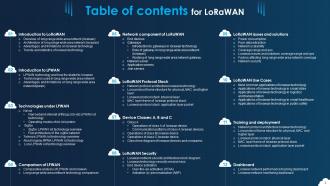
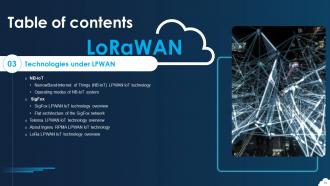
Slide 3: The slide displays Table of contents for presentation.
Slide 4: The slide again renders Title of contents.
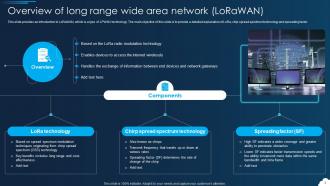
Slide 5: This slide provides an introduction to LoRaWAN, which is a type of LPWAN technology.
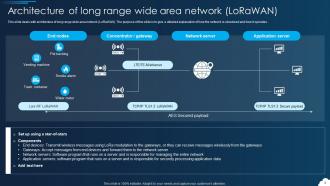
Slide 6: This slide deals with architecture of long range wide area network (LoRaWAN).
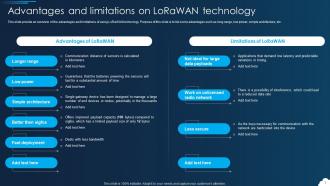
Slide 7: This slide provide an overview of the advantages and limitations of using LoRaWAN technology.
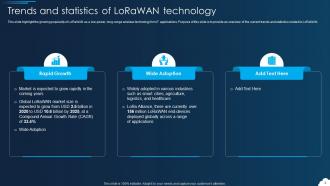
Slide 8: This slide highlight the growing popularity of LoRaWAN as a low-power, long-range wireless technology for IoT applications.
Slide 9: The slide describes Title of contents further.
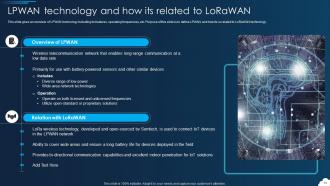
Slide 10: This slide gives an overview of LPWAN technology including its features, operating frequencies, etc.
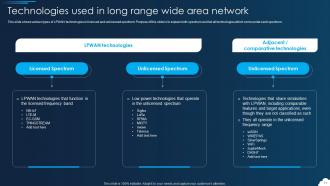
Slide 11: This slide shows various types of LPWAN technologies in licensed and unlicensed spectrum.
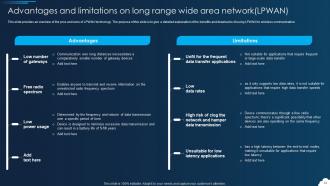
Slide 12: This slide provides an overview of the pros and cons of LPWAN technology.
Slide 13: The slide displays Title of contents further.
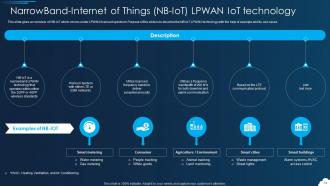
Slide 14: This slide gives an overview of NB-IoT which comes under LPWAN licensed spectrum.
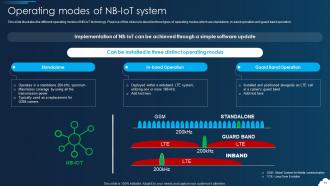
Slide 15: This slide illustrates the different operating modes of NB-IoT technology.
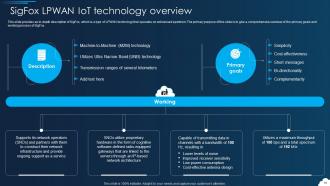
Slide 16: This slide provides an in-depth description of SigFox, which is a type of LPWAN technology that operates on unlicensed spectrum.
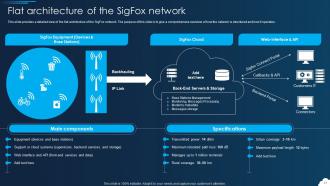
Slide 17: This slide provides a detailed view of the flat architecture of the SigFox network.
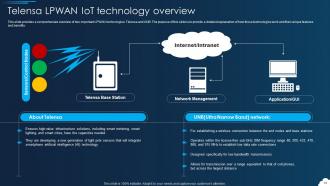
Slide 18: This slide provides a comprehensive overview of two important LPWAN technologies: Telensa and UNB.
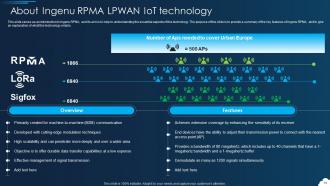
Slide 19: This slide serves as an introduction to Ingenu RPMA, and its aim is to help in understanding the essential aspects of this technology.
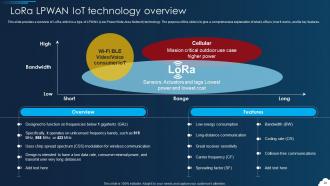
Slide 20: This slide provides a overview of LoRa, which is a type of LPWAN (Low-Power Wide-Area Network) technology.
Slide 21: The slide represents Title of contents further.
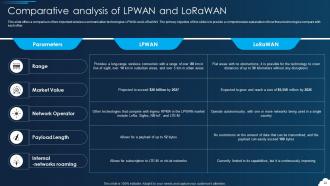
Slide 22: This slide offers a comparison of two important wireless communication technologies: LPWAN and LoRaWAN.
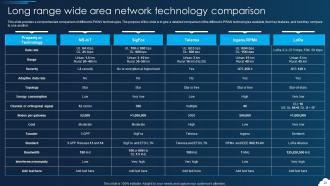
Slide 23: This slide provides a comprehensive comparison of different LPWAN technologies.
Slide 24: The slide renders another Title of contents.
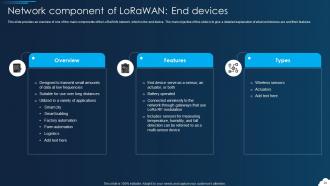
Slide 25: This slide provides an overview of one of the main components of the LoRaWAN network, which is the end device.
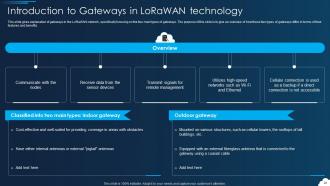
Slide 26: This slide gives explanation of gateways in the LoRaWAN network, specifically focusing on the two main types of gateways.
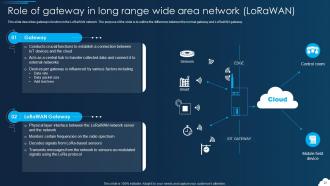
Slide 27: This slide describes gateway's function in the LoRaWAN network.
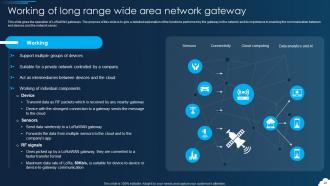
Slide 28: This slide gives the operation of LoRaWAN gateways.
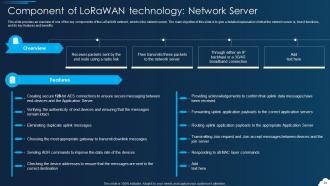
Slide 29: This slide provides an overview of one of the key components of the LoRaWAN network, which is the network server.
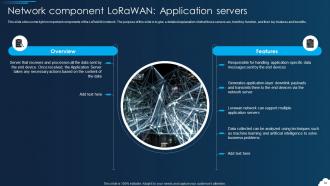
Slide 30: This slide shins some light on important components of the LoRaWAN network.
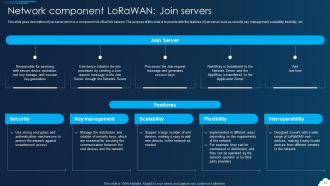
Slide 31: This slide gives description of join server which is a component of LoRaWAN network.
Slide 32: The slide depicts Title of contents which is to be discussed further.
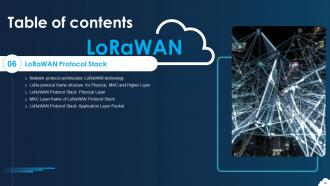
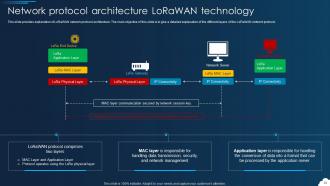
Slide 33: This slide provides explanation of LoRaWAN network protocol architecture.
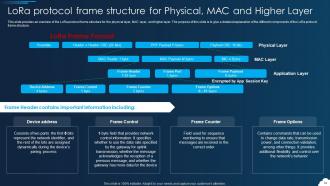
Slide 34: This slide provides an overview of the LoRa protocol frame structure for the physical layer, MAC layer, and higher layer.
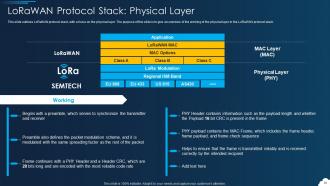
Slide 35: This slide outlines LoRaWAN protocol stack, with a focus on the physical layer.
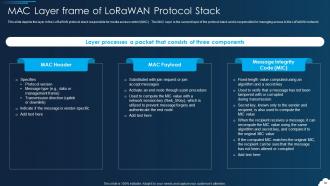
Slide 36: This slide depicts the layer in the LoRaWAN protocol stack responsible for media access control (MAC).
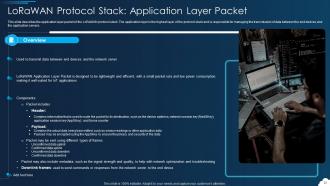
Slide 37: This slide highlights the application layer packet of the LoRaWAN protocol stack.
Slide 38: The slide describes Title of contents further.
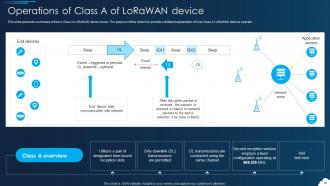
Slide 39: This slide presents a summary of how a Class A LoRaWAN device works.
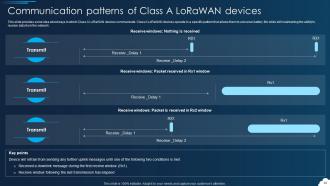
Slide 40: This slide provides some idea about ways in which Class A LoRaWAN devices communicate.
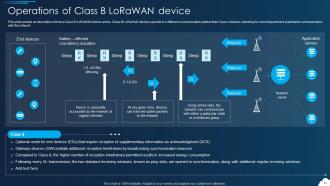
Slide 41: This slide gives an description of how a Class B LoRaWAN device works.
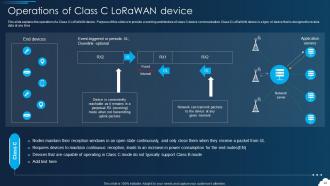
Slide 42: This slide explains the operation of a Class C LoRaWAN device.
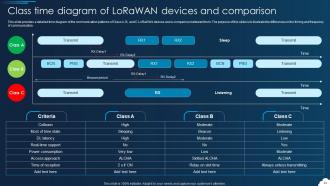
Slide 43: This slide provides a detailed time diagram of the communication patterns of Class A, B, and C LoRaWAN devices and a comparison between them.
Slide 44: The slide depicts Title of contents further.
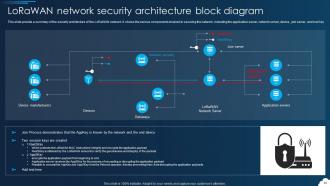
Slide 45: This slide shows a summary of the security architecture of the LoRaWAN network.
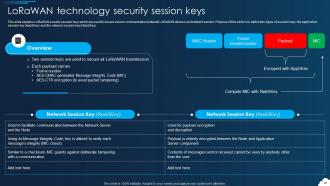
Slide 46: This slide explains LoRaWAN security session keys which are used to ensure secure communication between LoRaWAN devices and network servers.
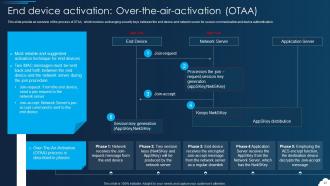
Slide 47: This slide provide an overview of the process of OTAA, which involves exchanging security keys between the end device and network server.
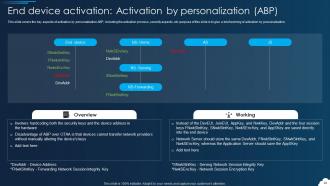
Slide 48: This slide covers the key aspects of activation by personalization ABP, including the activation process, security aspects, etc.
Slide 49: The slide renders Title of contents further.
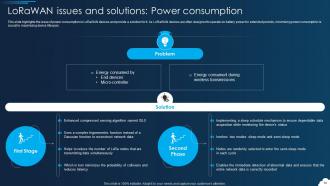
Slide 50: This slide highlights the issue of power consumption in LoRaWAN devices and provide a solution for it.
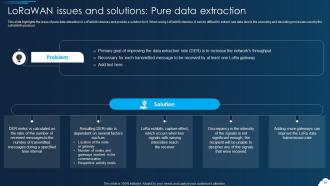
Slide 51: This slide depicts the issue of pure data extraction in LoRaWAN devices and provide a solution for it.
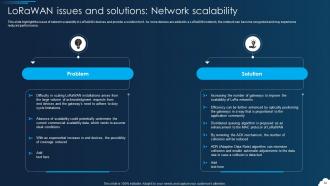
Slide 52: This slide renders the issue of network scalability in LoRaWAN devices and provide a solution for it.
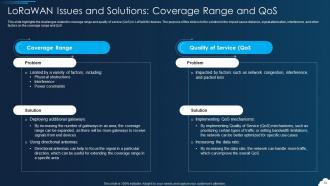
Slide 53: This slide illustrates the challenges related to coverage range and quality of service (QoS) in LoRaWAN devices.
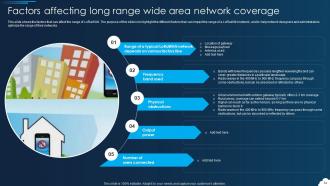
Slide 54: This slide shows the factors that can affect the range of LoRaWAN.
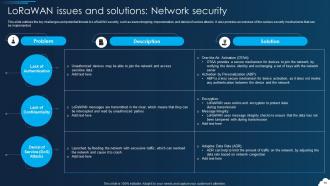
Slide 55: This slide outlines the key challenges and potential threats to LoRaWAN security.
Slide 56: The slide depicts title of contents which is to be discussed further.
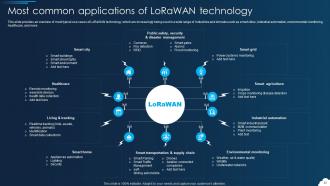
Slide 57: This slide provides an overview of most typical use cases of LoRaWAN technology.
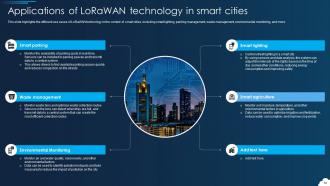
Slide 58: This slide highlights the different use cases of LoRaWAN technology in the context of smart cities.
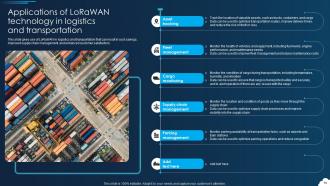
Slide 59: This slide gives use of LoRaWAN in logistics and transportation that can result in cost savings, improved supply chain management, and enhanced customer satisfaction.
Slide 60: This slide shows use cases of LoRaWAN technology in the domain of Smart Healthcare, highlighting the potential benefits.
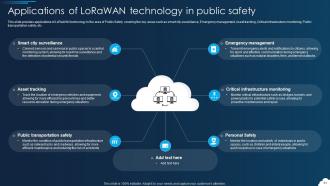
Slide 61: This slide provides applications of LoRaWAN technology in the area of Public Safety covering the key areas.
Slide 62: The slide depicts another Title of contents.
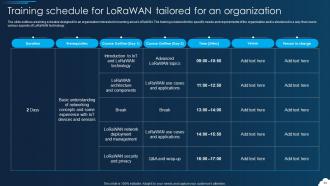
Slide 63: The slide outlines a training schedule designed for an organization interested in learning about LoRaWAN.
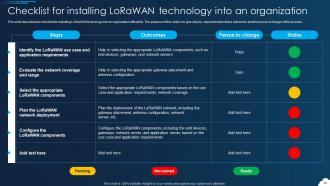
Slide 64: This slide describes the checklist for installing LoRaWAN technology into an organization efficiently.
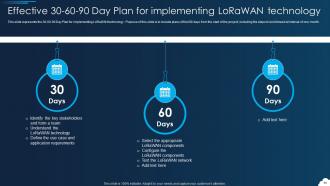
Slide 65: This slide represents the 30-60-90 Day Plan for implementing LoRaWAN technology.
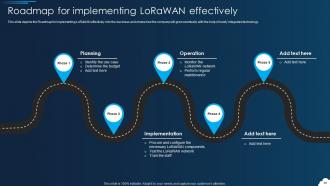
Slide 66: This slide depicts the Roadmap for implementing LoRaWAN effectively into the business and shows how the company will grow eventually.
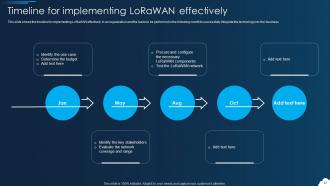
Slide 67: This slide shows the timeline for implementing LoRaWAN effectively in an organization and the tasks to be performed.
Slide 68: The slide displays Title of contents which is to be discussed further.
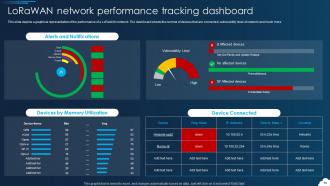
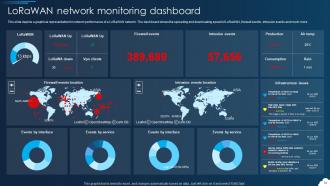
Slide 69: This slide depicts a graphical representation of the performance of a LoRaWAN network.
Slide 70: This slide continues a graphical representation for network performance of a LoRaWAN network.
Slide 71: This slide shows all the icons included in the presentation.
Slide 72: This slide is titled as Additional Slides for moving forward.
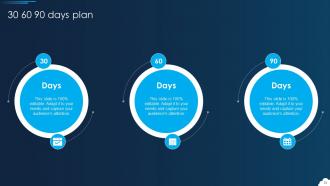
Slide 73: This slide provides 30 60 90 Days Plan with text boxes.
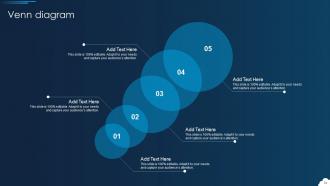
Slide 74: This slide depicts Venn diagram with text boxes.
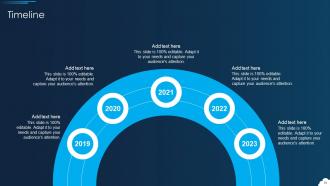
Slide 75: This is a Timeline slide. Show data related to time intervals here.
Slide 76: This is Our Mission slide with related imagery and text.
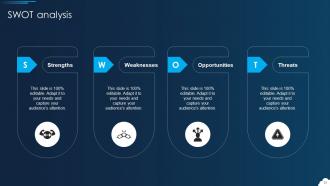
Slide 77: This slide shows SWOT describing- Strength, Weakness, Opportunity, and Threat.
Slide 78: This is an Idea Generation slide to state a new idea or highlight information, specifications etc.
Slide 79: This is a Thank You slide with address, contact numbers and email address.
LoRaWAN Powerpoint Presentation Slides with all 87 slides:
Use our LoRaWAN Powerpoint Presentation Slides to effectively help you save your valuable time. They are readymade to fit into any presentation structure.












FAQs for LoRaWAN
So LoRaWAN is this low-power network thing that's actually pretty cool for IoT stuff. Basically, your devices can send tiny bits of data over crazy long distances without killing the battery. We're talking years on one charge, which is nuts. The catch? Data rates are painfully slow - like, don't even think about streaming anything. But for sensors that just need to check in once in a while - soil monitors, parking meters, whatever - it's perfect. Way better than trying to use WiFi or cellular for that kind of thing. If you're doing remote sensing stuff, definitely worth checking out.
So LoRaWAN basically has four pieces you gotta understand. Your end devices are the actual sensors and IoT stuff doing the work. Gateways pick up those radio signals - kinda like souped-up routers but for LoRa instead of WiFi. Then there's the network server, which honestly is where things get messy with all the routing and device management. Application servers handle your data processing. Oh, and definitely figure out your gateway coverage first if you're setting this up - learned that one the hard way on my last project.
So LoRaWAN actually has pretty decent security with AES-128 encryption working on two levels. Your data gets encrypted between the device and network server, then there's another layer that only your app server can unlock. Each device has its own unique keys too - either pre-loaded or created when it joins the network. That way if someone hacks one device, they can't mess with your others. Oh, and definitely use the latest LoRaWAN version since they've beefed up the security features. Just don't screw up the key management part because that's where most people trip up.
Honestly, LoRaWAN is pretty sweet for long-range stuff. You'll get like 10-15km coverage in rural areas, which is nuts. Battery life is where it really shines though - devices sleep most of the time and only wake up to send data, so they last years on one battery. Way simpler than dealing with cellular or WiFi headaches too. The whole thing uses a star setup with gateways instead of some mesh network that breaks when one sensor craps out. Perfect for sensors that just need to check in once in a while over crazy distances.
Honestly, LoRaWAN is perfect for stuff like agriculture and smart cities where you need sensors everywhere but don't want to spend a fortune. Farms use it to track soil moisture, cities monitor water meters and streetlights - that kind of thing. The range is insane, like several kilometers, and sensors can run for years on one battery. Power consumption is basically nothing. I mean, if cellular seems like overkill and WiFi won't reach far enough, LoRaWAN's probably what you want. It's cheap to deploy too, which is why everyone's jumping on it.
LoRaWAN absolutely crushes other wireless tech when it comes to battery life - I'm talking 2-10 years on a single battery versus WiFi dying in days. The magic happens because devices sleep like 99% of the time and only wake up to quickly send data. WiFi and cellular are constantly chattering and maintaining connections, which just murders your battery. Bluetooth's better but still nowhere close. Honestly, if you're doing IoT sensors that need to sit somewhere forever without anyone babysitting them, LoRaWAN's probably your only real option that makes sense.
Smart cities use LoRaWAN for all those sensors that just sit there collecting data for years. Air quality monitoring, parking sensors, flood detection - stuff that doesn't need constant updates but has to last forever on battery. The range is nuts, like 10+ kilometers sometimes. Waste bins that tell you when they're full, smart streetlights, tracking city bikes. Honestly, noise monitoring is probably underrated too. Main thing is these devices only send data occasionally, not streaming constantly. Look at what your city still does manually - walking around checking meters or whatever. That's your low-hanging fruit right there.
So basically, when you cram too many LoRaWAN devices together, they start interfering with each other's signals. Think of it like everyone talking at once in a crowded room - nobody can hear anything clearly. You'll see your packet delivery rates tank pretty quickly. Most gateways handle around 100-500 devices okay, but it really depends on what spreading factors you're using. Higher SF gives better range but hogs more airtime, which is annoying. I'd keep an eye on those collision rates and maybe spread your devices out geographically if possible. The sweet spot varies though.
So gateways are like bridges - they grab radio signals from your LoRa sensors and shoot them to the internet. Kind of like Wi-Fi routers but for LoRa stuff instead. They're intentionally pretty basic, which honestly keeps the price reasonable. The gateway doesn't decide anything, just passes messages along without caring who they belong to. Placement is where it gets tricky though. You need good line-of-sight and terrain matters way more than you'd think. I'd start by figuring out where all your devices will actually be, then work backwards from there to pick gateway spots.
Honestly, gateway placement is way trickier than people think - buildings and hills mess with signals more than you'd expect, even with LoRaWAN's range. Coverage gaps are inevitable. When you scale up to thousands of devices, they'll compete for airtime and things get messy. Oh, and debugging remote sensors is genuinely annoying since you can't just walk over and check them. Different countries have different frequency rules too, which is a headache if you're going international. I'd definitely start small with a pilot to figure out your specific interference patterns first.
So LoRaWAN uses this star-of-stars setup where your devices talk to multiple gateways, then everything routes through a central network server. That server handles all the heavy lifting - authentication, routing, picking the best gateway automatically. Pretty smart design if you ask me. When you're scaling up, the protocol adjusts data rates and spreading factors so devices don't interfere with each other as much. Traffic gets balanced across gateways without you doing anything. Oh, and you can start super simple - just a few devices and gateways - then expand later without rebuilding everything.
Hey! So for LoRaWAN stuff, definitely start with a proper site survey - trust me, it saves so much headache down the road. Gateway placement is huge - you want some overlap but not too much or you'll get interference issues. Set your devices to use the lowest spreading factor that still works reliably. Adaptive Data Rate is your friend here since it automatically tweaks transmission settings. Oh, and spread out when your devices transmit so they're not all hitting the network at once during busy times. Traffic management might sound boring but it makes a real difference. The RF mapping upfront is honestly the most important step.
So LoRaWAN has this thing called Adaptive Data Rate that's actually pretty clever - it automatically tweaks your data rates based on how strong your signal is. Closer to the gateway = faster speeds and bigger payloads. You get data rates from DR0 (super slow but goes far) up to DR5 or higher, depending on where you are. Payload sizes go from like 51 bytes at DR0 to 242 bytes at DR5. The network server keeps optimizing everything to save battery while keeping things reliable. Just heads up though - make sure your app can handle different payload sizes since they'll shift around as conditions change.
LoRaWAN's getting way smarter - AI stuff for predictive analytics, better security, and it'll actually play nice with other IoT platforms. The 1.1 upgrade is huge, mostly because the security fixes are legit game-changers. Satellite integration's coming too, which is pretty wild for global coverage. Oh, and edge computing capabilities are expanding fast. Honestly, if you're still on older versions, you should probably start planning that 1.1 migration soon. Don't wait until you're forced into it - that never goes smoothly.
So LoRaWAN is actually pretty clever about urban interference. Spread spectrum modulation spreads the signal wide, which makes it way more resistant to noise. Plus there's adaptive data rate that tweaks transmission settings automatically based on what's happening with the channels. Devices hop between frequencies too, and multiple networks can overlap without going crazy on each other. Honestly, even with all that 2.4GHz mess in cities, your LoRaWAN stuff will punch through just fine. Oh and definitely get your gateway up high - elevation cuts through interference like nothing else.
-
“I required a slide for a board meeting and was so satisfied with the final result !! So much went into designing the slide and the communication was amazing! Can’t wait to have my next slide!”
-
Based on my personal experience, I would recommend other people to subscribe to SlideTeam. No one can be disappointed here!
-
Unique research projects to present in meeting.
-
These stunning templates can help you create a presentation like a pro.