


Cognitive Radio IT Powerpoint Presentation Slides






Try Before you Buy Download Free Sample Product
 Impress Your
 Audience
 100%
100% Editable
 Save Hours
 of Time


This PowerPoint presentation briefly explains the problems with conventional wireless sensor networks and how cognitive radio technology can overcome those problems. In this Cognitive Radio PowerPoint Presentation, we have covered the global CR market size, market share by type, and cognitive radio market growth factors. It also highlights the overview of CR by covering its introduction, importance, characteristics, types, and advantages. In addition, this Sensor Networks PPT contains the architecture of cognitive radio, its working and functional blocks, and an overview of the CR spectrum. It also incorporates spectrum management, its logical framework, spectrum analysis, spectrum database, and spectrum allocation. Also, the Cognitive Sensors PPT presentation includes a section on spectrum sensing techniques, classification of spectrum sensing, signal processing, and cooperative sensing techniques. Additionally, the presentation includes slides presenting cognitive radio access paradigms, cognitive radio models, dynamic spectrum cognitive, interference temperature cognitive, and cognitive cooperation models. Furthermore, this Cognitive Wireless Sensor Networks template comprises the integration of cognitive radio with wireless sensor network systems and applications of CR-WSNs in different areas. In last, the Cognitive Radio Technology PPT presentation caters to a consolidated approach to drive CR, a budget for CR implementation, a timeline, a roadmap, and a dashboard to track spectrum consumption. Download our 100 percent editable and customizable template, which is also compatible with Google Slides.
People who downloaded this PowerPoint presentation also viewed the following :
Content of this Powerpoint Presentation
Slide 1: This slide introduces Cognitive Radio (IT). Commence by stating Your Company Name.
Slide 2: This slide depicts the Agenda of the presentation.
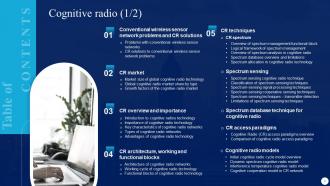
Slide 3: This slide includes the Table of Contents.
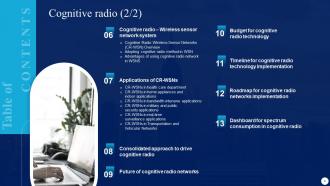
Slide 4: This is yet another slide continuing the Table of Contents.
Slide 5: This slide highlights the Title for the Topics to be covered in the upcoming template.
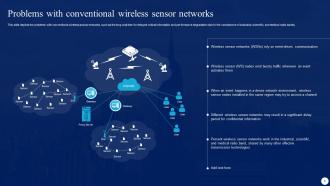
Slide 6: This slide states the problems with conventional wireless sensor networks, such as the long wait time for delayed critical information and performance degradation.
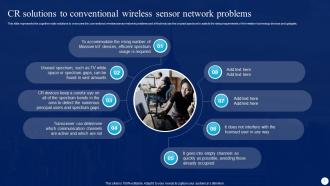
Slide 7: This slide represents the cognitive radio solutions to overcome the conventional wireless sensor network problems and effectively use the unused spectrum to satisfy the rising requirements of information technology devices and gadgets.
Slide 8: This slide incorporates the Heading for the Contents to be discussed further.
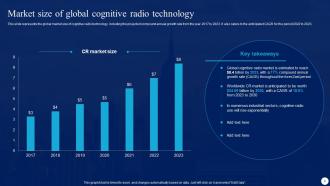
Slide 9: This slide showcases the global market size of cognitive radio technology.
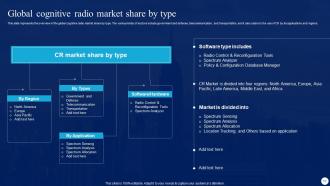
Slide 10: This slide gives an overview of the global cognitive radio market share by type.
Slide 11: This slide talks about the growth factors of the cognitive radio market, including increased demand for spectrum freedom, intelligent devices and goods, and services.
Slide 12: This slide exhibits the Title for the Ideas to be covered next.
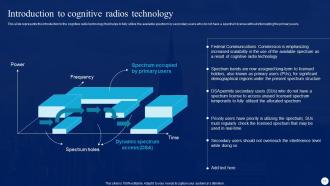
Slide 13: This slide presents the introduction to the cognitive radio technology that helps to fully utilize the available spectrum by secondary users who do not have a spectrum license without interrupting the primary users.
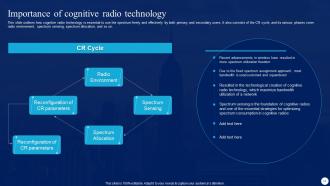
Slide 14: This slide outlines how cognitive radio technology is essential to use the spectrum freely and effectively by both primary and secondary users.
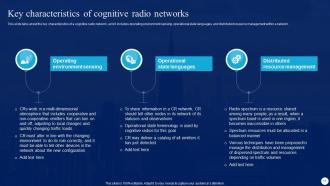
Slide 15: This slide talks about the key characteristics of a cognitive radio network, and it includes operating environment sensing, operational state languages, and distributed resource management within a network.
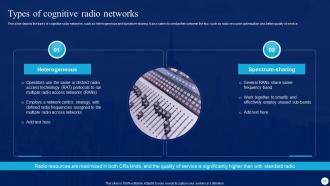
Slide 16: This slide depicts the types of cognitive radio networks, such as heterogeneous and spectrum-sharing.
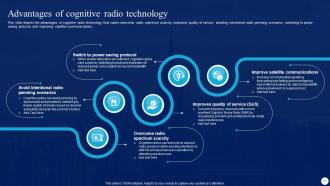
Slide 17: This slide highlights the advantages of cognitive radio technology that caters overcome radio spectrum scarcity, improved quality of service, avoiding intentional radio jamming scenarios, switching to power-saving protocol, and improving satellite communications.
Slide 18: This slide elucidates the Heading for the Components to be covered further.
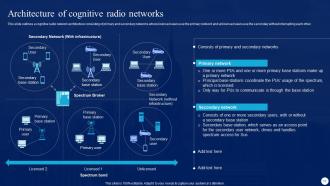
Slide 19: This slide outlines a cognitive radio network architecture consisting of primary and secondary networks where licensed users use the primary network and unlicensed users use the secondary without interrupting each other.
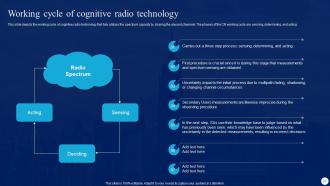
Slide 20: This slide displays the working cycle of cognitive radio technology that fully utilizes the spectrum capacity by sharing the unused channels.
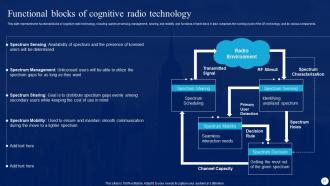
Slide 21: This slide represents the functional blocks of cognitive radio technology, including spectrum sensing, management, sharing, and mobility and functions of each block.
Slide 22: This slide incorporates the Title for the Topics to be covered in the forth-coming template.
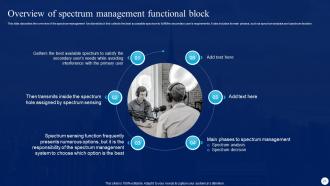
Slide 23: This slide gives the overview of the spectrum management functional block that collects the best accessible spectrum to fulfill the secondary user’s requirements.
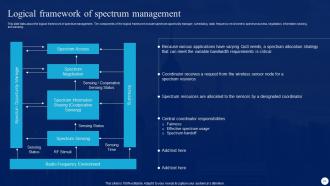
Slide 24: This slide talks about the logical framework of spectrum management.
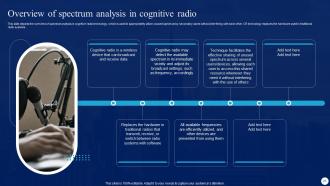
Slide 25: This slide depicts the overview of spectrum analysis in cognitive radio technology, which is used to appropriately utilize unused spectrum by secondary users without interfering with each other.
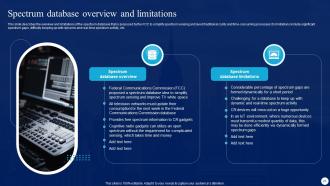
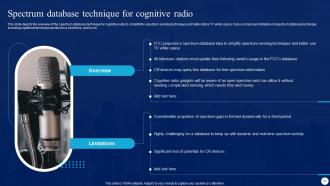
Slide 26: This slide presents the overview and limitations of the spectrum database that is proposed by the FCC to simplify spectrum sensing and avoid traditional costly and time-consuming processes.
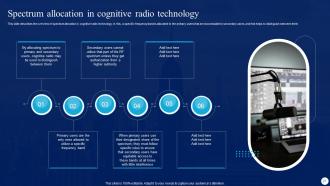
Slide 27: This slide shows the overview of spectrum allocation in cognitive radio technology.
Slide 28: This slide contains the Heading for the Ideas to be discussed further.
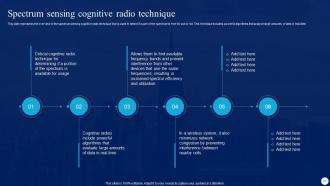
Slide 29: This slide represents the overview of the spectrum sensing cognitive radio technique that is used to detect if a part of the spectrum is free for use or not.
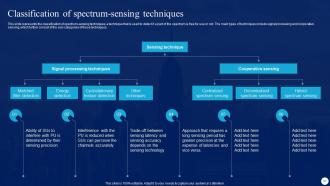
Slide 30: This slide potrays the classification of spectrum-sensing techniques, a technique that is used to detect if a part of the spectrum is free for use or not.
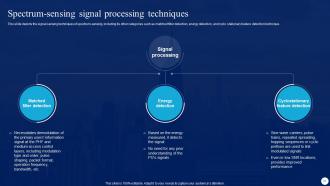
Slide 31: This slide mentions about the signal sensing techniques of spectrum-sensing, including its other categories such as matched filter detection, energy detection, and cyclo stationary feature detection technique.
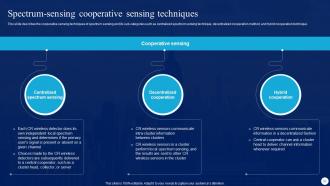
Slide 32: This slide describes the cooperative sensing techniques of spectrum sensing and its sub-categories such as centralized spectrum sensing technique, decentralized cooperation method, and hybrid cooperation technique.
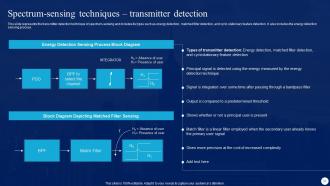
Slide 33: This slide represents the transmitter detection technique of spectrum-sensing.
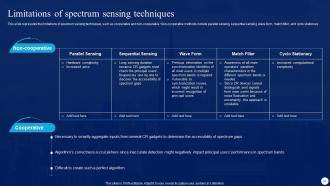
Slide 34: This slide indicates the cooperative and non-cooperative limitations of spectrum sensing techniques.
Slide 35: This slide elucidates the Title for the Topics to be covered further.
Slide 36: This slide depicts the overview of the spectrum database technique for cognitive radio to simplify the spectrum sensing techniques and better utilize TV white space.
Slide 37: This slide consists of the Main Heading for the Components to be discussed next.
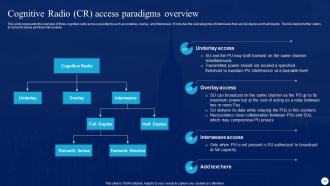
Slide 38: This slide represents the overview of three cognitive radio access paradigms such as underlay, overlay, and interweave.
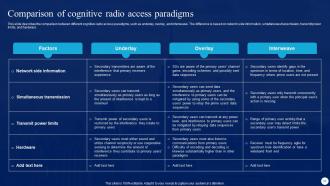
Slide 39: This slide describes the comparison between different cognitive radio access paradigms.
Slide 40: This slide exhibits the Title for the Ideas to be covered in the following template.
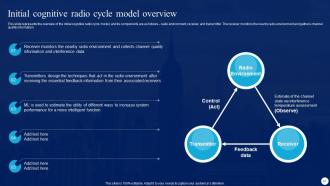
Slide 41: This slide gives the overview of the initial cognitive radio cycle model, and its components are as follows – radio environment, receiver, and transmitter.
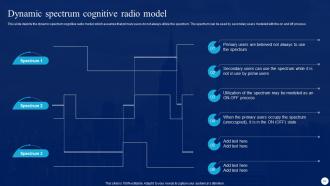
Slide 42: This slide illustrates the dynamic spectrum cognitive radio model, which assumes that primary users do not always utilize the spectrum.
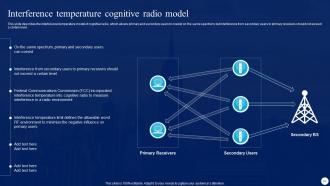
Slide 43: This slide describes the interference temperature model of cognitive radio, which allows primary and secondary users to coexist on the same spectrum, but interference from secondary users to primary receivers should not exceed a certain level.
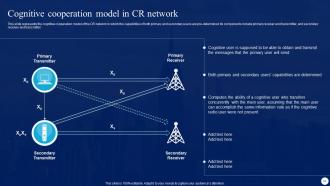
Slide 44: This slide presents the cognitive cooperation model of the CR network in which the capabilities of both primary and secondary users are pre-determined.
Slide 45: This slide incorporates the Heading for the Topics to be discussed next.
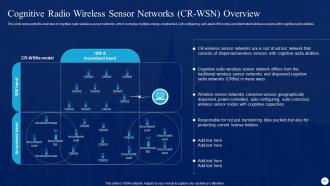
Slide 46: This slide represents the overview of cognitive radio wireless sensor networks, which comprise multiple energy-constrained, self-configuring, self-aware WS nodes and distributed wireless sensors with cognitive radio abilities.
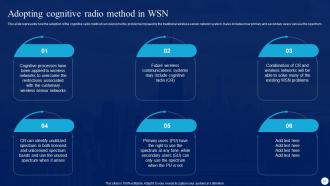
Slide 47: This slide deals with Adopting cognitive radio method in WSN.
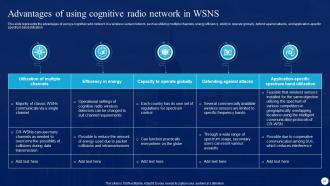
Slide 48: This slide exhibits the Advantages of using cognitive radio network in WSNS.
Slide 49: This slide focuses on the Title for the Topics to be covered further.
Slide 50: This slide talks about how the application of cognitive radio wireless network systems in the healthcare department is advancing the medical field.
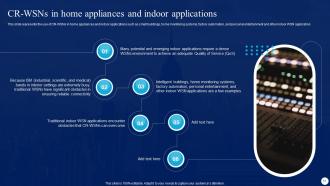
Slide 51: This slide reveals the use of CR-WSNs in home appliances and indoor applications such as smart buildings, home monitoring systems, factory automation, and personal entertainment and other indoor WSN application.
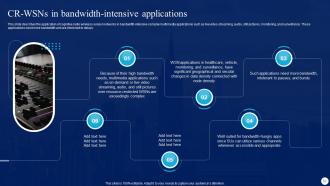
Slide 52: This slide focuses on CR-WSNs in bandwidth-intensive applications.
Slide 53: This slide depicts the use of cognitive radio wireless sensor networks in the military and public security applications.
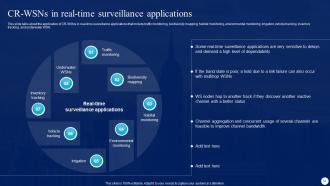
Slide 54: This slide talks about the application of CR-WSNs in real-time surveillance applications that include traffic monitoring, biodiversity mapping, etc.
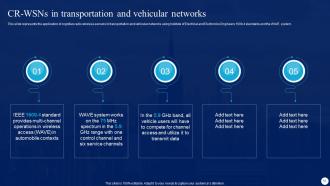
Slide 55: This slide illustrates the application of cognitive radio wireless sensors in transportation and vehicular networks using Institute of Electrical and Electronics Engineers 1609.4 standards and the WAVE system.
Slide 56: This slide contains the Heading for the Ideas to be covered further.
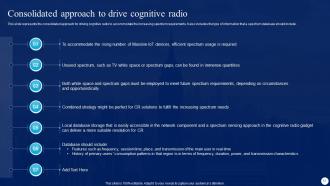
Slide 57: This slide represents the consolidated approach for driving cognitive radio to accommodate the increasing spectrum requirements.
Slide 58: This slide indicates the Title for the Topics to be covered further.
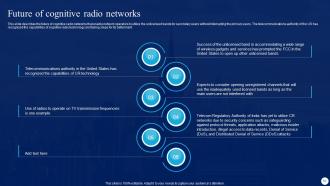
Slide 59: This slide describes the future of cognitive radio networks that enable network operators to utilize the unlicensed bands for secondary users without interrupting the primary users.
Slide 60: This sldie showcases the Heading for the Ideas to be covered next.
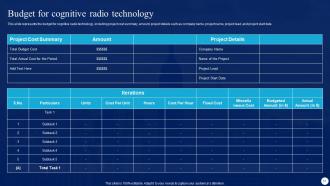
Slide 61: This slide represents the budget for cognitive radio technology, including project cost summary, amount, and project details.
Slide 62: This slide showcases the Title for the Topics to be discussed next.
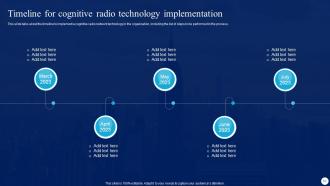
Slide 63: This slide talks about the timeline to implement a cognitive radio network technology in the organization, including the list of steps to be performed in the process.
Slide 64: This slide incorporates the Heading for the Components to be covered further.
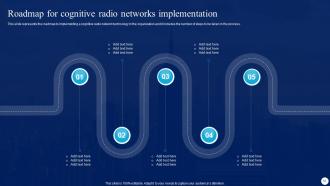
Slide 65: This slide illustrates the Company's Roadmap for cognitive radio networks implementation.
Slide 66: This slide highlights the Title for the Ideas to be discussed in the upcoming template.
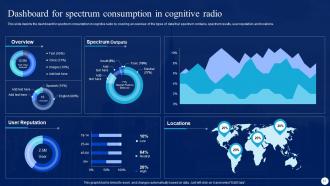
Slide 67: This slide depicts the dashboard for spectrum consumption in cognitive radio by covering an overview of the types of data that spectrum contains, spectrum results, user reputation, and locations.
Slide 68: This is the Icons slide containing all the Icons used in the plan.
Slide 69: This slide is used for showcasing some Additional information.
Slide 70: This is Meet our awesome team slide. Mention the information related to your team members here.
Slide 71: This slide potrays a Magnifying glass for elucidating minute details.
Slide 72: This is Our goal side. State your company goals here.
Slide 73: This is the Venn diagram slide for showcasing some relevant company information.
Slide 74: This is the Puzzle slide with related imagery.
Slide 75: This slide includes the Post it notes for reminders and deadlines.
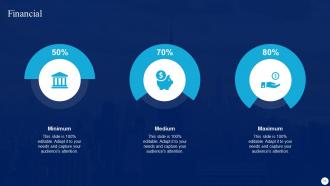
Slide 76: This slide incorporates information related to the Financial topic.
Slide 77: This is the Thank You slide for acknowledgement.
Cognitive Radio IT Powerpoint Presentation Slides with all 82 slides:
Use our Cognitive Radio IT Powerpoint Presentation Slides to effectively help you save your valuable time. They are readymade to fit into any presentation structure.
























FAQs for Cognitive Radio IT
So basically cognitive radios are like smart radios that can sense what's happening around them. They scan for unused frequency bands, then automatically jump to those open channels to avoid interference. Pretty neat stuff tbh. The radio continuously monitors everything and adapts in real-time without you having to do anything. It's kind of like having AI built into your wireless communication - learns from experience and gets better over time. If you're working on any wireless projects, definitely worth thinking about how this could help optimize your spectrum usage. Way better than dealing with interference manually.
So basically, cognitive radio makes spectrum way more efficient by jumping around to find empty frequencies instead of staying stuck on one channel like old systems do. It's kinda like musical chairs but for radio waves - constantly scanning for open spots and hopping in when nobody's using them. Traditional radios just camp on their assigned frequency whether it's busy or not, which is honestly pretty wasteful. The cognitive ones sense what's available in real-time and grab those "white spaces" without messing up other users. You end up fitting tons more communication into the same spectrum space. Pretty clever stuff if you're working on wireless design.
So ML is basically what makes cognitive radios actually smart, you know? It automatically figures out which spectrum bands are free and predicts interference patterns. The algorithms learn from past network conditions to optimize transmission parameters in real time. Pretty neat how they adapt to changing environments and manage power levels too. They can even predict when primary users will reclaim their spectrum - honestly that part still blows my mind. If you're building CR systems, you'll want to train your models with diverse spectrum data. That's really what separates decent cognitive radios from the basic ones.
So cognitive radios basically scan around and jump between frequencies depending on what's open at the moment. Your device isn't stuck on one band - it finds those empty "white spaces" where licensed users aren't doing anything and hops right in. When interference shows up or the main users come back, it bounces to somewhere cleaner. Honestly, the sensing algorithms are probably what you'll want to dig into first since they handle all the switching logic. It's actually pretty neat how it all works in real-time like that.
Ugh, spectrum regulations are such a pain for cognitive radios. Most policies still assume you'll stick to one assigned frequency forever - they weren't built for devices that jump around opportunistically. What happens if your radio accidentally messes with a licensed user? Nobody really knows who gets blamed. The FCC is trying with TV white space rules and stuff, but policy always lags behind tech by like a decade. Actually, their experimental bands are getting more interesting lately. Worth checking out their emerging tech proceedings if you're serious about this field.
So basically, rural areas are way easier for cognitive radios - tons of open spectrum means they can crank up the power and use wider channels without issues. Cities are a nightmare though, with WiFi and cell towers hogging everything. But here's where cognitive radios really shine: they're constantly sniffing around for those tiny unused frequency gaps and jumping between them. Pretty clever stuff. The key is setting them up right from the start - focus on range optimization if you're out in farmland, but go for quick frequency hopping if you're dealing with urban chaos.
So basically you've got two big problems with cognitive radio security. Bad actors can fake spectrum occupancy to mess with your sensing, or they can pretend to be legit users and steal bandwidth. Authentication is brutal too - trying to manage who gets access while everything's constantly changing? Ugh. Plus all that spectrum data flying around between nodes creates a ton of opportunities for eavesdropping and tampering. Honestly I'd start with solid encryption and some kind of anomaly detection right away. That way you can spot weird spectrum behavior before it becomes a real problem.
Your CR system basically monitors the radio spectrum 24/7 to see if primary users are broadcasting. Three main detection methods do the heavy lifting: energy detection measures signal power, matched filter detection searches for known patterns, and cyclostationary detection spots periodic characteristics. Energy detection's the easiest but honestly struggles with background noise - imagine trying to eavesdrop in a noisy restaurant. The system continuously samples frequencies, runs analysis, then decides what's free to use. Just make sure your algorithms can handle false alarms properly, or you'll have bigger problems.
So basically, primary users own the spectrum licenses - they get priority access to those frequency bands. Secondary users? They're the unlicensed ones who jump in when those bands aren't being used. It's kinda like using your neighbor's parking spot while they're away, but you gotta bolt when they come home. Primary users don't stress about interference since they literally own the rights. Secondary users have it tougher though - they're constantly scanning to see what's available and have to bail immediately when primaries need their spectrum back. Honestly, cognitive radio design gets tricky because you're planning for secondary users getting booted all the time.
So cognitive radio is pretty cool for disaster stuff - it automatically hunts for open frequencies when regular networks crash. Like when hurricanes trash cell towers? These radios just hop between whatever bands are free - military, commercial, ham radio, doesn't matter. They're smart enough to scan the airwaves and switch on the fly. Emergency crews can stay connected even when everything else is dead. The trick is getting them set up beforehand though, not scrambling after things go sideways. Way better than being stuck with nothing when you need comms most.
So cognitive radio could totally flip telecom economics on its head. Basically you're sharing spectrum dynamically instead of paying insane amounts for dedicated bands - kinda like Airbnb for frequencies if that makes sense. Way cheaper to operate once it's running. Plus telecom companies can offer way more flexible services and squeeze better performance out of their networks. Honestly though, the setup costs are brutal upfront. And don't even get me started on dealing with regulators - that's gonna be a nightmare. But if you're thinking long-term, the savings are pretty huge.
Look, spectrum sensing is basically the make-or-break thing for your cognitive radio setup. Get it right and you'll have solid throughput with way fewer headaches. Miss the mark though? You're either wasting good spectrum or - way worse - accidentally jamming people who actually have licenses to use those frequencies. Speed matters a ton here since primary users can pop up anytime and you need to bail fast. Honestly, I'd put all my energy into nailing the sensing algorithms first. Everything else kind of falls into place once that's dialed in properly.
So cognitive radio is getting crazy smart with machine learning - basically AI that figures out the best frequencies by learning patterns. 5G networks are gonna depend on this stuff heavily for sharing spectrum dynamically. Hardware's shrinking and getting way more efficient, which honestly took long enough. Plus devices will start sharing spectrum info with each other in real-time, which is pretty cool. If you're doing any wireless projects, I'd start thinking about cognitive features now because they won't be optional much longer. The whole field is moving fast.
So cognitive radio makes IoT devices way smarter about finding open frequencies - they'll automatically hop around to avoid interference. Super useful when you've got tons of devices trying to connect at once. Picture a smart city with sensors scattered everywhere, or some factory where signal issues could actually break things. The devices adapt on the fly, which is honestly pretty cool. Industrial setups especially benefit since interference there can screw up critical operations. Short version: if you're doing any big IoT project, this tech will save you from pulling your hair out later when connectivity gets messy.
Yeah, cognitive radios are actually pretty sweet for the environment. They're super efficient at using spectrum, so you don't need as many base stations cluttering up the landscape. Power levels adjust automatically based on what's actually needed instead of just maxing out 24/7 - which honestly seems pretty dumb when you think about it. The whole spectrum sharing thing means way better resource use too. Oh, and the energy savings over time are legit - that's something worth mentioning if you're trying to sell anyone on deployment. Less infrastructure overall = smaller carbon footprint, which is nice.
-
“Superb. What a great finding. Thankful for SlideTeam. We were paying people to make slides which went all in vain. We are so happy to have found you.”
-
Great experience, I would definitely use your services further.