

Cognitive computing strategy powerpoint presentation slides




Try Before you Buy Download Free Sample Product
 Impress Your
 Audience
 100%
100% Editable
 Save Hours
 of Time


Cognitive computing is an advanced technology that facilitates human thought processes in a computerized model. Here is a competently designed Cognitive Computing Strategy template covering details regarding current scenario assessment in terms of firm challenges and concerns associated with cognitive computing adoption in times of high IT infrastructure cost, customer attrition, rise in unstructured data, etc. The template covers details about comparative assessment of technology advancement extent and firm current management capabilities. The template covers the cognitive computing systems elements, functionality, essential attributes, and architecture. It caters to cognitive computing components such as capability areas, technologies, and strategies associated with cognitive computing. It caters role of cognitive technology in business processes and how it affects functional business areas, the requirement of future workforce skills, enabling customer-centric transformation. Cognitive computing addresses major applications and usage in various sectors such as healthcare in proactive diagnosis, financial services, etc. It covers details about the budget associated with technology implementation staff training cost. It covers impact assessment of cognitive computing initiatives and tracking essential activities in data insights and virtual agents dashboards. Get access now.
People who downloaded this PowerPoint presentation also viewed the following :
Content of this Powerpoint Presentation
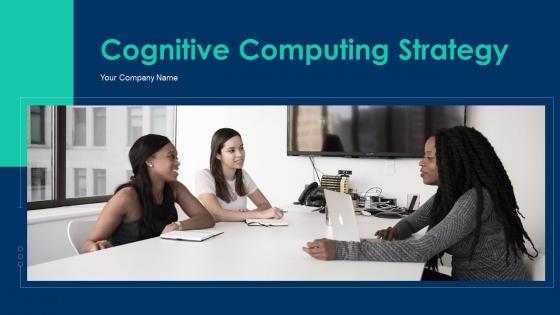
Slide 1: This slide introduces Cognitive Computing Strategy. State Your Company Name and begin.
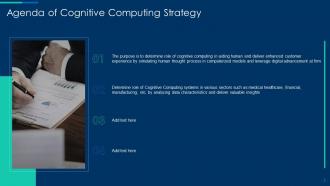
Slide 2: This slide shows Agenda of Cognitive Computing Strategy.
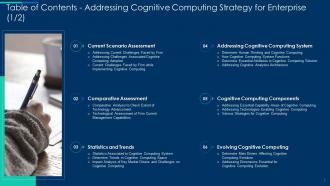
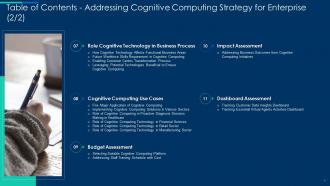
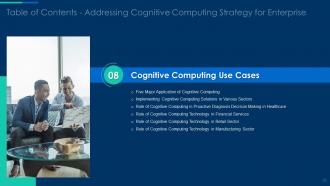
Slide 3: This slide presents Table of Content for the presentation.
Slide 4: This slide presents Table of Content for the presentation.
Slide 5: This slide shows title for topics that are to be covered next in the template.
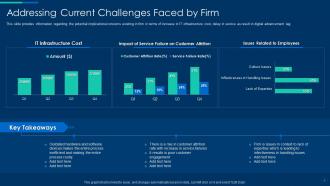
Slide 6: This slide presents potential implications/concerns existing in firm in terms of increase in IT infrastructure cost.
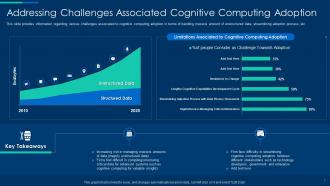
Slide 7: This slide displays Addressing Challenges Associated Cognitive Computing Adoption.
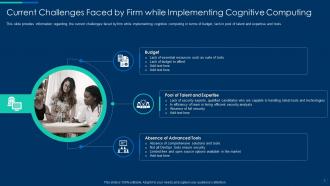
Slide 8: This slide represents Current Challenges Faced by Firm while Implementing Cognitive Computing.
Slide 9: This slide shows title for topics that are to be covered next in the template.
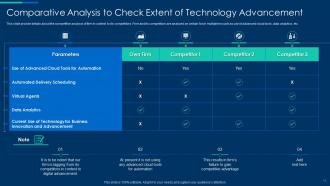
Slide 10: This slide showcases Comparative Analysis to Check Extent of Technology Advancement.
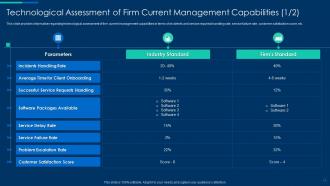
Slide 11: This slide presents Technological Assessment of Firm Current Management Capabilities.
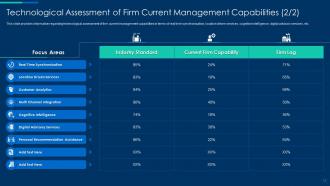
Slide 12: This is another slide continuing Technological Assessment of Firm Current Management Capabilities.
Slide 13: This slide shows title for topics that are to be covered next in the template.
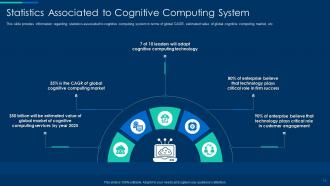
Slide 14: This slide displays Statistics Associated to Cognitive Computing System.
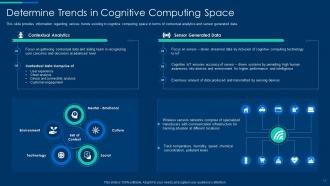
Slide 15: This slide represents various trends existing in cognitive computing space in terms of contextual analytics.
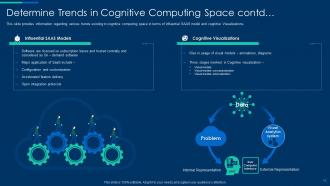
Slide 16: This slide showcases Determine Trends in Cognitive Computing Space.
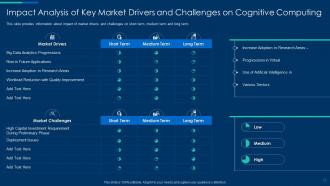
Slide 17: This slide presents Impact Analysis of Key Market Drivers and Challenges on Cognitive Computing.
Slide 18: This slide shows title for topics that are to be covered next in the template.
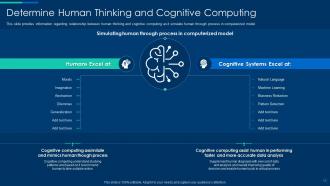
Slide 19: This slide displays Determine Human Thinking and Cognitive Computing.
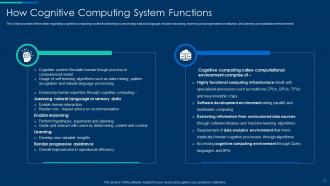
Slide 20: This slide provides information regarding cognitive computing system functioning.
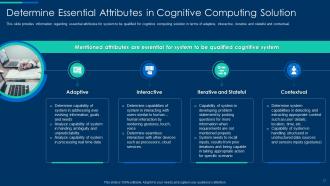
Slide 21: This slide showcases Determine Essential Attributes in Cognitive Computing Solution.
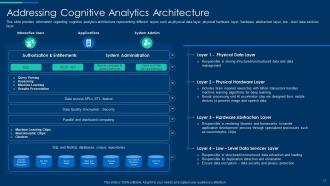
Slide 22: This slide provides information regarding cognitive analytics architecture representing different layers.
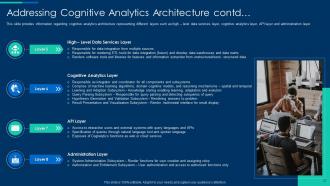
Slide 23: This is another slide continuing Cognitive Analytics Architecture.
Slide 24: This slide shows title for topics that are to be covered next in the template.
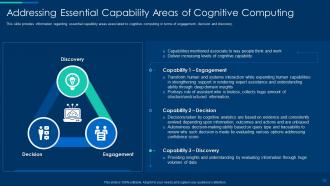
Slide 25: This slide presents Addressing Essential Capability Areas of Cognitive Computing.
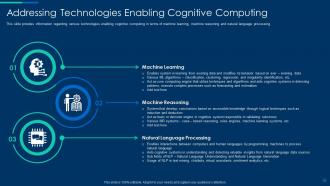
Slide 26: This slide displays Addressing Technologies Enabling Cognitive Computing.
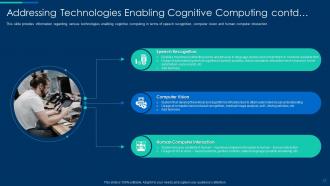
Slide 27: This is another slide continuing Addressing Technologies Enabling Cognitive Computing.
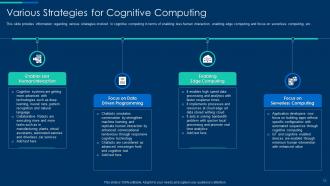
Slide 28: This slide provides information regarding various strategies involved in cognitive computing.
Slide 29: This slide shows title for topics that are to be covered next in the template.
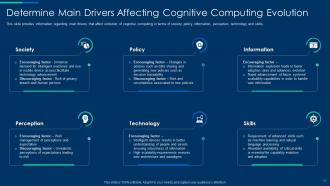
Slide 30: This slide presents Determine Main Drivers Affecting Cognitive Computing Evolution.
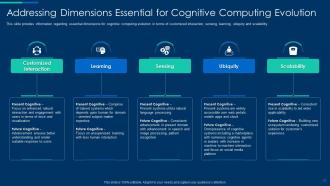
Slide 31: This slide displays Addressing Dimensions Essential for Cognitive Computing Evolution.
Slide 32: This slide shows title for topics that are to be covered next in the template.
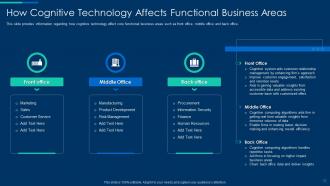
Slide 33: This slide displays How Cognitive Technology Affects Functional Business Areas.
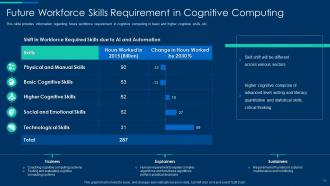
Slide 34: This slide represents Future Workforce Skills Requirement in Cognitive Computing.
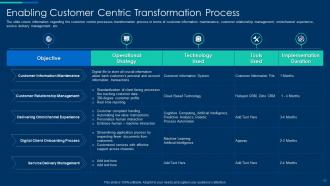
Slide 35: The slide covers information regarding the customer centric processes transformation process.
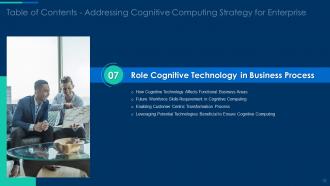
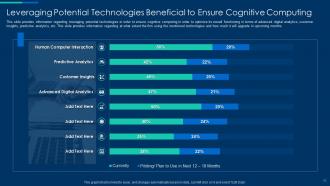
Slide 36: This slide showcases Leveraging Potential Technologies Beneficial to Ensure Cognitive Computing.
Slide 37: This slide shows title for topics that are to be covered next in the template.
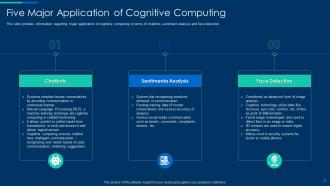
Slide 38: This slide provides information regarding major application of cognitive computing.
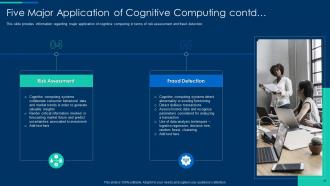
Slide 39: This is another slide continuing Five Major Application of Cognitive Computing.
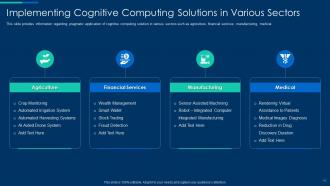
Slide 40: This slide presents Implementing Cognitive Computing Solutions in Various Sectors.
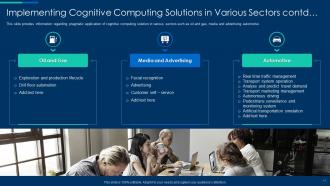
Slide 41: This is another slide continuing Implementing Cognitive Computing Solutions in Various Sectors.
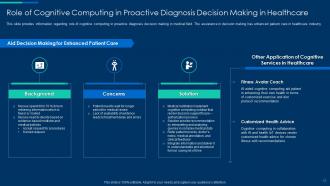
Slide 42: This slide displays Role of Cognitive Computing in Proactive Diagnosis Decision Making in Healthcare.
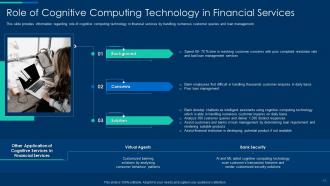
Slide 43: This slide represents Role of Cognitive Computing Technology in Financial Services.
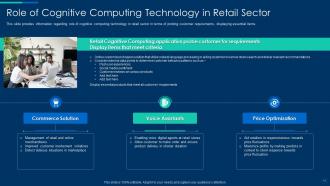
Slide 44: This slide showcases Retail Cognitive Computing application probe customer for requirements.
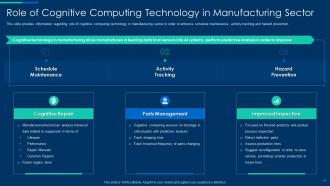
Slide 45: This slide shows Role of Cognitive Computing Technology in Manufacturing Sector.
Slide 46: This slide shows title for topics that are to be covered next in the template.
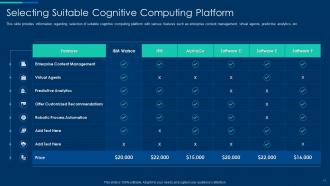
Slide 47: This slide represents Selecting Suitable Cognitive Computing Platform.
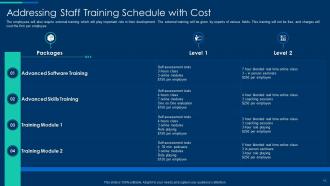
Slide 48: This slide showcases Addressing Staff Training Schedule with Cost.
Slide 49: This slide shows title for topics that are to be covered next in the template.
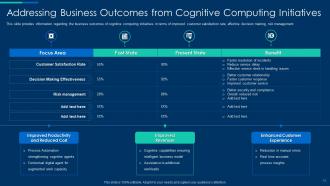
Slide 50: This slide displays Addressing Business Outcomes from Cognitive Computing Initiatives.
Slide 51: This slide shows title for topics that are to be covered next in the template.
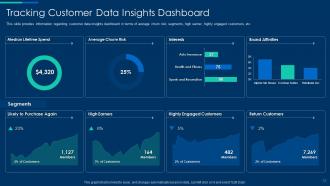
Slide 52: This slide provides information regarding customer data insights dashboard in terms of average churn risk.
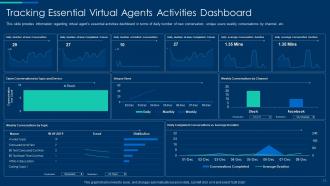
Slide 53: This slide presents Tracking Essential Virtual Agents Activities Dashboard.
Slide 54: This slide displays Icons Cognitive Computing Strategy.
Slide 55: This slide is titled as Additional Slides for moving forward.
Slide 56: This is Our Mission slide with related imagery and text.
Slide 57: This is Our Team slide with names and designation.
Slide 58: This is About Us slide to show company specifications etc.
Slide 59: This slide provides 30 60 90 Days Plan with text boxes.
Slide 60: This slide displays Weekly Timeline with Task Name.
Slide 61: This slide showcases Roadmap for Process Flow.
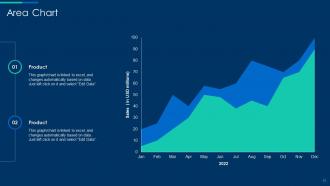
Slide 62: This slide depicts Area chart with two products comparison.
Slide 63: This slide depicts Venn diagram with text boxes.
Slide 64: This is an Idea Generation slide to state a new idea or highlight information, specifications etc.
Slide 65: This slide shows Post It Notes. Post your important notes here.
Slide 66: This is a Timeline slide. Show data related to time intervals here.
Slide 67: This is Our Target slide. State your targets here.
Slide 68: This is a Quotes slide to convey message, beliefs etc.
Slide 69: This is a Thank You slide with address, contact numbers and email address.
Cognitive computing strategy powerpoint presentation slides with all 74 slides:
Use our Cognitive Computing Strategy Powerpoint Presentation Slides to effectively help you save your valuable time. They are readymade to fit into any presentation structure.









FAQs for Cognitive computing strategy
**INPUT**: What are the key components of an effective cognitive computing strategy? **OUTPUT**: Key components include data infrastructure, machine learning algorithms, natural language processing, predictive analytics, and human-AI collaboration frameworks. These technologies streamline operations by automating complex decisions, enhancing customer interactions, and delivering actionable insights, with many organizations finding that strategic implementation ultimately provides significant competitive advantage and operational efficiency. [Word count: 52 words]
Cognitive computing enhances business decision-making by analyzing vast datasets, identifying complex patterns, and providing real-time insights that humans might miss. Through machine learning algorithms, banks accelerate loan approvals, hospitals improve diagnostic accuracy, and retailers optimize inventory management, while reducing human bias and processing time, ultimately delivering faster, more informed strategic decisions and competitive advantage.
Healthcare, financial services, retail, manufacturing, and telecommunications are most likely to benefit from adopting cognitive computing strategies. These industries leverage cognitive technologies to automate complex decision-making, enhance customer experiences, and streamline operations, with many organizations finding that cognitive computing delivers significant competitive advantages through improved efficiency and data-driven insights.
IBM Watson's deployment in healthcare for cancer diagnosis and treatment recommendations, JPMorgan Chase's COIN system for contract analysis, and Axa's cognitive claims processing demonstrate successful implementations across sectors. These systems streamline complex decision-making, enhance accuracy through machine learning, and deliver faster services, with many organizations finding that cognitive computing ultimately reduces operational costs while improving customer experiences.
Organizations can measure cognitive computing ROI through metrics like operational cost reduction, processing time improvements, accuracy gains, and revenue growth from enhanced decision-making capabilities. Financial services firms track fraud detection rates and loan processing speeds, while healthcare organizations measure diagnostic accuracy improvements and patient outcome enhancements, ultimately delivering measurable competitive advantages and quantifiable business value.
Data quality serves as the foundation of cognitive computing strategy, directly impacting algorithm accuracy, decision reliability, and system performance across all analytical processes. Poor data quality can compromise machine learning models, reduce predictive capabilities, and undermine strategic insights, while high-quality data enables organizations to achieve superior automation, enhanced customer experiences, and competitive advantage in increasingly data-driven markets.
Companies face integration challenges including legacy system compatibility, data quality and accessibility issues, skill gaps in AI expertise, substantial infrastructure costs, and change management resistance. While these obstacles require strategic planning and investment, organizations across healthcare, finance, and retail are successfully overcoming them through phased implementations, ultimately achieving enhanced decision-making capabilities and competitive advantages.
Ethical considerations fundamentally guide cognitive computing development through fairness protocols, transparency requirements, privacy safeguards, bias mitigation frameworks, and accountability measures. These principles shape algorithm design, data governance, and decision-making processes, with many financial institutions and healthcare organizations finding that ethical frameworks ultimately enhance user trust, regulatory compliance, and long-term competitive advantage.
Teams implementing cognitive computing solutions require data science expertise, machine learning knowledge, domain-specific understanding, change management skills, and cross-functional collaboration abilities. These capabilities enable organizations to effectively integrate AI technologies, train models accurately, and manage workflow transitions, with many companies finding that combining technical proficiency with strategic business acumen ultimately delivers faster implementation timelines and sustainable competitive advantages.
Cognitive computing differs from traditional AI by mimicking human thought processes through natural language processing, machine learning, and contextual awareness, while traditional AI follows pre-programmed rules and algorithms. This approach enables systems to understand unstructured data, learn from interactions, and adapt to new scenarios, with healthcare providers and financial institutions finding that cognitive systems deliver more intuitive customer experiences and nuanced decision-making capabilities.
Best practices for training cognitive computing models include ensuring diverse, high-quality datasets, implementing iterative feedback loops, establishing robust validation frameworks, and maintaining continuous model monitoring. These approaches enhance accuracy by minimizing bias, optimizing performance through real-world testing, and enabling adaptive learning, with many organizations finding that systematic training protocols ultimately deliver more reliable insights and competitive advantage.
Cognitive computing enhances customer relationship management by analyzing customer data, predicting behaviors, personalizing interactions, and automating support responses. Through machine learning and natural language processing, banks streamline loan approvals, retailers deliver targeted recommendations, and service teams resolve inquiries faster, ultimately improving customer satisfaction while reducing operational costs.
Organizations should anticipate trends including explainable AI for transparent decision-making, edge computing integration for real-time processing, autonomous systems requiring minimal human intervention, and industry-specific cognitive solutions tailored to healthcare, finance, and manufacturing. These developments enable faster insights, reduced operational costs, and enhanced customer experiences, with many enterprises finding that early adoption delivers significant competitive advantages in increasingly data-driven markets.
Cognitive computing enhances predictive analytics by processing unstructured data, recognizing complex patterns, and continuously learning from new information to refine forecasting accuracy. Through machine learning algorithms and natural language processing, organizations in healthcare, finance, and retail can anticipate customer behavior, market trends, and operational risks more precisely, ultimately delivering competitive advantages and strategic decision-making capabilities.
Regulatory implications include data privacy compliance, algorithmic transparency requirements, industry-specific governance standards, audit trail mandates, and ethical AI guidelines. Financial services face stringent oversight for loan decisions, healthcare requires FDA approval for diagnostic tools, and manufacturing must ensure safety protocols, with organizations increasingly finding that proactive compliance frameworks deliver competitive advantage while minimizing regulatory risks.
-
Excellent work done on template design and graphics.
-
Visually stunning presentation, love the content.
-
Excellent work done on template design and graphics.
-
Good research work and creative work done on every template.
-
Awesome presentation, really professional and easy to edit.