


Major stages of startup fundraising strategy




Try Before you Buy Download Free Sample Product
 Impress Your
 Audience
 100%
100% Editable
 Save Hours
 of Time


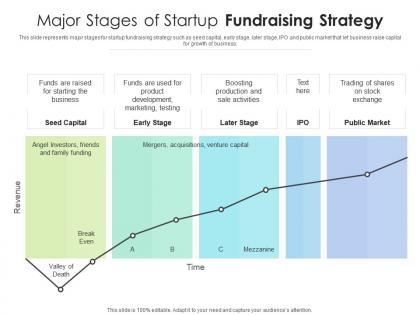
This slide represents major stages for startup fundraising strategy such as seed capital, early stage, later stage, IPO and public market that let business raise capital for growth of business.
People who downloaded this PowerPoint presentation also viewed the following :
Major stages of startup fundraising strategy with all 2 slides:
Use our Major Stages Of Startup Fundraising Strategy to effectively help you save your valuable time. They are readymade to fit into any presentation structure.

FAQs for Major stages of
A startup's pitch deck should include problem identification, solution presentation, market size analysis, business model clarity, competitive landscape assessment, and financial projections. These elements work together by demonstrating market opportunity, revenue potential, and scalability, with many successful startups finding that clear traction metrics, experienced team credentials, and realistic funding requirements ultimately deliver investor confidence and competitive positioning.
Startups can determine funding needs by analyzing cash flow requirements, growth projections, operational scaling costs, market expansion plans, and runway calculations for each stage. Through detailed financial modeling and milestone mapping, companies assess working capital needs, hiring plans, and infrastructure investments, while benchmarking against similar ventures, ultimately ensuring adequate capital for sustainable growth and competitive positioning.
Common fundraising pitfalls include overvaluing the company, lacking clear financial projections, targeting wrong investor types, inadequate market research, and poor presentation skills. These mistakes often result from insufficient preparation and unrealistic expectations, with many startups finding that thorough due diligence, realistic valuations, and strategic investor alignment significantly enhance their chances of securing funding while building sustainable partnerships.
Startups can strategically leverage their network by engaging mentors and advisors for introductions, tapping alumni connections from universities or previous companies, utilizing customer testimonials and case studies as social proof, and activating employee networks for warm referrals. These relationship-driven approaches streamline investor outreach, enhance credibility through trusted introductions, and significantly increase meeting conversion rates, with many startups finding that network-facilitated connections result in faster funding cycles and better investor alignment.
Market research fundamentally shapes fundraising strategy by validating market size, identifying target customers, analyzing competitive landscapes, and demonstrating product-market fit to potential investors. Through comprehensive market analysis, startups can articulate compelling value propositions, justify funding requirements, and present realistic growth projections, ultimately delivering investor confidence and competitive positioning in an increasingly crowded fundraising environment.
Startups should prioritize equity financing for growth-stage funding and product development, while leveraging debt financing for predictable cash flow needs, inventory, or equipment purchases. Equity financing enables rapid scaling and strategic partnerships, though it dilutes ownership, while debt preserves control but requires consistent revenue streams, with many successful startups finding that a strategic combination optimizes both growth potential and founder equity retention.
Angel investors, venture capital firms, accelerators, crowdfunding platforms, and strategic corporate investors are typically best suited for early-stage startups. These funding sources deliver not just capital but also mentorship, industry connections, and market validation, with many startups finding that angel investors and seed-stage VCs offer the most strategic combination of financial support and operational guidance for sustainable growth.
Startups effectively capture investor interest by crafting a compelling narrative that clearly articulates their problem-solution fit, market opportunity, traction metrics, and growth potential. Through storytelling that connects emotional impact with data-driven insights, many successful startups demonstrate scalable business models and competitive advantages, ultimately delivering investor confidence and securing strategic funding partnerships.
Startups should focus on revenue growth, customer acquisition cost (CAC), monthly recurring revenue (MRR), user engagement rates, and market penetration metrics to demonstrate traction. These KPIs enable investors to assess scalability and viability, with many finding that consistent month-over-month growth, improving unit economics, and strong retention rates ultimately deliver the most compelling investment narratives.
Startups can prepare by anticipating challenging questions about market size, competitive differentiation, revenue projections, team expertise, and scalability concerns through thorough market research and financial modeling. Successful preparation involves developing detailed responses with supporting data, practicing with mentors or advisors, and creating backup slides addressing potential investor concerns, ultimately enabling founders to demonstrate deep business knowledge and build investor confidence during critical pitch moments.
Crowdfunding advantages include access to capital without equity dilution, market validation, customer base building, and reduced reliance on traditional investors. However, it presents challenges through public exposure of business ideas, campaign management complexity, and potential failure visibility, with many startups finding that successful campaigns require significant marketing investment and may not guarantee long-term sustainability.
Startups determine valuation through market comparables, revenue multiples, discounted cash flow analysis, and investor feedback from initial meetings. By benchmarking against similar companies in their sector, assessing growth trajectories, and understanding current market conditions, founders can establish realistic ranges that attract investors while minimizing dilution, ultimately positioning themselves competitively for successful funding rounds.
Startups must consider securities regulations, investor accreditation requirements, disclosure obligations, intellectual property protection, and employment law compliance during fundraising. These legal frameworks ensure regulatory adherence while protecting company interests, with many startups finding that early legal counsel streamlines due diligence processes, minimizes compliance risks, and ultimately accelerates funding timelines while establishing stronger investor relationships.
Having a clear exit strategy is crucial for startups seeking investment, as it demonstrates strategic thinking, market understanding, and provides investors with a roadmap for returns through IPO, acquisition, or merger opportunities. This forward-thinking approach enhances credibility with venture capitalists and angel investors, ultimately delivering stronger valuations and more favorable terms, with many successful startups finding that well-defined exit plans accelerate funding timelines.
Current fundraising trends include extended due diligence periods, increased focus on profitability metrics over growth-at-all-costs, sector-specific investor preferences, and greater emphasis on sustainable business models. These shifts reflect a more cautious investment climate, with many startups finding that demonstrating clear paths to revenue and operational efficiency has become essential for securing funding in today's market.
-
Appreciate the research and its presentable format.
-
Use of different colors is good. It's simple and attractive.
-
Use of different colors is good. It's simple and attractive.
-
Excellent template with unique design.