


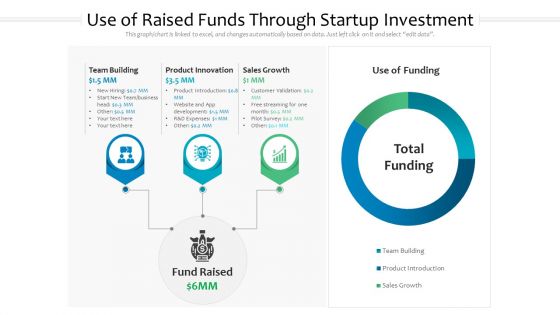
Use of raised funds through startup investment




Try Before you Buy Download Free Sample Product
 Impress Your
 Audience
 100%
100% Editable
 Save Hours
 of Time


Our Use Of Raised Funds Through Startup Investment are topically designed to provide an attractive backdrop to any subject. Use them to look like a presentation pro.
People who downloaded this PowerPoint presentation also viewed the following :
Use of raised funds through startup investment with all 2 slides:
Use our Use Of Raised Funds Through Startup Investment to effectively help you save your valuable time. They are readymade to fit into any presentation structure.
FAQs for Use of raised funds
So basically there are 5 main rounds. Pre-seed is friends and family money - just need a decent idea. Seed funding comes from angels, they want some validation. Series A is where bigger VCs jump in, but you better have real revenue by then. Series B and beyond? That's scaling money. Eventually you're looking at an IPO or getting bought out. Each round gets bigger but costs you more equity. Honestly, don't stress about Series B when you haven't even nailed your seed metrics yet. The expectations jump pretty dramatically between stages - investors get way pickier as the checks get larger.
Tell a story that connects problem to solution, then hit them with real numbers. Investors basically decide in the first few minutes (which is kinda insane but whatever). Go: problem, solution, market size, business model, traction, team, funding ask. Keep slides visual - nobody wants to read paragraphs. Practice until you're not reading off slides like a robot. Oh, and be ready for brutal questions about your assumptions. They'll tear apart any wishful thinking, so have actual data backing everything up. The whole thing should feel like a conversation, not a corporate presentation.
Look, investors really care about your team first - they're backing you as much as your idea. Market size matters too, obviously. Can you show some early traction? Even small stuff counts. Your business model needs to make sense, though honestly the financial projections are just fancy guesswork at this point (everyone knows that). Being able to execute is huge - lots of people have great ideas but can't pull them off. Oh, and have some customers who actually want what you're building before you walk in there. That competitive advantage better be crystal clear too.
Yeah you still need one, unfortunately. VCs and banks definitely want to see a proper business plan - not some crazy long document, but something solid. Show them you get your market, how you'll make money, and your growth plan. The financial projections are huge - that's where they'll really dig in. Angel investors are way more chill about it, but even they want proof you know what you're doing. Honestly, nail the executive summary first since that's what they read. Skip the fluff and focus on the numbers that actually matter.
Dude, you absolutely need solid market research before pitching investors. They want proof you're not just building something because it sounds fun - they need real data on market size, customer problems, who you're competing against. I've watched so many founders bomb their pitches because they couldn't back up their ideas with actual research. It basically shows investors this isn't just a risky gamble. You gotta nail down exactly who your customers are and why they'd actually pay money for what you're making. Trust me on this one.
Start with your 12-18 month goals and work backwards from there. What hires do you need? Product development costs? Marketing budget? Add 20-30% on top because I promise you'll hit unexpected expenses - learned this the hard way! Six months of runway isn't enough either. Investors want to see you can reach real milestones that'll make your Series A (or whatever's next) way easier to close. Oh, and don't forget operational stuff like office space if you're doing that. Map out your growth targets first, then slap dollar amounts on everything.
Honestly? Bootstrapping keeps you in total control and makes you think lean, but you're gonna grow slower and risk your own money. Funding speeds everything up and brings smart people to the table - though you'll lose equity and deal with investor pressure. Plus fundraising is such a massive time drain, ugh. It really comes down to your industry and how fast you need to move. Can you prove your market works and grow steadily on your own dime? That's usually the smarter play. But if you need serious upfront cash or there's a land grab happening, start schmoozing investors now.
So you've got a few routes here. Bootstrapping with your own cash is always an option, plus friends and family rounds. Angels are honestly your sweet spot early on - way faster than VCs and they get that you're still figuring things out. Seed VCs come later. There's crowdfunding too, and accelerators can be solid. Oh, and grants exist but unless you're doing biotech or something with social impact, they'll probably just eat up your time. Figure out how much runway you actually need first, then see what fits your stage.
So convertible notes are basically IOUs that flip into stock later instead of getting paid back in cash. When you need money but your valuation's still all over the place, they're clutch. Investors give you cash now, then get shares at like 15-25% off during your Series A. Way quicker to close than equity deals since there's less back-and-forth. Oh and don't drag your feet - you've got maybe 12-24 months to actually do that next round or you'll owe real money back. Perfect bridge funding though.
Dude, get your cap table cleaned up first - investors hate messy ownership records. Also make sure all your IP actually belongs to the company, not just floating around in founders' names. Securities stuff is pretty strict too, so you gotta follow the filing rules and check investor accreditation properly. Founder agreements are huge - seriously, don't wait on vesting schedules because it gets super weird negotiating equity splits when you're already in talks with VCs. Oh and grab a decent startup attorney before you pitch anyone. I learned that one the hard way lol. Trust me, it's way cheaper upfront than fixing things later.
Look, most founders get this totally backwards - they only reach out when they need cash. Start way earlier than that. Hit up investors for coffee when you're NOT raising, just to chat about market stuff or get their take on whatever problem you're stuck on. I used to think this was annoying them, but they actually love tracking companies over time. Send them quick updates every few months, even boring ones. Hit milestones? Loop them in. The whole point is staying on their radar so you're not some random pitch deck later - you're the company they've been watching grow.
So every time you raise money, you're giving away more of your company - that's dilution. Founders usually start at 100% and end up with like 10-20% after multiple rounds, which honestly sucks to watch happen. But here's the thing: if your valuation jumps enough, you'll still make bank even with a smaller slice. Watch those anti-dilution clauses though - investors love sneaking those in. I learned this the hard way with my second startup. Make sure each round actually grows your pie faster than you're giving pieces away. Don't raise at crappy valuations just because you need cash.
Dude, crowdfunding isn't just throwing stuff online and hoping for the best. Build your audience first - social media, email, whatever works. Most people skip this part and wonder why they fail lol. Your rewards need to actually be cool, not just random junk. Tell people why you're doing this without sounding fake. Here's the thing though - get like 30-40% of your goal from friends and family before you launch. That momentum makes strangers way more likely to back you. Oh and keep updating backers! They hate being ignored after they give you money.
Dude, VCs are obsessed with a few key numbers. Your LTV needs to be at least 3x your CAC - if it's not, you're basically lighting money on fire to get customers. Revenue growth rate is obvious but huge. Burn rate tells them how long before you're broke (awkward). MRR is everything if you're SaaS. Don't sleep on gross margins either. Honestly, the real magic number? Growing fast without your unit economics falling apart. It's harder than it sounds. Get these into a spreadsheet that doesn't look like garbage and you'll actually seem like you know what you're doing.
Dude, get your data room sorted NOW, not when investors start asking. Financial statements, legal stuff (incorporation docs, cap table, contracts), IP papers, employee agreements - all that boring but crucial stuff. Most founders wait until the last second and it's painfully obvious to investors. Your team should be ready for reference calls too. Have solid answers prepared for the hard questions about your business model and competition - though honestly, growth projections always feel like educated guessing to me. Better to be upfront about problems than let them find issues on their own. Just create a shared folder system today so you're not panicking later.
-
Easily Understandable slides.
-
Excellent design and quick turnaround.
-
Awesome presentation, really professional and easy to edit.
-
Understandable and informative presentation.
-
Illustrative design with editable content. Exceptional value for money. Highly pleased with the product.
-
Very unique and reliable designs.
-
The Designed Graphic are very professional and classic.