


Pitch deck raise funding pre seed capital use of raised funds ppt show




Try Before you Buy Download Free Sample Product
 Impress Your
 Audience
 100%
100% Editable
 Save Hours
 of Time


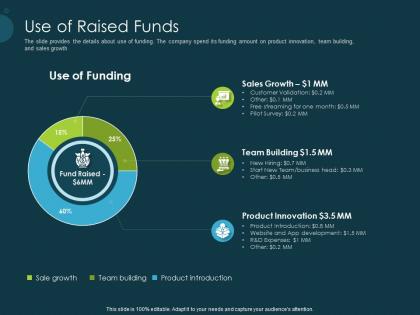
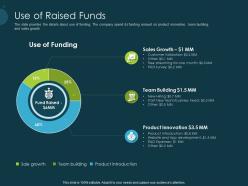
The slide provides the details about use of funding. The company spend its funding amount on product innovation, team building, and sales growth.
People who downloaded this PowerPoint presentation also viewed the following :
Pitch deck raise funding pre seed capital use of raised funds ppt show with all 2 slides:
Use our Pitch Deck Raise Funding Pre Seed Capital Use Of Raised Funds Ppt Show to effectively help you save your valuable time. They are readymade to fit into any presentation structure.
FAQs for Pitch deck raise funding pre seed capital use of raised
Okay so for your pitch deck, hit the basics: problem, solution, market size, business model, traction, team, financials. Lead with a problem that makes people go "ugh yes, I hate that too." Show your solution and why you're the right person to pull this off. Real numbers matter - actual users, revenue, whatever you've got. Investors hate fluff. Your team slide is huge because honestly, they're investing in you more than the idea sometimes. Keep it under 12 slides and practice till you're not reading off the screen like a robot. Oh, and don't make it too pretty - content over design.
Think of your pitch like telling a story - you're guiding investors from "here's this huge problem" to "we found the perfect solution" to "look at this massive opportunity." Each slide should flow naturally into the next instead of feeling like random facts dumped together. Start with a customer pain point that makes people go "ugh, yes, I hate that too." Build up the tension around the problem, then bring relief with your solution. Honestly, the best pitches feel like you're just having a conversation, not reading bullet points. End with the exciting market stuff so they're pumped about profits.
Dude, biggest thing is don't cram a wall of text on every slide - it's brutal to sit through. Keep your deck short, like 10-12 slides tops. Be specific about your numbers too, especially market size and how you actually make money. Investors hate vague stuff. Honestly, I see so many people obsess over product features when they should focus on the problem first. Skip the cheesy stock photos - they're the worst. Practice until you're not stumbling over words. Oh, and tell a real story about why this matters instead of just listing features. Trust me, it makes a huge difference.
Dude, visual design is HUGE for first impressions. I've literally watched investors tune out by slide two because someone used like 5 different fonts - it's harsh but happens all the time. Clean, consistent slides make you look professional and detail-oriented. Messy ones? Instant credibility killer. Plus good design helps people actually follow your story and remember the important stuff. Stick to consistent colors and fonts, keep it simple, and make your key data stand out visually. Honestly, think of your design as a silent teammate keeping everyone focused while you pitch.
Dude, visuals are a game changer for pitch decks. Charts and graphs tell your story way better than boring spreadsheets - our brains just eat up visual info so much faster. Turn your market size into a pie chart, show growth with a nice upward line, make those user numbers into bars that actually look impressive. Keep it simple though (I learned this the hard way). Pick your best data points and make them stand out. Skip the clutter. Honestly, investors will thank you for not making them decode another wall of text.
Honestly, it's all about knowing your audience. Angels care way more about whether you're solving a real problem and if you're the right person to do it - they're basically betting on YOU. VCs? Totally different beast. They want massive markets and solid unit economics that show crazy growth potential. So with angels, hit them with your passion and maybe some customer stories. VCs want the cold hard numbers and your path to like 10x returns. Though honestly some angels these days think exactly like VCs, so definitely stalk their portfolio first to see what they're actually into.
Honestly, just nail the basics first - problem, solution, market, traction, and what you're asking for. Everything else is noise. I get that you've probably spent weeks researching every detail, but most of that stuff belongs in backup slides anyway. One big idea per slide, and use pictures instead of cramming text everywhere. Here's what I do: look at each slide and ask "would this make me want to hear more?" If not, trash it. You'll probably end up with like 10-12 slides, which is perfect. Way better than boring people to death with slide 47.
Look, you HAVE to be direct about what you want - I can't stress this enough. Too many founders do this weird dance around their ask and investors just sit there confused. Tell them exactly what you need: how much money, what kind of partnership, timeline, whatever it is. I've watched incredible pitches completely bomb because the founder was too shy to actually ask for anything. Why waste everyone's time? End with something concrete - "I'm raising $2M" or "let's schedule due diligence next week." Honestly, confidence in your ask shows you know your business. Don't make them guess what you want.
Honestly, check out Airbnb's deck first - they literally showed how much hotels suck before pitching their solution. Buffer's revenue slides are crazy transparent too. Uber nailed the market opportunity part. Here's what works: they tell actual stories instead of just dumping features on people. Keep it visual but don't drown investors in data (learned that one the hard way). The magic three things are problem size, timing, and why your team won't screw it up. Study how they structure the whole narrative flow, then adapt it to your industry. Don't just copy-paste their approach though.
Use 2-3 slides for this section. Start big with your total addressable market - investors want to see huge potential, but back it up with solid data or they'll roll their eyes. Break it down to what's actually serviceable and what you can grab in the next couple years. Don't ignore competitors (seriously, that's such a newbie move). Create a simple comparison chart highlighting your key advantages instead of just name-dropping everyone. Oh, and make sure those advantages actually matter to customers, not just cool tech features. The whole point is proving you get the market while showing why you'll win.
Honestly, just stick to the basics that show you're not going to tank their investment. Revenue growth rate is huge - they want to see that upward curve. Customer acquisition cost and lifetime value are critical too, plus that LTV/CAC ratio proves your business model actually works. If you're SaaS, definitely include MRR or ARR. Gross margins show you can scale without bleeding money everywhere. Don't forget burn rate and runway - nobody wants to guess how long you'll survive. Pick maybe 4-5 metrics max though. I've seen too many founders drown investors in spreadsheets when a clean story works way better.
Put your value prop right up front - slide 2 or 3 max. Start with the actual problem, then show how you're different from everyone else. Skip the buzzword garbage though (seriously, nobody cares about your "revolutionary AI-powered whatever"). Focus on real benefits people actually want. Keep it simple, maybe throw in a visual comparison. The whole point is making it obvious why they'd pick you over doing nothing or going with some competitor. Oh, and test it on friends outside your industry first - they'll tell you if you're being too jargony.
Start with a problem that hits them right away. Stories work way better than boring feature lists - people actually remember them. Mix up how you present things so it doesn't get monotonous. Rhetorical questions are gold for engagement. Props help if you've got them. Don't be scared to pause dramatically or let your personality show through. The 10-20-30 thing is pretty solid: max 10 slides, 20 minutes, font size 30 or bigger. Practice those transitions between sections - awkward pauses kill momentum. Honestly, half the battle is just watching their body language. If they're leaning in or nodding, you're doing something right.
Dude, pitch feedback is basically free gold. Write down every question they ask - especially the ones that keep coming up. Like if multiple investors are confused about your revenue model, that slide obviously sucks. Watch their body language too. Awkward silence usually means you lost them somewhere. I keep a simple tracker after each pitch (maybe overkill but whatever). Look for patterns across like 5+ pitches, then fix the stuff that consistently trips people up. Don't obsess over one person's random opinion though. The stuff they *don't* say is often more telling than what they do.
Honestly, investors care way more about your team than your idea – I've seen mediocre concepts succeed with amazing teams. Show them you've got the right skills and experience to actually pull this off. Skip the boring job titles and focus on real wins each person has had. Why is Sarah specifically the right person to crack this market? What has Mike already built that proves he can do it again? Oh and definitely update everyone's LinkedIn beforehand because they'll 100% stalk you after the meeting. Btw investors see tons of similar pitches, so your team is what makes you different.
-
Easily Understandable slides.
-
Editable templates with innovative design and color combination.
-
Attractive design and informative presentation.