


Man teamwork network of people ppt icons graphics




Try Before you Buy Download Free Sample Product
 Impress Your
 Audience
 100%
100% Editable
 Save Hours
 of Time


Invoke divinity with our Man Teamwork Network Of People Ppt Icons Graphics. Recieve the blessings of the powers that be.
People who downloaded this PowerPoint presentation also viewed the following :
Content of this Powerpoint Presentation
Description:
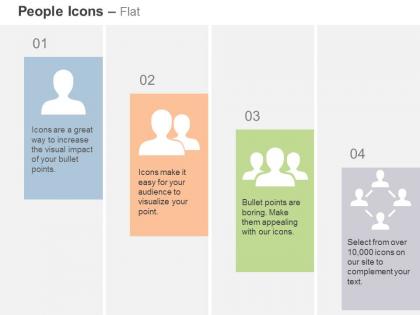
This image is of a PowerPoint slide titled "People Icons – Flat," which is designed to showcase how icons can be used effectively in presentations to visually represent concepts and ideas. The slide is divided into four sections, each with a different icon representing a number of people, accompanied by a brief explanation of the icon's potential use:
1. Single Person Icon:
Suggests that icons can enhance the visual impact of bullet points.
2. Two People Icon:
Emphasizes that icons can help the audience visualize a point, likely referring to partnerships or teamwork.
3. Three People Icon:
States that bullet points are dull and suggests using icons to make the presentation more appealing, possibly representing a team.
4. Network of People Icon:
Invites users to select from over 10,000 icons to complement their text, representing a network or organization.
Use Cases:
This slide can be effectively used in various industries for presentations where visual communication is essential. Here are seven industries and specific uses:
1. Education:
Use: Enhancing educational materials.
Presenter: Educator.
Audience: Students.
2. Marketing:
Use: Visualizing customer segments.
Presenter: Marketing Manager.
Audience: Marketing Team.
3. Human Resources:
Use: Illustrating organizational structures.
Presenter: HR Specialist.
Audience: New Employees.
4. Healthcare:
Use: Representing patient demographics.
Presenter: Healthcare Administrator.
Audience: Medical Staff.
5. Technology:
Use: Depicting user roles in software documentation.
Presenter: Technical Writer.
Audience: End-Users.
6. Non-profit Organizations:
Use: Showing volunteer groups or committees.
Presenter: Community Outreach Coordinator.
Audience: Volunteers.
7. Corporate Training:
Use: Clarifying team roles in training modules.
Presenter: Corporate Trainer.
Audience: Trainees.
Man teamwork network of people ppt icons graphics with all 4 slides:
Acquaint them with current developments. Our Man Teamwork Network Of People Ppt Icons Graphics keep them abreast and with it.
FAQs for Man teamwork network of people
Effective teamwork in modern workplaces includes clear communication channels, defined roles and responsibilities, shared goals and accountability, mutual trust and respect, and collaborative problem-solving capabilities. These elements streamline project delivery, enhance innovation through diverse perspectives, and improve employee engagement, with many organizations finding that strong teamwork frameworks ultimately deliver faster execution, reduced conflicts, and sustainable competitive advantage.
Diverse team dynamics enhance creativity by combining varied perspectives, cultural backgrounds, problem-solving approaches, and professional experiences that challenge conventional thinking. Teams with cognitive diversity generate more innovative solutions through constructive debate and cross-pollination of ideas, with organizations like tech companies and consulting firms finding that heterogeneous teams consistently outperform homogeneous ones in creative problem-solving.
Communication and feedback serve as foundational pillars for collaborative teamwork, enabling clear goal alignment, transparent progress updates, and rapid problem resolution. Through regular check-ins and constructive feedback loops, teams streamline decision-making processes, minimize misunderstandings, and enhance overall productivity, with many organizations finding that structured communication ultimately delivers stronger project outcomes and improved team cohesion.
Team performance success extends beyond project completion through metrics like collaboration quality, communication effectiveness, knowledge sharing, individual skill development, and team cohesion scores. These indicators help organizations assess relationship building, problem-solving capabilities, and innovation potential, with many companies finding that strong teamwork metrics ultimately predict future project success and employee retention.
Teams can overcome conflicts through open communication, active listening, establishing clear roles and expectations, focusing on shared goals, and implementing structured problem-solving processes. These strategies enable organizations to transform disagreements into productive discussions, with many companies finding that regular team-building exercises and conflict resolution training ultimately enhance collaboration, boost productivity, and strengthen workplace relationships.
Remote teams maintain unity and purpose through regular virtual check-ins, shared digital workspaces, collaborative project management tools, and structured team-building activities. These approaches streamline communication by establishing clear goals, fostering transparent progress tracking, and creating meaningful connections, with many distributed organizations finding that consistent engagement rituals ultimately deliver stronger cohesion and enhanced productivity.
Leadership style significantly impacts team collaboration and morale by establishing communication patterns, decision-making processes, trust levels, psychological safety, and overall team dynamics. Collaborative leaders in organizations like tech companies and healthcare institutions enhance transparency, encourage diverse perspectives, and foster open dialogue, while autocratic approaches can reduce innovation and engagement, ultimately affecting productivity and retention rates.
Team-building activities contribute to stronger interpersonal relationships by fostering trust, improving communication, and breaking down professional barriers between colleagues. Through collaborative challenges, shared experiences, and structured interactions, team members develop deeper understanding of each other's strengths and working styles, ultimately enhancing workplace collaboration and creating more cohesive, productive teams.
Effective hybrid teamwork tools include video conferencing platforms, cloud-based collaboration software, project management systems, instant messaging applications, and digital whiteboarding solutions. These technologies streamline communication, enhance document sharing, and facilitate real-time collaboration across distributed teams, with many organizations finding that strategic integration of multiple platforms ultimately delivers improved productivity and seamless workflow management.
Cultural diversity enhances team interactions through varied perspectives, problem-solving approaches, communication styles, and decision-making processes, while presenting coordination and integration challenges. These diverse viewpoints enable organizations to develop more innovative solutions, better understand global markets, and improve customer experiences, with many multinational companies finding that culturally diverse teams ultimately deliver superior performance and competitive advantage.
Methods to ensure accountability include establishing clear individual roles and responsibilities, implementing regular check-ins and progress reviews, creating shared project dashboards, setting measurable team goals, and fostering peer accountability systems. These approaches streamline collaboration by enhancing transparency, minimizing role confusion, and enabling proactive problem-solving, with many organizations finding that structured accountability frameworks ultimately deliver improved project outcomes and stronger team cohesion.
Individual strengths contribute to team effectiveness by creating complementary skill sets, diverse perspectives, and specialized expertise that address complex challenges comprehensively. When teams strategically leverage members' unique capabilities, organizations experience enhanced problem-solving, faster project completion, and improved innovation, with many companies finding that diverse strengths ultimately deliver superior outcomes and competitive advantage.
Common teamwork barriers include poor communication, unclear roles and responsibilities, conflicting personalities, lack of trust, and misaligned goals or priorities. These challenges can be addressed by establishing clear communication protocols, defining specific role expectations, implementing regular team-building activities, and creating shared accountability systems, with many organizations finding that structured collaboration frameworks ultimately enhance productivity and deliver stronger project outcomes.
Teams adapt their strategies during change by maintaining open communication channels, establishing flexible workflows, and regularly reassessing priorities based on evolving circumstances. Through cross-functional collaboration and continuous feedback loops, organizations can pivot quickly while preserving team cohesion, with many companies finding that empowering decision-making at multiple levels ultimately delivers greater adaptability and sustained performance.
Trust serves as the foundation for effective collaboration by enabling open communication, encouraging risk-taking, fostering psychological safety, and reducing interpersonal conflicts within teams. When team members trust each other, they share ideas more freely, delegate responsibilities confidently, and support collective decision-making, ultimately delivering enhanced productivity and stronger project outcomes across organizations.
-
Easily Editable.
-
Qualitative and comprehensive slides.