


Managed it service timeline approach ppt powerpoint presentation infographics slides




Try Before you Buy Download Free Sample Product
 Impress Your
 Audience
 100%
100% Editable
 Save Hours
 of Time


Our Managed It Service Timeline Approach Ppt Powerpoint Presentation Infographics Slides are topically designed to provide an attractive backdrop to any subject. Use them to look like a presentation pro.
People who downloaded this PowerPoint presentation also viewed the following :
Content of this Powerpoint Presentation
Description:
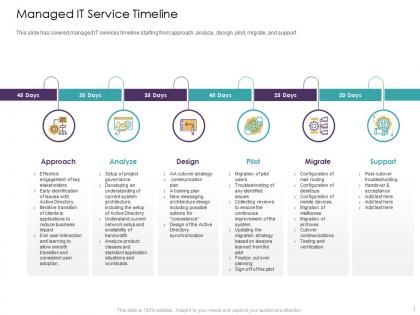
The image is a PowerPoint slide titled "Managed IT Service Timeline," which provides an overview of a managed IT services project from inception to support. It details a timeline with specific phases and their corresponding durations:
1. Approach (45 Days):
Involves engaging stakeholders, identifying issues with Active Directory, facilitating iterative transitions, and ensuring user interaction leads to smooth transition and adoption.
2. Analyze (35 Days):
Sets up project governance, develops an understanding of the current system architecture including Active Directory setup, and analyzes network setup and application workloads.
3. Design (35 Days):
Covers account cutover strategy, communication plan, training plan, messaging architecture design with coexistence options, and directory synchronization.
4. Pilot (45 Days):
Migrates pilot users, troubleshoots issues, conducts reviews to ensure continuous improvement, and plans for the final cutover.
5. Migrate (25 Days):
Configures mail routing, desktops, mobile devices, migrates mailboxes and archives, and ensures communication channels are verified.
6. Support (20 Days):
Focuses on post-cutover troubleshooting, handover and acceptance, and additional text fields for further details.
Use Cases:
This structured approach to IT service management can be employed across various sectors:
1. Healthcare:
Use: Implementing new healthcare IT systems
Presenter: IT Project Manager
Audience: Healthcare Administration
2. Finance:
Use: Upgrading banking software and systems
Presenter: IT Compliance Officer
Audience: Bank Executives
3. Education:
Use: Transitioning to digital learning platforms
Presenter: Chief Information Officer
Audience: Educational Administrators
4. Retail:
Use: Rolling out new point-of-sale systems
Presenter: Retail Technology Manager
Audience: Store Managers
5. Telecommunications:
Use: Updating network management systems
Presenter: Telecommunications Project Lead
Audience: Technical Teams
6. Manufacturing:
Use: Integrating manufacturing execution systems
Presenter: Systems Integration Specialist
Audience: Operations Managers
7. Transportation:
Use: Implementing logistics and tracking systems
Presenter: Logistics IT Coordinator
Audience: Supply Chain Stakeholders
Managed it service timeline approach ppt powerpoint presentation infographics slides with all 2 slides:
Use our Managed It Service Timeline Approach Ppt Powerpoint Presentation Infographics Slides to effectively help you save your valuable time. They are readymade to fit into any presentation structure.
FAQs for Managed it service timeline approach ppt powerpoint
Key milestones include early remote monitoring in the 1990s, cloud computing adoption in the 2000s, cybersecurity integration, artificial intelligence implementation, and modern comprehensive IT management platforms. These developments have streamlined operations by reducing downtime, enhancing security protocols, and automating routine tasks, with many organizations finding that strategic IT partnerships ultimately deliver cost savings and competitive advantage.
Demand for managed IT services has surged dramatically over the last decade, driven by cloud adoption, cybersecurity threats, remote work requirements, and digital transformation initiatives. Organizations increasingly recognize that outsourcing IT management delivers cost efficiency, specialized expertise, and 24/7 support, with many finding that managed services enable faster innovation while reducing operational overhead.
Essential components include comprehensive discovery and assessment phases, detailed migration planning, phased implementation schedules, testing protocols, and ongoing monitoring frameworks. These elements work together by establishing clear milestones, minimizing operational disruptions, and ensuring seamless service transitions, with many organizations finding that structured timelines reduce implementation risks while accelerating time-to-value for their IT investments.
Technological advancements drive managed IT services growth by creating complexity that requires specialized expertise, increasing cybersecurity demands, and enabling cloud-based service delivery models. These developments allow providers to offer more sophisticated solutions like AI-powered monitoring, automated threat detection, and scalable infrastructure management, ultimately delivering enhanced operational efficiency and competitive advantages for organizations across industries.
Cybersecurity concerns significantly accelerate managed IT services timelines, as organizations prioritize rapid deployment of threat detection, vulnerability assessments, compliance monitoring, and incident response capabilities. With cyberattacks increasingly targeting businesses across healthcare, finance, and retail sectors, companies streamline implementation phases to minimize exposure windows, ultimately delivering enhanced security postures and reduced operational risks.
Customer needs drive managed IT services evolution through shifting demands for cloud migration, cybersecurity enhancement, remote work support, and digital transformation initiatives. As businesses increasingly require scalable solutions, providers adapt by offering specialized services like AI integration, compliance management, and 24/7 monitoring, ultimately delivering customized support that enhances operational efficiency and competitive advantage.
Common challenges when implementing managed IT services include resistance to change from staff, integration complexities with existing systems, data security concerns during transitions, vendor selection difficulties, and establishing clear communication protocols. While these hurdles can initially slow deployment, organizations in healthcare, finance, and manufacturing find that proactive change management, phased implementations, and strategic vendor partnerships ultimately streamline operations and enhance system reliability.
Service level agreements establish specific performance benchmarks, response times, resolution deadlines, and uptime guarantees that directly shape project timelines and service delivery schedules. These contractual commitments help organizations plan more effectively by providing predictable service windows, while ensuring managed service providers maintain consistent performance standards, ultimately delivering greater operational reliability and strategic planning capabilities for businesses across industries.
Cloud computing significantly transforms managed IT services by enabling remote monitoring, scalable infrastructure management, automated backup solutions, and enhanced security protocols. This shift allows managed service providers to deliver faster deployment, reduce operational costs, and provide 24/7 support across multiple client environments, with many organizations finding that cloud-integrated services ultimately enhance their competitive advantage while minimizing internal IT resource requirements.
Managed IT services adoption varies significantly across industries based on regulatory requirements, operational complexity, and digital maturity levels. Healthcare and financial services typically embrace comprehensive managed services for compliance and security, while manufacturing and retail focus on operational efficiency and customer experience solutions, with many organizations finding that industry-specific expertise accelerates implementation timelines.
Organizations should track key performance indicators including system uptime, response times, resolution rates, security incident frequency, and cost per ticket. These metrics enable businesses to assess service quality, operational efficiency, and return on investment, with many companies finding that comprehensive monitoring ultimately delivers improved productivity, reduced downtime, and enhanced competitive advantage.
Regulatory and compliance requirements significantly shape managed IT services evolution by driving enhanced security protocols, automated compliance monitoring, and specialized governance frameworks. Financial services, healthcare, and manufacturing sectors increasingly demand providers who deliver real-time audit trails, data protection measures, and regulatory reporting capabilities, ultimately creating more sophisticated, industry-specific service offerings.
Future trends redefining managed IT services include AI-driven automation, edge computing integration, cybersecurity mesh architectures, multi-cloud orchestration, and zero-trust security frameworks. These technologies streamline operations by reducing manual interventions, enhancing real-time processing, and strengthening security protocols, with many organizations finding that strategic adoption ultimately delivers faster incident resolution and competitive advantage.
Vendor partnership proves critical in managed IT services timelines, significantly accelerating development through shared expertise, established infrastructure, and proven methodologies. Strategic partnerships enable organizations to leverage specialized resources, reduce implementation risks, and streamline deployment phases, with many enterprises finding that collaborative vendor relationships deliver faster market entry and enhanced service quality.
Organizations can effectively communicate IT service milestones through regular dashboard updates, automated progress notifications, stakeholder-specific reporting formats, milestone celebration announcements, and structured review meetings. These communication strategies streamline transparency by providing real-time visibility, maintaining consistent stakeholder engagement, and establishing clear accountability frameworks, with many enterprises finding that proactive milestone communication ultimately delivers enhanced project success rates and stronger stakeholder confidence.
No Reviews