


Manufacturing Quality Management Powerpoint Ppt Template Bundles




Try Before you Buy Download Free Sample Product
 Impress Your
 Audience
 100%
100% Editable
 Save Hours
 of Time


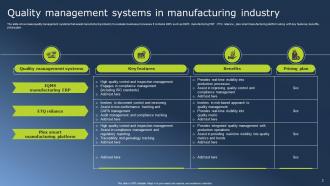
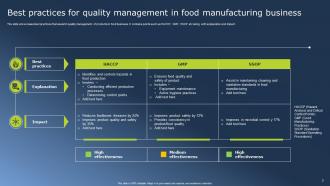
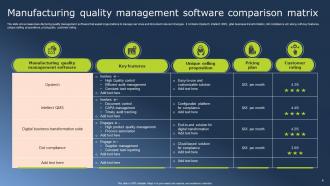
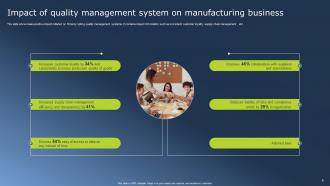
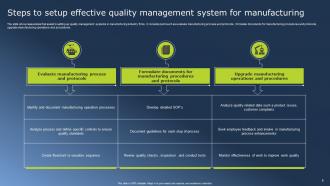
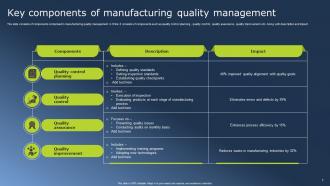
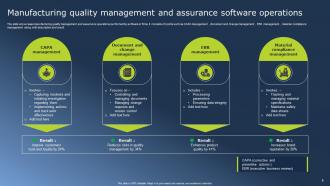
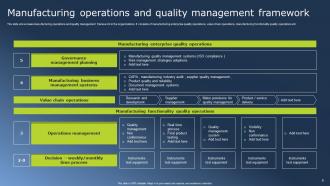
Introducing our comprehensive PowerPoint PPT presentation on Manufacturing Quality Management. This visually engaging and informative presentation is designed to provide a deep understanding of quality management systems within the food manufacturing industry.Explore the key concepts and principles of quality management, including process control, quality assurance, and continuous improvement. Gain insights into industry specific challenges and regulations, and discover effective strategies to ensure product safety and compliance.Our PPT also highlights the crucial role of software solutions in streamlining quality management processes, enhancing traceability, and driving operational efficiency. Learn how advanced software solutions empower organizations to manage quality data, conduct real time monitoring, and facilitate data driven decision making.With this PPT, you will gain valuable knowledge and practical guidance to optimize manufacturing quality management and deliver safe, high quality products in the food industry.
People who downloaded this PowerPoint presentation also viewed the following :
Manufacturing Quality Management Powerpoint Ppt Template Bundles with all 21 slides:
Use our Manufacturing Quality Management Powerpoint Ppt Template Bundles to effectively help you save your valuable time. They are readymade to fit into any presentation structure.










FAQs for Manufacturing Quality Management Powerpoint
So basically you want customer focus, continuous improvement, getting employees involved, plus process-based thinking and decisions backed by actual data. Build quality into your processes instead of checking everything at the end - saves tons of money. Management has to be all-in or nothing works, trust me on that one. Prevention beats fixing mistakes later, so standardize procedures and train people regularly. Don't sleep on supplier quality either! I'd start by mapping what you're doing now and finding your biggest headaches. That's honestly where you'll see results fastest.
So DMAIC is your best bet here - Define, Measure, Analyze, Improve, Control. Basically you define what's actually broken first, then measure how bad it really is with actual numbers. The analyze part is honestly where it gets fun because you're detective-ing the real root causes. After that, implement fixes and set up controls so stuff doesn't backslide. Don't go crazy trying to fix everything though. Pick one process that's been driving everyone nuts and use it as your test case. Way easier to show wins that way, plus you'll learn the methodology without overwhelming yourself.
So TQM basically makes your whole manufacturing setup into this continuous improvement thing. You're not waiting until the end to catch problems - quality gets baked into every step. Workers become like quality detectives, catching issues before they blow up. Honestly, it's kinda wild how much smoother everything runs when everyone's thinking about quality, not just the QC people. The trick is getting your floor workers on board though - they'll spot problems first and usually have the best ideas for fixing them. Way less waste and rework too.
Dude, IoT sensors are game-changers for quality control - they watch your equipment nonstop and catch problems way before manual inspections would. The AI part is honestly wild because it learns to predict machine failures and quality issues before they happen. Computer vision beats human inspectors every time for consistency too. Though honestly, I'd start simple - just throw some basic IoT monitoring on one production line first and see how it goes. Don't go crazy with the whole operation right away. The real-time data you'll get is something you've probably never experienced before.
Honestly, the worst part is dealing with inconsistent processes and equipment that acts up randomly. People make mistakes too - we're all human, right? Your suppliers will definitely mess with you when material quality suddenly changes. Oh, and don't get me started on trying to hit deadlines while keeping quality high. Temperature and humidity can screw everything up if you're not careful. Regulations keep changing which is super annoying. But here's what actually works - nail down your processes first, then train people properly. That'll fix most of your problems, I swear.
Honestly, you'll want to watch both sides - stuff like defect rates while you're making things, plus the aftermath like customer complaints and returns. Real-time dashboards help a ton for tracking first-pass yield, scrap rates, that kind of thing. Don't go crazy with data though. Pick maybe 3-5 metrics that actually matter for what you're doing specifically. Control charts are great for catching trends early, and run Pareto analysis regularly to find your biggest headaches. Oh, and make sure whatever data you're collecting actually changes how you make decisions - otherwise you're just creating busywork nobody reads.
So regulatory compliance basically makes you bake quality into every single step instead of just testing at the end. Yeah, it's a total hassle at first - all that documentation and auditing feels like busy work. But honestly? It catches problems way earlier than you'd expect. FDA or ISO (whatever applies to you) will want validation records, traceability, the whole nine yards. I'd start by comparing what you're doing now against the actual requirements. That'll show you exactly where you're screwed. The bonus is customers actually trust you more when you've got your act together like that.
Honestly, training your people is huge for quality - like, way more important than most managers realize. Your team needs to get the "why" behind standards, not just follow steps blindly. When they actually understand the reasoning, they'll spot problems early instead of letting them snowball into expensive disasters later. Confident employees who know their stuff also tend to be way more engaged (which makes your life easier too, let's be real). Studies show companies with solid training see 20-30% fewer defects. Don't do the one-and-done training thing though - quality habits need constant practice to actually stick.
Make quality everybody's problem, not just the QC team's headache. Leadership walking around asking about quality numbers actually works - people pay attention to what the boss cares about. Train folks on the real impact, like how defects cost money and piss off customers. Those cheesy "quality is free" posters are useless honestly. Instead, celebrate wins publicly and let teams own their processes. Create safe ways to report problems without getting blamed. Quality circles where operators suggest improvements? Gold. Oh, and share the data openly so everyone knows where they stand and can fix things.
Honestly, your supply chain IS your product quality. Bad raw materials? Your final product will suck no matter what you do internally. I've watched so many companies learn this the hard way - like, you can't polish garbage inputs into gold, you know? Longer chains create more screw-up opportunities too. Build solid relationships with suppliers and audit them regularly. Oh, and always have backup suppliers ready to go. Don't just chase the cheapest option - that usually bites you later.
So you'll need three main things: SPC software for control charts, CAPA systems for corrective actions, and quality databases like TrackWise. Minitab's pretty much the gold standard for stats - everyone uses it. Excel works too if you're just getting started though. Oh, and don't forget the basic stuff like digital calipers and CMMs for actually collecting data. My old boss always said measurement tools are where the rubber meets the road. Start with one decent SPC tool first. Way easier than trying to roll out everything at once and overwhelming people.
So first thing - collect everything. Complaints, reviews, random social media rants, whatever. But here's where most people mess up: they just hoard it instead of doing anything useful with it. Take those patterns you're seeing and actually fix your processes. Maybe tweak your quality checks or rewrite those confusing instructions nobody follows anyway. I'd set up a simple tracker that shows you the biggest problems each month. Then get someone to own the top issues - otherwise it'll just sit there forever. Trust me, feedback only works if you actually close the loop.
Dude, you've gotta look at AI predictive analytics and real-time IoT stuff - that's where the money is. Digital twins are finally going mainstream too. Machine learning can catch quality patterns we'd never spot ourselves, which is honestly pretty wild. Augmented reality is making training so much better for operators. Oh, and blockchain for supply chains is everywhere now, though sometimes I think it's just buzzword nonsense. My advice? Start simple with IoT sensors on whatever processes matter most. That's your quickest win without going crazy on budget.
You'll need to document literally everything - ISO 9001 makes you create consistent processes for your whole operation. No more winging it. The paperwork is honestly brutal at first, but defect rates do drop when everyone follows the same procedures. Better traceability too when things go wrong. Many customers won't even work with you without certification these days. I'd start by mapping what you're currently doing - that usually shows you where the gaps are. It's kind of annoying but it actually works once you get through the initial setup nightmare.
So here's the thing - root cause analysis actually saves your sanity. You know how you keep fixing the same broken stuff over and over? RCA stops that cycle by digging into why things break, not just that they broke. Maybe it's bad equipment settings, wonky processes, or your suppliers cutting corners. The cool part is once you nail down the real problem and fix it, you're done dealing with that headache. No more constant firefighting. I learned this the hard way at my last job - we'd patch issues all day until someone finally said "let's figure out what's actually causing this mess."
-
I have just started downloading templates for my presentations and I must say this is a great design. It helped accelerate my presentation design process and made it more visually appealing.
-
I was mind-blown by the services that SlideTeam provided me. Thanks a ton!