

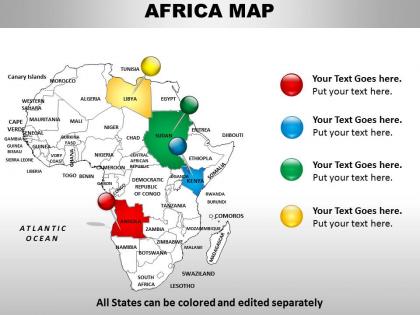
Map of african countries 1314




Try Before you Buy Download Free Sample Product
 Impress Your
 Audience
 100%
100% Editable
 Save Hours
 of Time


Experience fascination with our Map Of African Countries 1314. They will excite your every cell.
People who downloaded this PowerPoint presentation also viewed the following :
Map of african countries 1314 with all 5 slides:
Under pressure to get that big project done right? Our Map Of African Countries 1314 can help get your presentation looking great in seconds.


FAQs for Map of
Medieval Africa's major powers included the Ghana Empire, Mali Empire, Songhai Empire, Kingdom of Kush, Axum, Great Zimbabwe, and Swahili city-states along the East African coast. These civilizations revolutionized continental development through extensive trans-Saharan and Indian Ocean trade networks, advanced metallurgy, and sophisticated governmental systems, ultimately establishing Africa as a central hub in global commerce while creating lasting cultural and economic foundations.
Trans-Saharan trade routes fundamentally transformed medieval African economies by connecting gold-producing regions like Ghana and Mali with North African markets, facilitating exchange of salt, ivory, and slaves. These networks fostered cultural synthesis through Islamic influence, Arabic literacy, and architectural innovations in cities like Timbuktu and Gao, while enabling powerful kingdoms to accumulate wealth and establish sophisticated administrative systems that dominated regional commerce.
Islam significantly influenced medieval African kingdoms by introducing new legal frameworks, administrative systems, centralized governance structures, and educational institutions through Islamic scholarship. Through strategic adoption of Islamic practices, kingdoms like Mali, Songhai, and various Swahili city-states enhanced their trade networks, diplomatic relationships, and cultural exchanges, while maintaining traditional customs, ultimately delivering greater political legitimacy and economic prosperity across diverse regions.
Medieval African art and architecture reflected spiritual beliefs, royal power, and cultural identity through elaborate religious sculptures, monumental mosques, and ceremonial palaces. These artistic expressions demonstrated social hierarchies, Islamic influences, and ancestral reverence across civilizations, with kingdoms like Mali, Great Zimbabwe, and Ethiopia creating distinctive architectural styles that enhanced cultural continuity, reinforced political authority, and ultimately delivered lasting legacies of African creative excellence.
Medieval African agriculture evolved through iron tool adoption, crop diversification including sorghum and millet, advanced irrigation systems, terraced farming, and livestock integration. These innovations enabled population growth, urbanization in kingdoms like Mali and Great Zimbabwe, increased trade surplus, and social stratification, with agricultural specialists supporting craft production and long-distance commerce networks.
Medieval African societies featured diverse social structures including royal families, noble classes, merchant traders, skilled artisans, farmers, and various forms of servitude. These hierarchies varied significantly across kingdoms like Mali, Songhai, and Ethiopia, with wealth, occupation, and lineage determining status, while social mobility remained possible through trade success, military service, or religious scholarship, ultimately creating dynamic communities where economic prosperity and strategic alliances could elevate one's position.
Indigenous religions coexisted with Christianity and Islam through syncretism, where traditional beliefs merged with new faiths, creating hybrid practices that preserved ancestral customs while adopting foreign elements. Many African societies, including Ethiopian Christians and West African Muslims, maintained traditional rituals alongside imported religions, with communities often practicing multiple belief systems simultaneously, ultimately creating distinctive African expressions of global faiths.
Primary sources of conflict among medieval African societies included competition for trade routes, water resources, territorial expansion, and control over gold and salt deposits. However, cooperation flourished through extensive trade networks, intermarriage between ruling families, shared religious practices, and diplomatic alliances, with many kingdoms finding that strategic partnerships ultimately delivered greater prosperity and security than sustained warfare.
Medieval Africa's diverse geography significantly shaped settlement patterns, with communities clustering around rivers like the Nile and Niger, fertile highlands, and strategic trade routes across the Sahara. These geographic advantages enabled the rise of powerful kingdoms like Ghana, Mali, and Ethiopia, while desert regions fostered nomadic lifestyles and coastal areas supported maritime trade, ultimately delivering diverse economic systems and cultural exchanges.
Notable medieval African figures include Mansa Musa of Mali, who established trade networks and showcased Africa's wealth globally, Sundiata Keita who founded the Mali Empire, Queen Nzinga of Ndongo who resisted Portuguese colonization, and scholars like Al-Umari who documented African civilizations. These leaders revolutionized governance, commerce, and cultural exchange across Africa, ultimately establishing diplomatic relationships, educational institutions, and economic systems that enhanced regional prosperity and international recognition.
European exploration of medieval Africa began through coastal trading posts and maritime expeditions, particularly Portuguese ventures along West and East African coasts in the 15th century. These early encounters established trade networks for gold, ivory, and slaves, while introducing European technologies and diseases, ultimately laying foundational patterns that would accelerate into full colonial expansion, with many African societies finding their traditional power structures and economic systems increasingly disrupted.
Women in medieval African societies held diverse roles including traders, political advisors, religious leaders, agricultural managers, and in some regions like the Swahili coast and West African kingdoms, powerful queens and merchants. These multifaceted positions enabled women to significantly influence economic networks, spiritual practices, and governance structures, with many societies finding that women's leadership in trade and diplomacy ultimately enhanced cultural exchange and strengthened community resilience across the continent.
Oral traditions preserved medieval African history through griots, praise singers, genealogical recitations, ceremonial narratives, and community storytelling sessions. These cultural custodians maintained dynastic chronicles, moral teachings, and ancestral knowledge across generations, with kingdoms like Mali and Songhai finding that structured oral transmission systems effectively documented political achievements, social customs, and religious practices, ultimately delivering cultural continuity and collective identity.
Medieval African kingdoms employed diverse governance systems including centralized monarchies with divine kingship, age-grade societies, council-based leadership, and Islamic administrative structures. These systems integrated customary law, Islamic jurisprudence, and oral traditions, with kingdoms like Mali, Ghana, and Ethiopia demonstrating sophisticated legal frameworks that balanced traditional authority with trade regulations, ultimately enabling efficient resource allocation and cross-cultural commercial relationships.
Modern interpretations of medieval African history have evolved from colonial-era misconceptions to evidence-based narratives emphasizing sophisticated kingdoms, trade networks, architectural achievements, and scholarly traditions across empires like Mali, Songhai, and Great Zimbabwe. These revised perspectives challenge Eurocentric historical frameworks while promoting cultural understanding, educational reform, and contemporary African identity formation, with many institutions finding that accurate historical representation enhances cross-cultural dialogue and dismantles persistent stereotypes.
-
Illustrative design with editable content. Exceptional value for money. Highly pleased with the product.
-
Informative design.